Eureka Coffee Grinder Review: Is It Worth It?
Welcome, I'm Sam, and I use grinders and brewers every day. I know the Niche Zero from coffee shops and customers' kitchens.
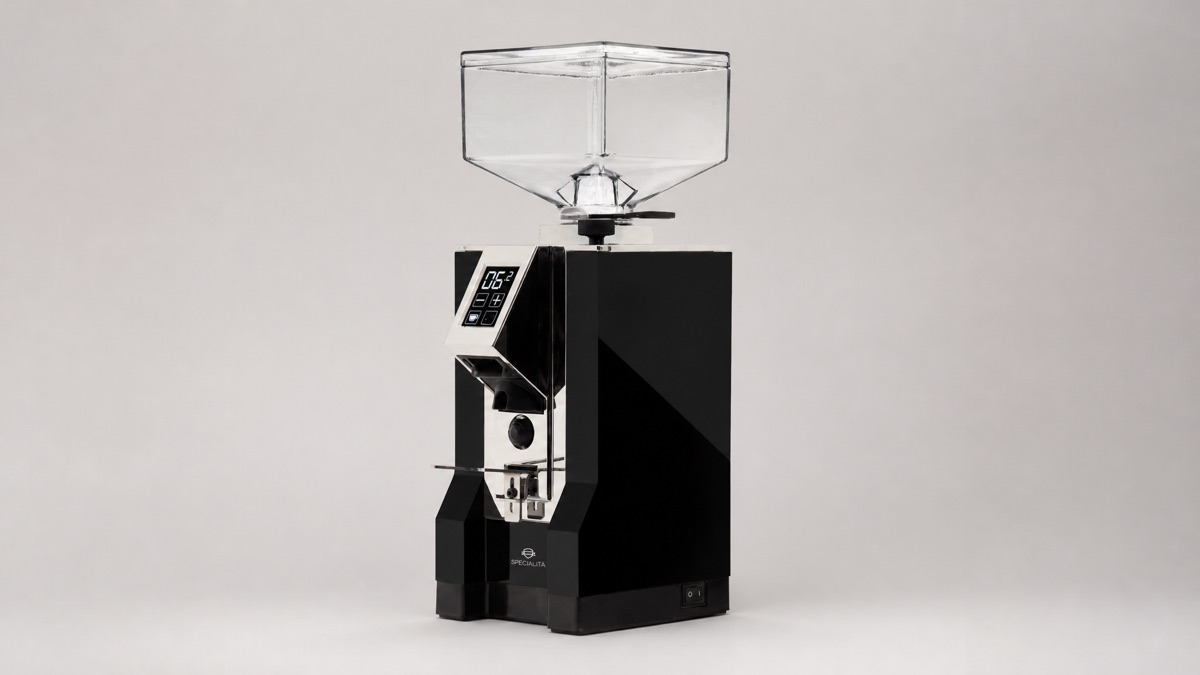
The Eureka grinder is an Italian flat-burr electric coffee grinder line built mainly for home espresso. Eureka has made grinders in Florence since 1920. The Mignon Specialita, with 55 mm (2.2 in) burrs and a touchscreen timer, is the model most buyers weigh first.
The Specialita grinds fluffy, consistent espresso grounds and holds retention under 0.5 g (0.02 oz) per dose in reports. Stepless adjustment gives endless settings, and timed dosing finishes a double shot in 10 to 12 seconds. The silent case keeps noise near 55 dB. Prices run from under $300 for the Notte to $1,099 for the Atom 75.
Owners complain about the resistive touchscreen, the small dial and the plastic hopper. The grinder also favors espresso over filter coffee. Below, I cover stepless adjustment, timed dosing and noise level, plus a straight answer.
What Is the Eureka Grinder?
The Eureka grinder is an Italian electric flat-burr coffee grinder line built mainly for home espresso. Eureka sells the line as Mignon models. The Mignon Specialita is the most reviewed of them.
Eureka spells the model Specialità, with an accent. Shops and owners also write Specialita. Both names mean the same grinder.
Eureka started in Florence, Italy, in 1920. The company makes home and commercial grinders and assembles them in Florence. Decades of commercial work back the metal bodies and the simple servicing.
The Mignon Specialita carries 55 mm (2.2 in) flat steel burrs, a programmable touchscreen and a silent case. One US dealer lists it at $549 to $599 in November 2026.
The grinder is compact. It measures about 5 inches (12.7 cm) wide, 5.6 inches (14.2 cm) deep and 13.8 inches (35 cm) tall. The square hopper holds 300 g (10.6 oz) of beans.
Which Models Make Up the Eureka Grinder Line?
The Eureka grinder line includes 13 Mignon models, plus larger grinders such as the Atom 75. Each Mignon suits a different budget and brew style.
The Notte and Facile are the entry models. Both use 50 mm (2 in) flat burrs. The Notte costs under $300 and has a manual switch with no timer. The Facile costs $280 to $320 and adds timed dosing.
The Silenzio adds the silent case. The Perfetto adds a programmable timer and an EZ dial. The Perfetto costs about $20 less than the Specialita.
The Libra weighs each dose with a built-in scale and costs $799. The Atom 75 uses 75 mm (3 in) burrs and an 800 W motor. It costs $999 to $1,099.
Eureka also built single-dose models. The Mignon Zero and Oro grind one measured dose at a time. The Crono and Brew Pro suit drip and pour-over.
Eureka Grinder Models:
| Model | Burrs | Dosing | Price |
|---|---|---|---|
| Notte | 50 mm (2 in) | Manual switch | Under $300 |
| Facile | 50 mm (2 in) | Timed | $280 to $320 |
| Specialita | 55 mm (2.2 in) | Touchscreen timer | $549 to $599 |
| Libra | 55 mm (2.2 in) | By weight | $799 |
| Atom 75 | 75 mm (3 in) | Programmable | $999 to $1,099 |
What Features Does the Eureka Grinder Have?
The Eureka grinder can have features such as flat steel burrs, stepless adjustment and a programmable touchscreen. The Specialita packs all three into a compact metal case.
The Specialita uses hardened steel flat burrs of 55 mm (2.2 in). Stock Mignons use 50 mm (2 in) burrs. Larger burrs grind faster. Faster grinding leaves less time for heat to build up.
A 310 W motor spins the burrs at a fixed 1350 RPM. A backlit resistive touchscreen sets grind time for single, double and continuous modes. Timers run in steps of 0.1 second.
Eureka rates the Specialità burrs at 300 kg (660 lb) of coffee before they need replacing.
The case and key internal parts are metal. The hopper and hopper stopper are plastic. The grinder weighs about 12.5 pounds (5.7 kg), which keeps it steady on the counter.
A wider chute with Eureka's ACE anti-static system gives fluffy grounds. The grounds clump very little. Distribution in the portafilter is easier as a result.
Key Features:
- 55 mm (2.2 in) flat steel burrs
- 310 W motor at 1350 RPM
- Programmable touchscreen timer
- Stepless micrometric adjustment
- 300 g (10.6 oz) hopper
- Silent case with rubber mounts
How Does Eureka Grinder Stepless Adjustment Work?
Eureka grinder stepless adjustment works through a micrometric dial that gives endless settings between fine and coarse. The dial has no click stops.
The burr carrier adjusts from below the motor mount. Pulling the top burr for cleaning does not change the setting. The dialed-in grind survives a full burr clean.
The adjustment wheel is small and carries sparse labels. The labels make it hard to tell which way is coarser. A marker line on the dial helps track a favorite setting.
The Specialita grinds between 195 and 1,400 microns. Espresso sits between 0 and 3.5 rotations from zero. Pour-over settings run up to about 2 rotations plus 2.5.
Dial Facts:
- Range of 195 to 1,400 microns
- Espresso at 0 to 3.5 rotations from zero
- Setting survives burr cleaning
- No click stops
How Does Eureka Grinder Timed Dosing Work?
Eureka grinder timed dosing works by running the motor for a preset time to drop a set dose. The touchscreen stores the single and double timers.
Pushing the portafilter into the fork starts the grind. The grinder stops on its own when the timer ends. A double shot takes 10 to 12 seconds, depending on the beans.
Once calibrated, timed doses stay within about 0.5 g (0.02 oz). A scale check confirms the dose whenever the beans change.
Bean age also changes the result. Grind by time drifts as a bag ages. A small turn finer every couple of days keeps the shot time steady.
How Well Does the Eureka Grinder Grind Espresso?
The Eureka grinder grinds espresso well, with fluffy and consistent grounds. The Specialita gives little clumping and an easy puck.
That raises the question of what shapes the taste. Flat burrs give clarity in the cup. Conical burrs give a fuller body. The taste gap between the two is small and personal. The burr set matters more than the burr shape.
Output speed differs between models. The Specialita outputs about 1.2 to 1.8 g per second. The Perfetto has 50 mm (2 in) burrs and outputs about 1.0 to 1.6 g per second. The Specialita finishes a dose faster.
The grinder pairs with prosumer machines. Examples are the Rancilio Silvia M, the Rocket Appartamento and the Lelit Bianca V3. The stepless dial, which has no fixed settings, gives those machines fine grind control.
The portafilter is the handle that holds the basket of grounds. The grinder's portafilter fork fits 58 mm (2.3 in) baskets well. A 54 mm (2.1 in) portafilter, such as the Breville one, is smaller than the fork expects. Grounds then miss the basket and land on the counter.
How Much Coffee Does the Eureka Grinder Retain?
The Eureka grinder retains no more than 0.3 g (0.01 oz) of coffee per double dose in a home test. Another report puts retention under 0.5 g (0.02 oz).
Beans left in the hopper add to that figure. A loaded hopper can leave 1 to 2 g (0.04 to 0.07 oz) in the burr chamber. Several grams of old grounds can also pack the chute over time.
A thorough cleaning removes them. Aftermarket single-dose hoppers and bellows cut retention almost to zero. Eureka also sells the Mignon Zero and Oro for single dosing.
Ways to Cut Retention:
- Fit an aftermarket single-dose hopper
- Use a bellows to clear the chute
- Choose the Mignon Zero or Oro
- Clean the chute thoroughly
Can the Eureka Grinder Handle Filter Coffee?
Yes. The Eureka grinder handles filter coffee, but it is built for espresso first. Eureka recommends the Specialita for espresso and fine drip or pour-over.
The burr set grinds both fine and coarse. Eureka also sells a grounds bin that swaps for the portafilter fork. The grounds can then drop into a bin instead of a portafilter.
Switching between espresso and filter is the hard part. The Specialita has a stepless dial, which means it has no fixed settings and moves in tiny increments. Moving from a fine espresso grind to a coarse filter grind, and back again, is slow. Finding the right spot again takes time.
For that reason, the Specialita works best as a dedicated espresso grinder. The Crono, Brew Pro and Zero Brew suit filter brewing better.
How Loud Is the Eureka Grinder?
The Eureka grinder is quiet, not loud, with the Specialita rated at about 55 dB. That level will not wake a household at 6 a.m.
Silent models run roughly 51 to 60 dB. The Specialita is quieter than the Niche Zero. The Niche is noticeably louder in a small apartment.
The decibel scale is logarithmic. A rise of about 10 dB sounds roughly twice as loud. The gap between 51 and 60 dB is therefore easy to hear.
The Notte lacks the silent case. The Notte runs louder than the silent range models. Early risers should pick the Silenzio, Perfetto or Specialita.
Eureka Grinder Noise:
| Model | Silent case | Noise |
|---|---|---|
| Specialita | Yes | About 55 dB |
| Silenzio | Yes | Silent range |
| Perfetto | Yes | Silent range |
| Notte | No | Louder |
How Does Eureka Grinder Silent Technology Work?
Eureka grinder Silent Technology works through a thick metal case with rubber mounts and gaskets. Eureka markets the feature across the Mignon line.
The motor adds to the quiet as well. It turns at a low 1350 RPM, while many stepped grinders turn at 1,400 to 1,600 RPM. A slower motor makes less noise and less heat.
Not every model gets the silent case. The Silenzio, Perfetto and Specialita carry it. The Notte does not. The Specialita is quiet enough that it will not wake anyone in the next room.
What Do Owners Say About the Eureka Grinder?
Owners say the Eureka grinder is durable, consistent and quiet. Many report years of reliable use and fluffy grounds.
Internal parts are easy to reach, so the grinder is simple to service. Eureka also sells replacement hoppers separately, and they are inexpensive.
Repairs are also covered by a warranty. Eureka lists 1 year of parts and labor for home use. Commercial use gets 1 year of parts and 3 months of labor. Buying from an authorized dealer keeps that coverage valid.
What Do Owners Like About the Eureka Grinder?
Owners like the Eureka grinder for its quiet case, its metal build and its precise stepless dial. A stepless dial has no fixed stops, so the setting can move in very small amounts. Fine steps take a shot from nearly right to right.
The square hopper looks different from other grinders. The Specialita comes in black, red, white and chrome. Other colors exist.
The touchscreen makes the morning routine simple. A press of one button grinds a double dose.
What Are the Common Eureka Grinder Complaints?
The common Eureka grinder complaints center on the touchscreen, the small adjustment knob and the missing base tray. The plastic hopper is a fourth point.
The resistive touchscreen is finicky. It can register ghost touches and develop dead zones over time. The soft screen needs a light press.
The grinder has no tray at the base, so stray grounds land on the counter. A small mat solves that. The plastic hopper and stopper are the likely failure point, and replacements are cheap.
Common Complaints:
- Finicky resistive touchscreen
- Small, sparsely labeled adjustment wheel
- No base tray
- Plastic hopper and stopper
- Timed doses drift with bean age
How Does the Eureka Grinder Compare to Rivals?
The Eureka grinder compares well to rivals at a similar price, with stronger build than most. Each rival gives up something in return.
The Baratza Vario+ has 54 mm (2.1 in) flat ceramic burrs and 220 settings. It costs $529.95. It suits heavy filter use better than the Specialita.
Baratza ships the Vario+ with ceramic flat burrs made by Ditting. Steel 54 mm (2.1 in) burrs are an optional accessory.
The Mahlkonig X54 has 54 mm (2.1 in) flat burrs and stepless adjustment. It costs slightly more. The Turin DF64 has 64 mm (2.5 in) flat burrs. Its build quality does not match Eureka.
The Baratza Sette 270 has 40 mm (1.6 in) conical burrs and works well for espresso. It underperforms for filter coffee. The Fiorenzato F64 EVO costs $1,695 and targets bars and restaurants.
Eureka Grinder vs Rivals:
| Grinder | Burrs | Price |
|---|---|---|
| Eureka Specialita | 55 mm (2.2 in) flat steel | $549 to $599 |
| Baratza Vario+ | 54 mm (2.1 in) flat ceramic | $529.95 |
| Niche Zero | 63 mm (2.5 in) conical | $650 to $720 |
| Fiorenzato F64 EVO | 64 mm (2.5 in) flat | $1,695 |
Is the Eureka Grinder Better Than the Niche Zero?
No. The Eureka grinder is not better than the Niche Zero for everyone, but it is quieter and cheaper. The two suit different workflows.
The Niche Zero is a single-dose grinder with 63 mm (2.5 in) conical burrs. Each dose is weighed first. Near-zero retention makes switching beans easy.
The Specialita is a hopper grinder with a timer. It is faster and quieter day to day. It costs roughly $400 to $600, against $650 to $720 for the Niche Zero.
Pick the Specialita for one espresso coffee and quiet mornings. Pick the Niche Zero for many beans and many brew methods.
Pick the Specialita If:
- You make one espresso coffee
- You value quiet mornings
- You want a timer
How Much Does the Eureka Grinder Cost?
The Eureka grinder costs from under $300 for the Notte to $1,099 for the Atom 75. The Specialita sits in the middle.
The entry models cost the least. The Notte costs under $300 and the Facile costs $280 to $320. The Silenzio costs $350 to $499, depending on the dealer. The Perfetto costs about $20 less than the Specialita.
The Specialita price depends on where it is bought. One dealer lists it at $549 in black, red or white and $599 in chrome in November 2026. Other pages list it between $400 and $500. Prices vary by dealer.
The top of the line costs more. The Libra costs $799. The Atom 75 costs $999 to $1,099. Specialty coffee dealers sell the line, and an authorized dealer keeps the warranty valid.
The filter and single-dose models cost less than the Specialita. The Crono Brew costs $229, the Mignon Zero costs $399 and the Brew Pro costs $499 at US dealers.
Eureka Grinder Prices:
| Model | Price |
|---|---|
| Crono Brew | $229 |
| Mignon Zero | $399 |
| Brew Pro | $499 |
| Specialita | $549 to $599 |
| Libra | $799 |
Is the Eureka Grinder Worth the Price?
Yes. The Eureka grinder is worth the price for home espresso, with big burrs and a strong motor. One review scores the Specialita 4.5 of 5 for value.
The reason is the hardware. The 55 mm (2.2 in) burrs, stepless dial and 310 W motor match pricier grinders. The Mahlkonig X54 costs slightly more. The build is also better than most grinders near the price.
Those features matter most when compared with grinders under $300. The silent case, the stepless dial and the larger burrs justify the jump in price. This holds for a home user who pulls one or two shots a day. The extra money buys workflow upgrades, not a night-and-day taste jump.
Is the Eureka Grinder Worth It?
Yes. The Eureka grinder is worth it for a home espresso bar that wants quiet, stepless, programmable grinding. The Specialita is the model that fits best.
Two other Eureka models are the Libra and the Atom 75. The Libra adds a scale for $799 and suits buyers who want every dose weighed. The Atom 75 suits small cafes. Both cost more and take more space.
Space matters for the Specialita because of its size. It stands 13.8 inches (35 cm) tall. A buyer should measure the gap under wall cabinets before buying.
These findings rest on manufacturer specs, dealer pages and owner reports. No lab test backs them. The figures are published numbers, so a buyer should weigh a few doses on arrival.
Who Should Skip the Eureka Grinder?
Buyers who split time evenly between espresso and filter coffee should skip the Eureka grinder. The burrs favor espresso.
Single-dosers should skip the Specialita too. The Niche Zero or the Mignon Zero fits that workflow better. A hopper leaves 1 to 2 g (0.04 to 0.07 oz) of old grounds behind.
Buyers who dislike a finicky resistive touchscreen should skip it as well. Anyone who needs a portable grinder should pick a hand grinder instead.
Skip the Eureka Grinder If:
- You split time between espresso and filter
- You single-dose
- A resistive touchscreen would annoy you
- You need a portable grinder
Odradeks Coffee House is reader-supported. If you buy through a link on this page, we may earn a small affiliate fee at no extra cost to you.