Espressione Coffee Grinder Review: Is It Worth It?
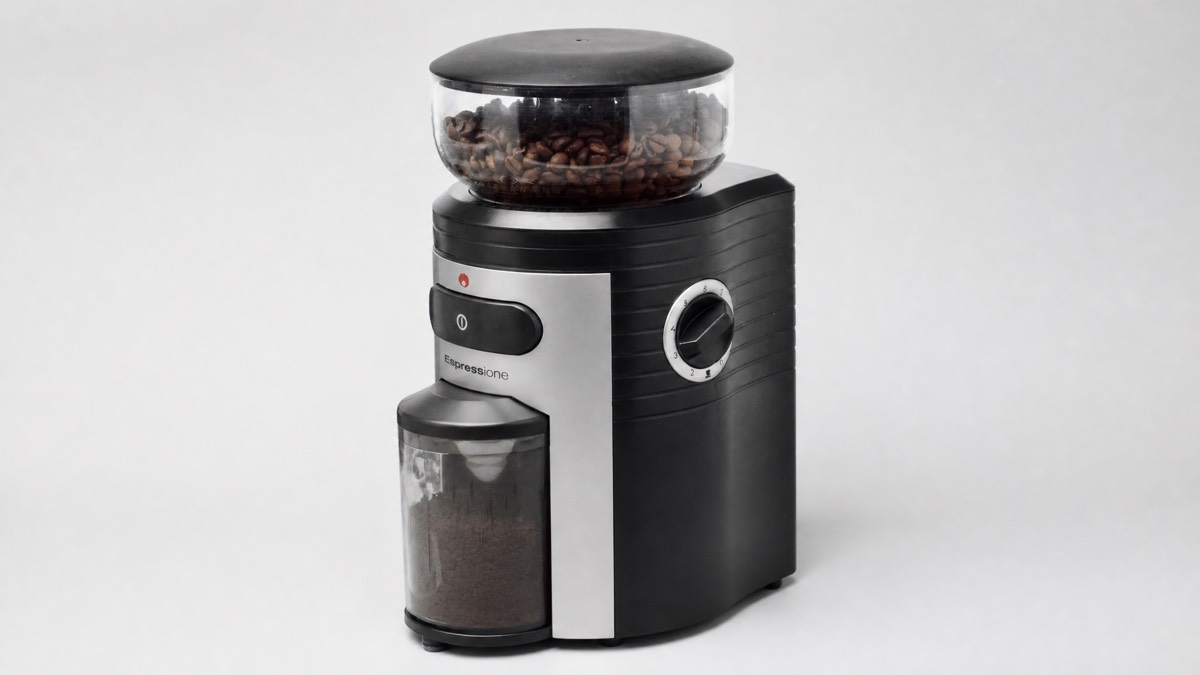
Come in, I'm Sam. After 14 years of running a coffee shop, I know what a conical burr grinder needs to handle. The Espressione coffee grinder is a 150-watt conical burr grinder sold as model 5198. It holds 8.5 ounces (241 grams) of beans and sells for about $75 to $90.
The grinder grinds well for drip, French press and cold brew, and it earns 4.0 stars from 232 US ratings. Its finest step suits AeroPress and some espresso use. Static, messy counters and a hard-to-clean chute are the main problems. The warranty lasts 1 year.
Many units run for years of daily use. The Baratza Encore and the OXO Brew cost more, with 40 and 15 settings. Pump espresso buyers find the finest step too coarse, while drip and French press buyers get a fair deal here. I give plain answers on grind settings, static and cleaning. Espressione gave no input.
What Is the Espressione Grinder?
The Espressione grinder is a 150-watt conical burr grinder for home coffee, sold as model 5198. The maker markets it for home and office use. A built-in timer sets the dose from 2 to 10 cups.
The grinder measures 6.3 by 5.9 by 10.9 inches (16 by 15 by 28 centimeters). The maker lists the weight at 3.8 pounds (1.7 kilograms), while one retail page lists 4.5 pounds (2 kilograms). The body is ABS plastic with steel parts.
The bean hopper holds 8.5 ounces (241 grams) of whole beans. The ground coffee container holds 4 ounces (113 grams). The base is slip resistant, and the power cord winds away for storage.
Key Specs:
| Spec | Value |
|---|---|
| Motor | 150 watts |
| Bean hopper | 8.5 oz (241 g) |
| Ground container | 4 oz (113 g) |
| Size | 6.3 x 5.9 x 10.9 in (16 x 15 x 28 cm) |
| Weight | 3.8 lb (1.7 kg) |
Espressione North America sells the grinder on its own site. Electra-Craft Inc. of Bergenfield, New Jersey, handles after-sales service for Espressione appliances. The manual lists that address for service questions.
Does the Espressione Grinder Use Real Conical Burrs?
Yes. The Espressione grinder uses real conical burrs, a fixed lower cone and a removable upper burr. The manual shows both parts. The upper burr twists out for cleaning.
A burr grinder crushes beans between two surfaces set a fixed distance apart. Because the gap stays the same, the pieces come out close in size. A blade grinder works differently. It chops beans at random and gives uneven pieces.
The maker states that the conical design cuts friction and heat. Less heat helps keep flavor and aroma in the grounds. The maker also calls the burrs commercial grade.
Some details are missing. No source states the burr material, the burr diameter or the motor speed. The manual only shows the two cones and how they come apart.
How Does the Espressione Grinder Work?
The Espressione grinder works by pulling beans from the hopper into a conical burr set driven by a 150-watt motor. The ground coffee drops straight into a removable container below.
The manual says the container must sit fully in place before grinding. Without it, ground coffee can blow out of the spout and spray the counter.
The bean container turns to point at a fineness setting. A rotary dial on the side sets the dose from 2 to 10 cups. The dose is set by time, so the chosen cup number decides how long the motor runs. The timer ends the run on its own. The motor stops when the set time for that cup number runs out.
Steps:
- Seat the ground coffee container fully in place.
- Turn the bean container to a fineness setting.
- Set the dial from 2 to 10 cups.
- Press the large front button.
How Many Grind Settings Does the Espressione Grinder Have?
The Espressione grinder does not have one clear count of grind settings: maker pages say 15, while the manual lists 10. Retail pages repeat the figure of 15.
The manual puts setting 1 at the finest and setting 10 at the coarsest. The maker names Turkish coffee as the use for the finest setting.
A finer setting narrows the gap between the two burrs. The beans pass through a smaller space and come out in smaller pieces. Labels can differ between units. An older unit marks the dial from fine to coarse, while a newer unit shows only numbers.
The setting never changes while the grinder runs. The manual says to turn the bean container only when the motor is off.
How Does the Espressione Grinder Timer Work?
The Espressione grinder timer works through a rotary dial set from 2 to 10 cups and stops the motor on its own. The front button starts the run.
A higher cup number runs longer, so more beans pass through the burrs. A finer setting also takes longer. The same amount of coffee therefore takes more time at a fine setting than at a coarse one.
The dial sets time, not weight. A kitchen scale checks the first few doses and shows how much coffee each dial setting gives. The Specialty Coffee Association uses 55 grams of coffee per liter (34 fluid ounces) of water as its standard brew ratio.
If the beans run out before the timer ends, the motor keeps running with nothing to grind. The motor can spin fast and loud when this happens. Large doses run the longest, so owners stay near the grinder for them.
How Well Does the Espressione Grinder Grind?
The Espressione grinder grinds well for drip, French press and cold brew and earns 4.0 stars from 232 US ratings. The global rating is 4.1 stars from 208 ratings.
Grind quality draws 44 comments, and 32 of them are positive while 12 are negative. Global ratings split into 57% five stars, 20% four stars, 9% three stars, 4% two stars and 10% one star.
The finest setting gets praise from owners, who describe it as a uniform powder. The coarse end runs finer than many French press users expect. Two separate reports mention a coarse setting that still looks fine.
Owners use the grinder for several brew styles, including cold brew, AeroPress, drip and French press. Daily use of this kind appears across several years of reports.
Can the Espressione Grinder Grind Fine Enough for Espresso?
Yes. The Espressione grinder grinds fine enough for espresso at its finest step, though some owners want it finer. The maker markets that step for espresso and Turkish coffee.
Owners report mixed results with that step. AeroPress espresso users describe a very fine and even grind. Several owners say the finest step is not fine enough for a pump machine.
Pressurized portafilter baskets forgive a coarse grind, while non-pressurized baskets need fine and even grounds. That split decides the espresso answer for most machines.
The manual gives a method for the finest steps. Fill only a few scoops of beans, then check that ground coffee reaches the container. The manual also says to clean the grinding chamber after finest grinding. Fine grounds pack into the chamber and block the next run.
Is the Espressione Grinder Quiet?
Yes. The Espressione grinder is quiet enough for daily use, though not silent. Five of six noise comments are positive.
Even so, owners do notice the sound. The loudest comparison they make is a vacuum cleaner. That comparison is easy to picture, but it leaves out how short the noise is. A grinding run lasts only seconds, so the noise ends fast.
An empty hopper makes the motor spin faster and louder. Beans in the hopper keep the sound steady.
What Are the Main Espressione Grinder Problems?
The main Espressione grinder problems are static cling, messy cleaning and a coarse end that runs fine. Static draws 16 negative comments and no positive ones.
Main Problems:
- Static cling on the plastic container
- Messy counters after each grind
- A coarse end that runs fine
- Motor strain when the hopper runs empty
Grounds gather in front of the grinder after each run. Flakes can also leak around the plastic container and onto the counter.
Reliability draws 22 comments, 16 positive and 6 negative. Some units stop working, and replacement units have worked.
A hopper that runs empty before the timer ends spins the motor hard. A seated ground coffee container keeps grounds from blowing out of the spout.
Why Does the Espressione Grinder Make Static?
The Espressione grinder makes static because grounds rub against the plastic catch container and cling to its walls. The grounds then stick to the sides and scatter.
Humidity changes the amount of static. Some days show none, and dry days show the most.
The Ross Droplet Technique cuts static in other grinders. It is a light water spritz on the beans before grinding. Water near steel burrs risks rust, and no source clears the method for this grinder.
A short burst of steam inside the container can calm static instead. Owners also wipe the base and the counter after each grind, since small piles gather in front.
Is the Espressione Grinder Hard to Clean?
Yes. The Espressione grinder is hard to clean around the burr and the chute, though the removable parts wash easily. The machine cannot come fully apart.
The bean container, ground coffee container and both lids wash with mild soap and water. These parts also fit on the top rack of a dishwasher. The upper burr does not go in the dishwasher, so it needs hand cleaning.
The upper burr lifts out of the grinder. The upper cone turns counterclockwise until it comes loose. A household brush cleans both cones. The upper cone then turns clockwise to lock back in place.
The manual calls for daily cleaning of the grinding chamber. Dark, oily beans leave rancid oils behind. The lower cone hides some grounds, so a brush pushed up through the chute clears them. Grindz cleaning tablets absorb oil residue between brush cleanings.
How Long Does the Espressione Grinder Last?
The Espressione grinder lasts as long as several years of daily use in many homes. Owner reports run from 2 years to more than 10 years.
Reliability draws 22 comments, 16 positive and 6 negative. The positive comments mention steady daily use without repairs.
Daily use of about 4 pounds (1.8 kilograms) of coffee a month has run for six years without a failure. That adds up to about 288 pounds (130 kilograms) of beans. Heavy cold brew use is the harshest case reported.
Some units fail early. Replacement units have arrived quickly and worked.
Does the Espressione Grinder Have a Warranty?
Yes. The Espressione grinder does have a 1-year limited warranty with proof of purchase. The warranty covers the original owner only.
Under the warranty, parts and labor are free. The owner still pays shipping both ways to the service center. The repair itself costs nothing, but the freight does.
Electra-Craft of Bergenfield, New Jersey, handles service at 201-439-1700 or info@electra-craft.com. Espressione asks owners to register the product online to get warranty service.
How Much Does the Espressione Grinder Cost?
The Espressione grinder costs about $75 to $90 at current US prices. The maker lists a suggested retail price of $140.
Sellers charge well below that suggested price. Espressione North America sells the grinder at $89.99. Zola, a wedding registry store, lists the same price. Prices were checked in November 2026.
Amazon charges less than both. It lists the grinder at $74.99 and shows an Amazon's Choice badge. Used and open-box units also appear on eBay and Poshmark.
Current Prices:
| Seller | Price |
|---|---|
| Amazon | $74.99 |
| Espressione North America | $89.99 |
| Zola | $89.99 |
Is the Espressione Grinder Worth the Price?
Yes. The Espressione grinder is worth the price near $75, and loses its edge near $150. Value draws 13 comments, 10 positive and 3 negative.
Price shapes how buyers judge the grinder. Buyers who paid about $60 call it a bargain. Buyers weighing a $150 price choose the Baratza Encore instead. The Espressione looks less appealing next to that rival.
The brewing method also affects whether the grinder feels worth its cost. Espresso results do not match the price for some buyers. Drip and French press results satisfy most.
Espressione Grinder vs Baratza Encore: Which Is Better?
The Baratza Encore offers 40 grind settings, while the Espressione grinder offers 10 to 15 settings at a lower price. The Encore uses a 40-millimeter (1.6-inch) conical burr.
The Encore hopper holds 8 ounces (227 grams), and its grounds bin holds 5 ounces (142 grams). Listings put the Encore at $119.95 to $149.95, with a 1-year warranty.
Baratza also sells the Encore ESP as an espresso and coffee version of the Encore.
The Espressione hopper holds 8.5 ounces (241 grams), and its container holds 4 ounces (113 grams). The price runs $75 to $90, and the warranty lasts 1 year.
The Encore weighs about 7 pounds (3.2 kilograms). The Espressione grinder weighs 3.8 pounds (1.7 kilograms) and adds a built-in cup timer.
Side by Side:
| Feature | Espressione 5198 | Baratza Encore |
|---|---|---|
| Grind settings | 10 to 15 | 40 |
| Bean hopper | 8.5 oz (241 g) | 8 oz (227 g) |
| Grounds container | 4 oz (113 g) | 5 oz (142 g) |
| Price | $75 to $90 | $119.95 to $149.95 |
| Warranty | 1 year | 1 year |
How Does the Espressione Grinder Compare With the OXO Brew?
The Espressione grinder compares with the OXO Brew as a cheaper grinder with a smaller 8.5-ounce (241 gram) hopper. The OXO Brew hopper holds 12 ounces (340 grams). The hopper is the bin that holds the beans before grinding. The OXO Brew holds more beans at once, and the Espressione holds fewer.
Both grinders use conical burrs. These are cone-shaped metal parts that crush the beans into even grounds. Since the burr type is the same, the other differences set the two apart.
The OXO Brew has 15 grind settings plus micro-adjustments. Micro-adjustments are small steps between the main settings. They give a finer way to tune the grind.
Price is where the Espressione has the edge. Listings put the OXO Brew at $99.95 to $114.99.
Warranty terms for the OXO Brew differ between listings. Some list 1 year, and others list 2 years.
Is the Espressione Grinder Worth It?
Yes. The Espressione grinder is worth it near $75 for drip, French press and cold brew, but not for pump espresso machines. The rating stands at 4.0 stars on 232 ratings.
The grinder is easy to use and fairly quiet. It is simple to set with the cup dial. A new user can pick an amount and press start. Many units run for years of daily use, which makes the low price near $75 look even better.
The costs show up in the grind itself and in cleanup. The coarse end runs fine. The fine end falls short for pump espresso.
Static and mess are the other costs. Static builds up on the plastic container, so grounds cling to it and spill onto the counter. An empty hopper also makes the motor spin hard, so the grinder runs only with beans loaded.
Pros:
- Built-in cup timer
- Easy to use
- Fairly quiet
- Low price near $75
- Years of daily use
Cons:
- Static on the plastic container
- Messy counters
- Coarse end runs fine
- Fine end falls short for pump espresso
Who Is the Espressione Grinder Not For?
The Espressione grinder is not for pump espresso buyers, heavy-volume cafes or anyone who dislikes static mess. Those buyers want a finer and cleaner grinder.
The maker markets the grinder for home and office use. That use sets its limits. A cafe grinds many shots a day, so it needs a larger hopper and a faster motor.
Pump machines such as the Gaggia Classic Pro work differently. They need a finer, steadier grind than the finest step gives.
Static is the last limit to weigh. Buyers who wipe the counter after each grind accept this. Buyers who want a spotless counter pick another grinder.
Odradeks Coffee House is reader-supported. If you buy through a link on this page, we may earn a small affiliate fee at no extra cost to you.