Enterprise Coffee Grinder Review: Is It Worth It?
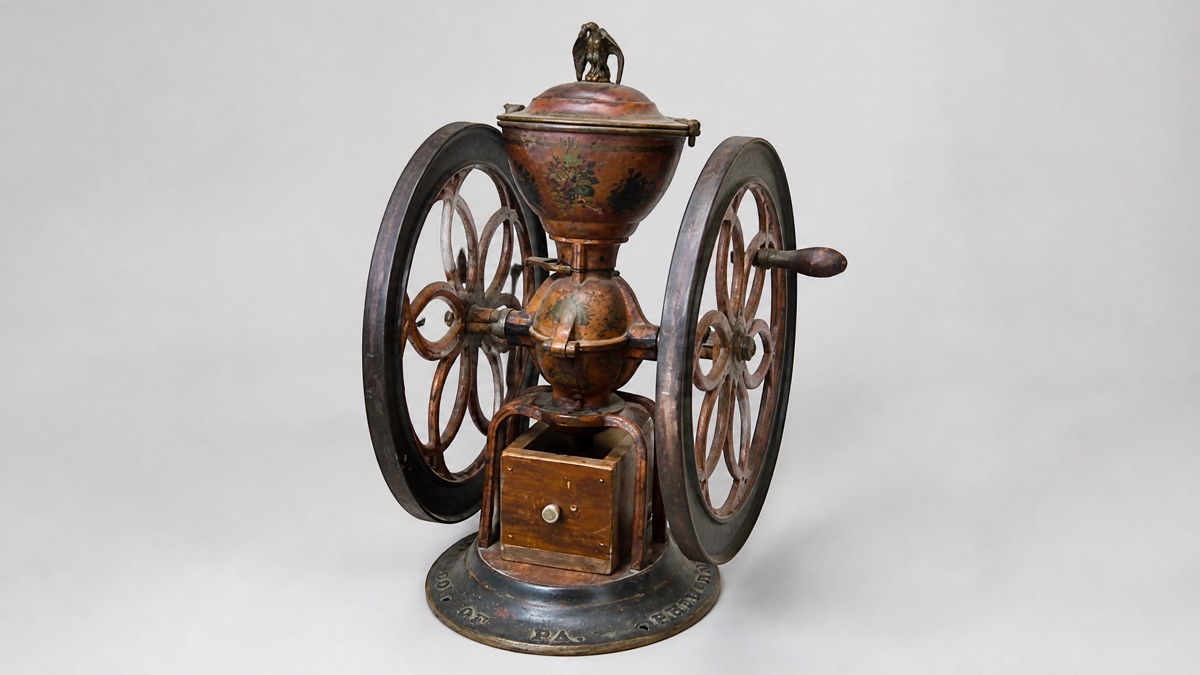
Welcome to another hand-crank coffee grinders review from my shop, I'm Sam. The Enterprise coffee grinder is an antique cast iron hand-crank coffee mill from Enterprise Mfg. Co. of Philadelphia. Makers sold it from the 1870s. Sizes ran from a 12 inch (30 cm) table model to a 60.5 inch (154 cm) floor mill.
I run a busy kosher coffee shop and wine bar, so I judge Enterprise with care. A hand crank turns the burrs, and owners report that a good set still grinds coffee. Rust, lost parts, lead paint and recast copies are the main problems. Small mills sell for about $150 to $250.
I list antique model numbers, grinding and adjusting and rival makers, then give my verdict. No sponsor paid for the verdict. The mill is a collector's piece first and a grinder second, and original paint and sound burrs set its value.
What Is the Enterprise Coffee Grinder?
The Enterprise coffee grinder is an antique cast iron hand-crank coffee mill made by Enterprise Mfg. Co. of Philadelphia. The company sold these mills from the 1870s. Grocers, general stores and farmhouses used them to grind beans by hand.
The mills ran from a 12 inch (30 cm) table model to a 7 foot (2.1 m) store mill. By 1883 the largest model weighed almost 500 pounds (227 kg).
A big floor mill was a status symbol for a grocer. Makers painted it red or green and added decals.
Sellers sort the mills into three formats by use:
- Wall mills: These bolt to a wall.
- Table mills: These sit on a counter.
- Floor mills: These stand on a cast iron stand.
Enterprise stopped making these mills long ago. Today the Enterprise coffee grinder sells as an antique, a display piece or a lamp base.
Who Made the Enterprise Grinder?
The Enterprise Manufacturing Company made the Enterprise grinder in Philadelphia. Henry Asbury, Jacob Smith and Jonathon Seltzer formed the firm in the 1860s. Its works stood at Third and Dauphin Streets in Philadelphia.
John Gulick Baker joined them soon after. Baker later won patents in 1870 and 1873. The company credited those patents for its success.
Enterprise printed its first trade catalogs in 1873 and 1874. They showed a full line of cast iron coffee grinders.
The firm also made cherry pitters, apple peelers, juicers and banks. Coffee mills became its best known product.
What Do the Enterprise Grinder Model Numbers Mean?
The model numbers of the Enterprise grinder rise with the size of the mill. The No. 1 stands about 12 inches (30 cm) tall. The No. 12 stands about 60.5 inches (154 cm) tall.
The No. 2 stands about 12.5 inches (32 cm) tall. The No. 00 is a small wall mount about 16 inches (41 cm) high.
The No. 5 measures about 16.75 inches (43 cm) with 12.5 inch (32 cm) wheels. The No. 7 stands about 22 inches (56 cm) tall with 17 inch (43 cm) wheels.
The No. 12-1/2 was a store mill built from 1886 to 1898. It stood 42 inches (107 cm) high with 25 inch (64 cm) wheels and weighed about 140 pounds (64 kg).
| Model | Height | Wheels |
|---|---|---|
| No. 00 wall mount | 16 in (41 cm) | Not stated |
| No. 1 | 12 in (30 cm) | Not stated |
| No. 2 | 12.5 in (32 cm) | Not stated |
| No. 5 | 16.75 in (43 cm) | 12.5 in (32 cm) |
| No. 7 | 22 in (56 cm) | 17 in (43 cm) |
| No. 12 | 60.5 in (154 cm) | 24.75 in (63 cm) |
| No. 12-1/2 | 42 in (107 cm) | 25 in (64 cm) |
How Does the Enterprise Coffee Grinder Work?
The Enterprise coffee grinder works by turning a hand crank that spins grinding wheels under the hopper. Beans drop from the hopper into the burrs. The burrs crush them as the crank turns.
Ground coffee falls into a catch below the burrs. The catch is a wooden drawer, a cast iron cup or a removable tin with a spout.
Large models carry one or two heavy flywheels. The mass of the flywheel keeps the crank turning smoothly.
The grinder has four working parts:
- Hopper: Holds the whole beans.
- Burrs: Crush the beans as the crank turns.
- Crank and flywheels: Drive the burrs.
- Drawer: Catches the ground coffee.
Does the Enterprise Grinder Still Grind Coffee?
Yes. The Enterprise grinder still grinds coffee when the burrs are in good shape. Owners report mills from the 1870s that work well today.
The burrs are the parts that crush the beans, so they decide the outcome. A hardware store does not stock replacement parts for a mill that old.
Most sellers market these mills as decor, not as daily grinders. No measured grind test for an Enterprise mill turned up, so how evenly one grinds remains unproven.
How Do You Adjust the Enterprise Grinder?
The Enterprise grinder adjusts its grind with a thumbscrew. Turning the screw moves the burrs closer together or farther apart. Closer burrs give a finer grind.
The screw is also the part that can fail. A worn adjuster can leave only one usable grind setting, and owners of old mills report this fault.
The simple test for a worn adjuster is to back the screw out. Then grind a small dose and check the result by eye.
What Are the Enterprise Coffee Grinder Features?
The Enterprise coffee grinder features two hopper styles. One style has a cast iron hopper. The other has a nickel-plated brass hopper topped with a gold eagle finial.
Hopper covers first appeared in 1876 and 1877. Decals arrived at about the same time.
Enterprise painted many mills red with black pinstripes. Floral decals and cast vines decorate the frame.
Cast lettering names the maker. A No. 2 base reads ENTERPRISE MFG CO, PAT. OCT 21, 73, PHILADELPHIA U.S.A. Each wheel carries the maker name as well.
The firm won a medal at the 1876 Centennial exhibition in Philadelphia. Some mills carry an inscription that records the award.
What Is the Enterprise Grinder Made Of?
The Enterprise grinder is made mostly of cast iron. The frame, the wheels and the grinding housing are all iron. A few parts use other materials. Some hoppers are nickel-plated brass, and some handles are wood or porcelain.
The mills are heavy. The No. 12-1/2 weighs about 140 pounds (64 kg).
Size adds even more weight. The biggest store mills weighed close to 500 pounds (227 kg).
How Do Patent Dates Date an Enterprise Grinder?
The patent marks on an Enterprise grinder give the earliest possible date, not the build year. A base marked Pat. Oct. 21, 73 and wheels marked Dec. 2, 1873 appear on a No. 2 mill made between 1893 and 1898.
A mill with the 1873 mark can therefore be many years younger than 1873.
A Pat. July 12, 98 mark places a mill after 1898.
The eagle finial, the decorative figure on top of the mill, gives a second clue. Enterprise put eagles on all mills from No. 7 up after 1898. An eagle on a No. 7 or larger mill therefore points to the same period as the 1898 patent mark.
| Mark | What it shows |
|---|---|
| Pat. Oct. 21, 73 | Earliest date is 1873 |
| Pat. July 12, 98 | Made after 1898 |
| Eagle finial on No. 7 or larger | Made after 1898 |
What Problems Does the Enterprise Coffee Grinder Have?
The Enterprise coffee grinder has age problems, mainly rust, paint loss and missing parts. Sale listings show cracked lids, lost handles and missing drawer tops.
Parts are scarce. Nobody sells new burrs for a 19th century Enterprise mill at a hardware store.
Size is a second problem. A floor model of 64 inches (163 cm) needs freight and floor space.
Repainting hurts value. Collectors prize the original paint and decals.
Paint safety matters. The federal government banned lead-based paint in housing in 1978. A mill painted in the 1800s predates that ban, so its paint may contain lead. Peeling or chipping paint is the concern, since it creates lead dust.
Copies exist. A dealer lists an ACME recast of the Enterprise No. 2, and the word recast marks a later casting. Check that the base, wheels and hopper belong together.
- Rust and paint loss
- Cracked lids, lost handles and missing drawer tops
- Burrs that cannot be replaced at a hardware store
- Weight and freight needs for floor models
- Paint that may contain lead
- Recast copies sold as originals
How Do You Clean an Enterprise Grinder?
The best way to clean an Enterprise grinder is to empty the drawer after each use. Pull the drawer out and shake out old grounds. Then turn the mill upside down to clear the rest.
A daily user can deep clean once a month. That means taking the parts apart and brushing out the grounds.
Heavy buildup can soak overnight in mild dish soap. Leave the original paint and decals alone.
How Does the Enterprise Coffee Grinder Compare to Rivals?
The Enterprise coffee grinder compares with rival American and French cast iron mills.
Landers, Frary & Clark of New Britain, Connecticut sold the Crown Coffee Mill. Elgin National sold a No. 40 mill with an eagle logo.
The Lane Brothers Swift Mill came from Poughkeepsie, New York. Its mechanism carries a Feb. 9, 1875 patent mark.
Peugeot Freres of France made cast iron mills as well. A Peugeot mill stands about 14 inches (36 cm) tall.
Arcade Manufacturing Co. of Freeport, Illinois is known for canister-type wall mills, and its No. 3 is its best known model. Charles Parker Company of Meriden, Connecticut marked its mills Meriden Conn. Coles Mfg. Co. of Philadelphia sold cast iron countertop grinders.
| Maker | Location | Known for |
|---|---|---|
| Landers, Frary & Clark | New Britain, Connecticut | Crown Coffee Mill |
| Lane Brothers | Poughkeepsie, New York | Swift Mill |
| Arcade Manufacturing Co. | Freeport, Illinois | Wall mills, No. 3 |
| Charles Parker Company | Meriden, Connecticut | Mills marked Meriden Conn. |
| Coles Mfg. Co. | Philadelphia | Cast iron countertop grinders |
Enterprise Grinder vs Landers, Frary & Clark?
The Enterprise grinder matches Landers, Frary & Clark in small table sizes. An Enterprise No. 2 stands 12.5 inches (32 cm) tall. A Landers, Frary & Clark No. 11 stands the same height.
The two small mills also look alike. Both are red cast iron with decals and a wood base.
Enterprise did not stop at table mills. It also made much larger store mills, and the No. 12 reaches 60.5 inches (154 cm).
No measured grind test compares Enterprise with its rivals. The condition of the burrs matters more than the brand on any mill this old.
How Much Does the Enterprise Coffee Grinder Cost?
The Enterprise coffee grinder costs about $150 to $250 for a typical small mill. A No. 1 on a wood base sold at auction for $413. A figural model sold for $632.50.
Price depends on size, condition and originality. Original paint and decals add the most value. A repaint, a missing drawer or a lost handle cuts it. A simple early mill that saw hard use sells for about $60 to $150.
The eagle finial and a nickel-plated brass hopper also raise the price of a mill.
Large mills cost more. A No. 7 carried an auction estimate of $950 to $2,850. Dealers list floor models at $1,575 and $2,400. A No. 12-1/2 store mill is worth well over $1,000.
| Mill | Price |
|---|---|
| Simple early mill | $60 to $150 |
| Typical small mill | $150 to $250 |
| No. 1 on wood base (auction) | $413 |
| Figural model (sold) | $632.50 |
| No. 7 (auction estimate) | $950 to $2,850 |
| Floor models (dealer) | $1,575 and $2,400 |
Is the Enterprise Grinder Worth the Price?
Yes. The Enterprise grinder is worth the price as an antique and display piece. Original paint and decals add value.
A modern grinder gives a more even grind for far less money. The antique earns its price as history, not as a brewing tool.
Where Can You Buy an Enterprise Grinder?
You can buy an Enterprise grinder where antique dealers, online marketplaces and auction houses sell it. eBay and Etsy carry dozens of listings. 1stdibs lists dealer pieces.
Auction houses sell large mills in lots. Check the photos for cracks, missing parts and repaint.
A sold price is a better guide than an asking price.
Is the Enterprise Coffee Grinder Worth It?
Yes. The Enterprise coffee grinder is worth it as an antique, not as a daily grinder. The mills look striking and carry real American history.
A modern burr grinder wins on grind control and cleanup. The Enterprise wins on character.
The condition of the burrs and the paint decide the value of each mill. The burrs, which are the metal parts that crush the beans, must be in good shape.
Repainting or restoring an original mill destroys its value.
Who Should Buy an Enterprise Grinder?
Collectors of general store pieces should buy an Enterprise grinder. Decorators can use one as a statement piece or a lamp base.
Home baristas who want precise grinds should buy a modern grinder instead.
Odradeks Coffee House is reader-supported. If you buy through a link on this page, we may earn a small affiliate fee at no extra cost to you.