Dienes Coffee Grinder Review: Is It Worth It?
Glad you came by, I'm Sam. My shop in Midwood is near Di Fara Pizza, and our vintage hand coffee grinders work all day.
The Dienes coffee grinder is a vintage hand mill made by Peter Dienes and sold under the PeDe name from 1869 to 1970. Buyers find it used, in wall-mounted, box and brass Mokka styles. This review covers how it works, what it costs and whether it earns a place in a modern kitchen.
The mill grinds with steel burrs turned by a hand crank, and a knob sets the grind from fine to coarse. Tabletop models sell for about $50 to $100, and Dutch wall mills reach $170 to $260. Rust is the main risk, and no lab test measures the grind. A Comandante C40 costs several times more, and shipping adds to a Dienes order.
The Dienes is worth it for collectors and occasional users on a budget, and a poor fit for anyone who needs exact settings each morning. The mill lasts and looks good, but it comes with no warranty and no test data. Read on for the types, the marks of a real PeDe mill and the checks to make before buying.
You will read about grinder history, grind adjustment and buying risks, and no brand paid me.
What Is the Dienes Coffee Grinder?
The Dienes coffee grinder is a vintage manual mill made by Peter Dienes and sold as PeDe. The firm made these hand grinders from 1869 until 1970. Today they sell only used.
Dienes made wall-mounted and tabletop models. Bodies came in cast iron, wood, ceramic and Bakelite. Each model grinds beans with a hand crank and needs no power.
Interest grew in 2025. Social media creators praised the Dutch wall-mounted PeDe grinder as a thrift store find.
What Does PeDe Mean on a Dienes Grinder?
PeDe on a Dienes grinder means Peter Dienes, the German who founded the company in 1869. The name is a short form of his own. Buyers see it on the case or the hopper.
Peter Dienes started the firm in Remscheid, Germany. Museum records say it took over the iron mill maker Wiebel Eisenkaffeemühlen. His sons Friedrich and Peter Gottlieb ran the company after his death in 1899.
The firm began in Germany. Dutch production started in 1919. Many buyers call the grinders Dutch, but the maker was German.
German models are prized for their age. Dutch models are prized for their painted designs and Dutch scenes. Both kinds still sell well.
How Does the Dienes Coffee Grinder Work?
The Dienes coffee grinder works by turning a hand crank that drives steel burrs inside the grinding chamber. Ground coffee falls into a pull-out drawer. Nothing in the mill needs electricity.
Steps:
- Set the grind with the adjusting knob.
- Fill the hopper with whole beans.
- Turn the crank until the beans are gone.
- Slide out the drawer and pour the grounds.
A burr mill crushes beans between two steel surfaces. A blade grinder chops them with a spinning blade. The burr design grinds more evenly, which matters most for fine coffee.
The burr assembly is adjustable. A knob or collar moves the burrs closer or further apart. The user sets the grind before pouring beans into the hopper.
Box models hold the ground coffee in a small drawer. The drawer slides out after the last turn.
How Do You Adjust the Dienes Grinder?
The Dienes grinder adjusts by turning a knob that moves the burrs closer or further apart. On the slim Model 543, the adjusting knob sits on the back. Turning it sets the grind from fine to coarse.
The distance between the burrs decides the size of the ground coffee. Closer burrs crush the beans into a finer grind. Wider burrs leave the pieces larger and make a coarser grind. The knob changes that distance. So the user finds the right setting by grinding a few beans and checking the result.
The knob position also matters when the mill is taken apart. Some grinders lose their zero point after a full strip. The old setting is then gone once the burrs are put back. Noting the setting before taking the mill apart saves time later. Marking the knob position makes it easy to return to the same grind.
What Types of Dienes Coffee Grinder Exist?
Dienes made three main types of coffee grinder: wall-mounted mills, wooden box mills and brass Mokka mills. Each type uses the same hand crank idea. The look and the size differ the most.
Dienes Grinder Types:
| Type | Materials | How It Is Used |
|---|---|---|
| Wall-mounted | Wood board, ceramic body, cast-iron handle | Fixed to a wall, cranked with one hand |
| Box | Hardwood, chrome cap, tin drawer | Held on a counter, drawer catches grounds |
| Brass Mokka | Brass | Small hand mill, set fine for moka pot or espresso |
A museum record dates a brass mill marked Pede MOKKA to 1895-1905. It dates a Model 538 box mill with Bakelite parts to 1925-1935. Model numbers and materials help place a mill in its era.
Zassenhaus and Peugeot also made vintage hand mills. A buyer should confirm the PeDe or Dienes mark before assuming a mill is a Dienes.
Model numbers help sort them. Listings name the 461 as a brass mill from the 1930s. The 538 is a box mill with Bakelite parts. The 543 is a slim box mill from the 1950s.
Other listed names include the Mokka, the Solida and the 520.
What Is a Dienes Wall-Mounted Grinder?
A Dienes wall-mounted grinder is a coffee mill fixed to a wall so one hand can turn the crank. The wall holds the body steady. Early versions served shops that ground large amounts of coffee.
The classic version has a wooden backing board, a ceramic body and a cast-iron handle. The board attaches to the wall and carries the weight. The iron handle does the turning.
Many of these mills carry Delft style windmill scenes. Others show only the word koffie.
Smaller wall mills were sold for homes in the late 1800s and early 1900s.
What Is a Dienes Box Grinder?
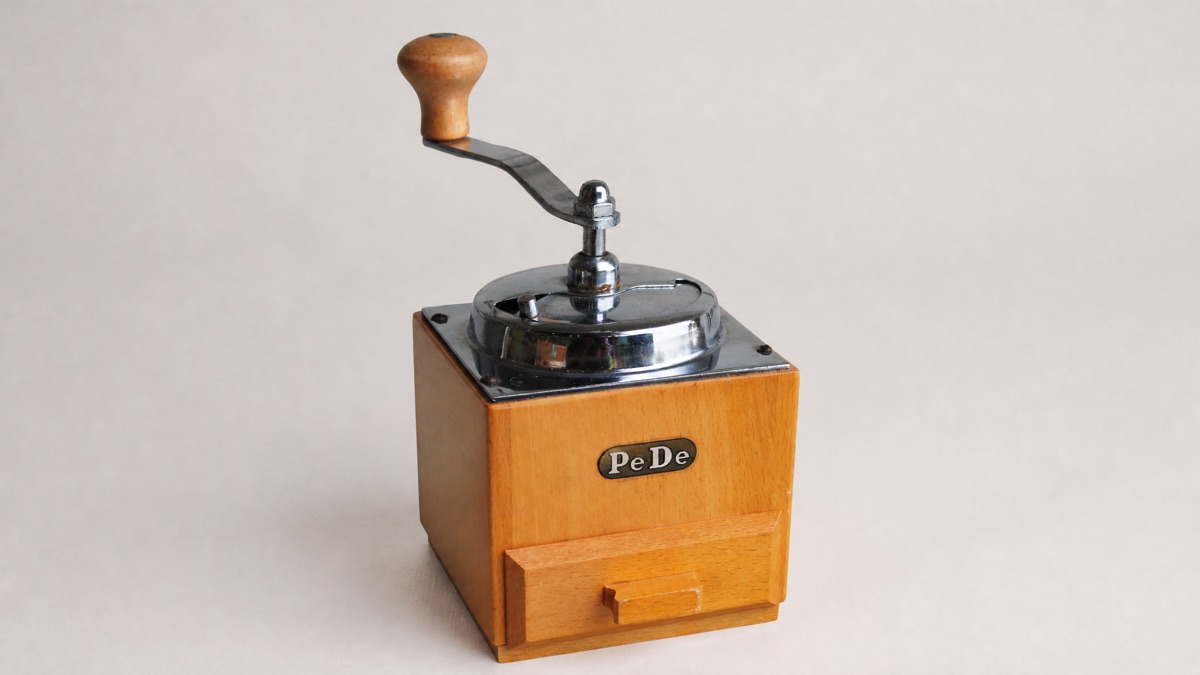
A Dienes box grinder is a tabletop coffee mill built into a wooden box with a pull-out drawer. The user holds the box in one hand and turns the crank with the other. The grounds fall into the drawer.
The Model 543 shows how this design looks in practice. It has a hardwood maple body and a chrome plated hopper cap. The catch drawer is tin with a wood front. This 1950s mill is 2.75 inches (7 cm) wide.
The Model 543 is 5.75 inches (14.6 cm) deep and 7.75 inches (19.7 cm) tall with the handle. A 1950s Dutch box mill, the E8, stands about 8 inches (20 cm) tall.
Does the Dienes Coffee Grinder Grind Well?
Yes. The Dienes coffee grinder grinds well for a hand mill, though no lab test measures the grind. Collectors call its burr system precise. No published test gives particle sizes or grind times.
Burrs are the two toothed metal parts that crush the beans. Some PeDe mills grind well for espresso and drip coffee but carry rust on the burrs.
Condition therefore decides the result. A mill with clean, unworn burrs grinds evenly. A mill with rust or worn burrs grinds unevenly.
Brass and wood models from the 1950s appear most often. Their steel burrs set fine, and owners use them for moka pots and espresso.
Can the Dienes Grinder Grind for Espresso?
Yes. The Dienes grinder can grind for espresso when set to a fine setting. One owner of a brass Mokka calls it perfect for espresso. The same mill also loosens up for a French press.
That praise rests on one owner's opinion. No shot data backs it up. Nobody has measured the dose, the time or the output. A buyer who needs exact, repeatable shots has no way to check the claim.
A fine grind and a steady grind are different things. Espresso also needs a grind that stays the same from shot to shot. The mill has no click stops to mark each setting. A buyer must find the right setting by taste.
What Do Owners Say About the Dienes Grinder?
Owners say the Dienes grinder grinds consistently fine and lasts for decades. Forum posts describe the grinders as getting rave reviews. Praise centers on a steady, fine grind.
Age is the strongest proof of that durability. A brass Mokka bought in Germany in 1956 is still in daily use. That shows the build can last. It does not show that every mill ages as well.
Hard use is the other test. One owner took a Mokka on a nine month trip around Australia. The mill ground coffee every day for an AeroPress. Travel and daily use did not stop it.
How Much Does a Dienes Coffee Grinder Cost?
A Dienes coffee grinder costs $50 to $100 for a tabletop model and $170 to $260 for a Dutch wall model. Prices depend on the model, the lettering and the condition.
Dienes Grinder Price Ranges:
| Model | Price |
|---|---|
| Tabletop wood (value guide range) | $50-$70 |
| 1950s Dutch box mill, model E8 | $49.99 |
| Wood PeDe on a design marketplace | $99 |
| Dutch wall mill, good condition | $170-$260 |
| German kaffee wall mill | $250 or more |
eBay, Etsy and Catawiki carry most listings. Prices on those sites run from tens of dollars to a few hundred. Sold prices tell more than asking prices, so compare several listings of the same model.
A value guide puts tabletop wood models at $50 to $70. A Dutch box mill from the 1950s lists at $49.99. A wood PeDe on a design marketplace lists at $99.
A wall model with missing parts sells for around $100. Shipping and import fees add to the total. One $49.99 listing added $49.08 for shipping and about $5.51 in import fees.
What Makes a Dienes Grinder Worth More?
Several features make a Dienes grinder worth more: the lettering, the age, the condition and the missing-parts count. A mill with all parts and an original finish sells for the most.
A 1950s wall mill with only the word koffie often sells for over $100. A mill marked kaffee may be German made and can bring over $250.
Certain 1930s designs and rare woods sit at the top of the range. Cracked dovetail joints and pitted crank arms lower the price.
What Are the Risks of Buying a Dienes Coffee Grinder?
Buying a Dienes coffee grinder carries three risks: rust, missing parts and an unproven age. Every mill is used. None ships with a warranty.
Risks to Check:
- Rust on the burrs or the handle
- Missing drawer, knob or crank
- No proof of age or origin
- Return terms that mark all sales final
Many listings mark all sales final within a short window. Some sellers do not accept returns at all. A buyer should read the return terms before paying.
Shipping from overseas adds cost. Check the photos for cracks in the wood and the ceramic before paying.
How Do You Spot a Real Dienes Grinder?
A real Dienes grinder shows the PeDe logo or the Peter Dienes name, so spot the mark first. Look for the mark on the case, the front panel or the hopper.
The mark can take several forms. Museum records describe the old logo as a deer head. The name also appears as PeDe, Pe De or PeDE Dienes. Photos of every mark help a buyer match the mill to a known model.
Build details back up the mark. Wooden models use finger-jointed or dovetailed corners. The mill has a metal hand crank and an adjustable steel burr. Origin marks read Made in Germany or Holland.
A mill with no mark at all is a risk, because nothing links it to Dienes. Ask the seller for close photos of every mark.
Does Rust Ruin a Dienes Grinder?
No. Rust does not ruin a Dienes grinder when it is light and limited to the surface. Grinding three to five grams of beans before first use can lift light rust from the burrs.
Deep rust on the burrs does damage the grind. Pitted burrs cut unevenly. A buyer should ask for photos of the burrs.
Water must stay away from steel burrs. Wet burrs rust fast. A dry brush cleans the mill best. Mold in the wooden body is a sign of a serious problem.
How Does the Dienes Coffee Grinder Compare to a Modern Hand Grinder?
The Dienes coffee grinder compares to a modern hand grinder as a simpler, older and cheaper mill. A modern grinder like the Comandante C40 has 39 mm (1.5 inch) conical burrs and click adjustment.
Dienes vs Comandante C40:
| Feature | Dienes | Comandante C40 MK4 |
|---|---|---|
| Price | $50-$100 used | $277-$363 new |
| Burrs | Steel, adjustable | 39 mm (1.5 in) conical |
| Adjustment | Knob, no click stops | Clicks |
The 1Zpresso JX-Pro is another modern hand grinder that buyers often set against the Comandante C40 for espresso. Both are built new, with published specs and adjustment steps.
Modern grinders sell new with published specs. The Dienes sells used, so condition varies. The Dienes has no documented click stops.
The Dienes wins on looks and price. The modern grinder wins on repeatable settings and support.
Does the Dienes Grinder Cost Less Than a Comandante C40?
Yes. The Dienes grinder costs far less than a Comandante C40, at $50 to $100 against $277 or more. The Comandante C40 MK4 sells from about $277 to $363 depending on the seller.
That gap means several Dienes grinders could be bought for the price of one Comandante. It grows once a buyer adds shipping to a Dienes order.
A low price does not make a grinder the better deal for every buyer. Someone who grinds every day may value the Comandante click stops more than the savings.
Is the Dienes Coffee Grinder Worth It?
Yes. The Dienes coffee grinder is worth it for collectors and occasional users on a budget. The build lasts and the looks stand out.
Pros:
- Low price for a hand mill
- Build that lasts for decades
- Fine grind for moka pot and espresso
- Strong looks and history
The mill falls short on proof. No test measures the grind. Condition varies and no warranty exists. A buyer must check every photo.
Daily users who want exact, repeatable settings should look at a modern hand grinder. Everyone else gets a lasting mill with a story.
Who Should Buy a Dienes Grinder?
Collectors and moka pot users should buy a Dienes grinder if looks matter more than exact settings. The mill rewards patience.
Buyers who want exact settings every morning should skip it. The mill has no clicks to count. Setting it takes trial and error.
Budget carefully for shipping and import fees. Those costs can double the price of a cheap listing.
Odradeks Coffee House is reader-supported. If you buy through a link on this page, we may earn a small affiliate fee at no extra cost to you.