Cunill Coffee Grinder Review: Is It Worth It?
Come in, I'm Sam. Morning crowds near Di Fara Pizza in Midwood show me which doser grinders keep up.
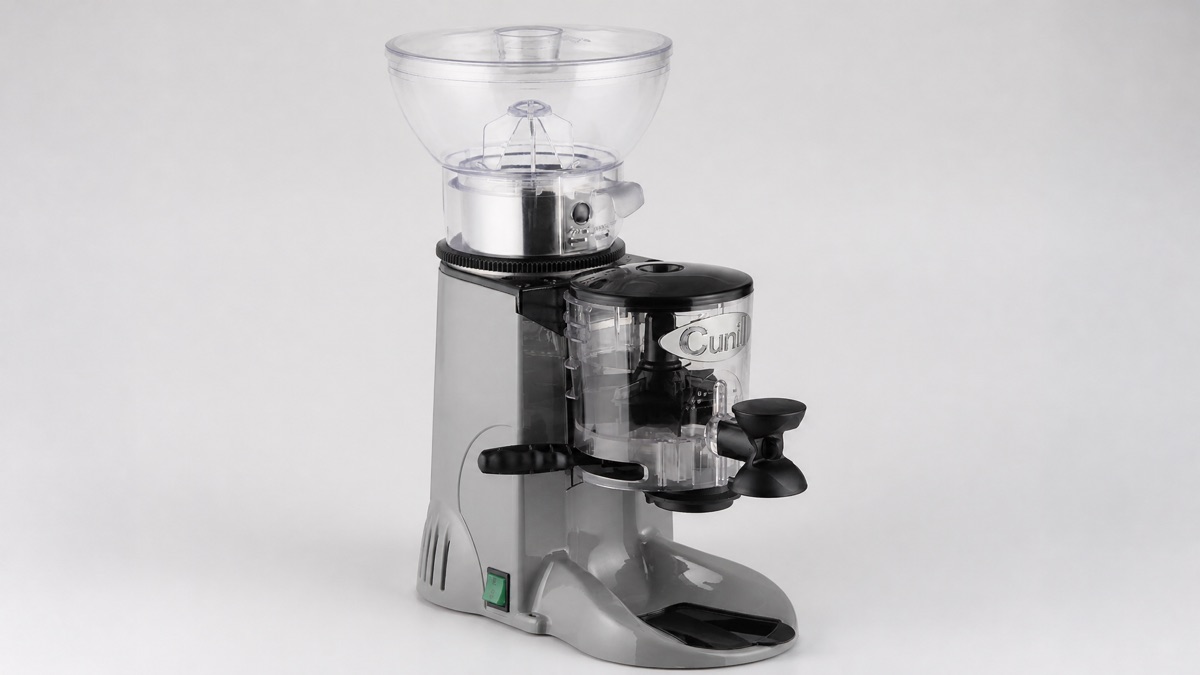
The Cunill coffee grinder is a Spanish professional burr grinder sold as doser and on-demand models. Molcunill builds it in Catalonia and has cut its own burrs since 1983. The compact Tranquilo II is the usual starting point for small cafes and home users.
Cunill sells 13 grinder families, and most use 60 mm (2.4 in) steel burrs. The Tranquilo II runs a 270 W motor, and its doser releases 5 g to 12 g (0.18 to 0.42 oz) per pull. The grind moves in steps of about 18 microns. A dry brush every 25 days handles cleaning, and the burrs are rated for 500 kg (1,102 lb).
The weak points are the coarse steps, grounds held in the exit chute and a fiddly timer on Tron models. No US list price is confirmed. Read on for specs, noise, cleaning and a clear verdict on who should buy one.
Cannot choose between the Cunill coffee grinder and the Ceado E37S? I cover grind adjustment for both, with no sponsor.
What Is the Cunill Coffee Grinder?
The Cunill coffee grinder is a professional doser or on-demand burr grinder made in Spain by Molcunill. Pere Cunill founded the company in 1957 as Talleres Cunill. The brand sells commercial grinders in many sizes.
Molcunill is based in Sils, in the Girona province of Catalonia, Spain. The Cunill spec sheet gives that address. The 1957 workshop stood in Manresa.
Talleres Cunill started by making parts for Gaggia coffee machines and grinders. Pere Cunill began building his own grinders in the 1970s. Tauro was the first of that series, and output passed 1,200 grinders per month.
Cunill has made its own burrs since 1983. Burrs are the toothed metal parts that cut the beans. The company calls itself the only national maker that cuts its own blades. Burrs, motor, hopper and doser all come from one factory line.
Cunill designs these grinders for commercial use. Cafes, bars and offices form the core market. The compact Tranquilo family serves as the entry point for lower-volume espresso.
Which Cunill Grinder Models Exist?
Cunill grinder models exist in 13 families, from the compact Tranquilo to the high-capacity Tauro and Space. Others are Brasil, Marfil, Kenia, Jamaica, Movie, Luxo, Iconic, Hawai, Michigan and Special Bar.
Three naming terms appear in the range:
- Tron: This name marks the on-demand electronic version of a family.
- ABS and Inox: These only describe the body material, plastic or stainless steel.
- Luxomatic: This is the electronic version of the Luxo.
Hopper and doser sizes grow up the range. The Tranquilo holds 0.5 kg (1.1 lb) of beans and a 300 g (10.6 oz) doser. The Marfil holds 2 kg (4.4 lb) and a 600 g (21.2 oz) doser.
The Michigan skips the doser and fills bags in bulk.
The Tranquilo II is the reference model for home buyers. Its 60 mm (2.4 in) burrs and 270 W motor do not carry over to other families.
Model Sizes:
| Model | Doser | Motor | Burr size |
|---|---|---|---|
| Tranquilo | 300 g (10.6 oz) | 270 W | 60 mm (2.4 in) |
| Marfil | 600 g (21.2 oz) | 352 W | 60 mm (2.4 in) |
| Michigan | None, fills bags | 680 W | 65 mm (2.6 in) |
How Does the Cunill Coffee Grinder Work?
The Cunill coffee grinder works by dropping beans from a hopper onto a spinning 60 mm (2.4 in) steel burr. A motor turns the burr at 1,300 or 1,600 rpm. The ground coffee leaves through an exit chute.
A doser model sends the grounds from the chute into a chamber. The chamber holds them until the user pulls a lever. The lever drops one measure into the portafilter. The doser holds 300 g (10.6 oz) on the Tranquilo II.
A Tron model has no doser chamber. The grounds fall straight into the portafilter while a timer runs the motor. The Tranquilo Tron also offers one or two instant doses.
The motor needs rest, and the rest times depend on the model. Manual models run 3 minutes and then stop 15 minutes. Electronic models run 6 seconds and stop 44 seconds. The maker caps continuous running at 30 minutes.
How Does the Cunill Grinder Adjust Grind Size?
The Cunill grinder adjusts grind size by turning the adjustment platen while an adjustment trigger is held. Turn right for finer coffee. Turn left for coarser coffee. The change works with the motor running.
The platen moves in fixed steps, so each turn changes the grind by a set amount. One owner counted 55 steps per full turn on an early Tranquilo. The burr carrier thread is 1 mm (0.04 in). Each step therefore moves the burr about 18 microns (0.0007 in).
That small movement still has a large effect on the cup. Each step shifts shot time by 5 to 10 seconds. A fine step matters for espresso, so the tuning works in coarse jumps. The maker calls the adjustment micrometric. The step size says otherwise.
Turning the platen left all the way removes it. The blades are then fully exposed. The manual warns never to run the grinder without every moving part in place.
How Does the Cunill Grinder Dose Coffee?
The Cunill grinder doses coffee with an adjustable doser that releases 5 g to 12 g (0.18 to 0.42 oz) per pull. A screw inside the doser sets the measure. Turning it right makes the dose smaller, and turning it left makes it larger.
The 12 g (0.42 oz) maximum matters for double shots. A double shot of 18 g (0.6 oz) needs two pulls at that maximum. The range is a setting, not a calibrated gram value. The user sets the doser by weighing a few pulls on a scale.
The doser also handles how the coffee reaches the basket. The lever can sit on the right or left side. A gasket-saver positions the portafilter, which is the handled basket that holds the coffee. A universal tamper comes built into the doser.
The Tranquilo Tron replaces the doser with a timer. A multi-language touch screen picks one dose, two doses or continuous grinding. A counter tracks totals, and a timer assistant helps set the grinding point.
A timer sets run time, not weight. The grind setting changes how much coffee falls in that time. A finer setting grinds slower, so the dose shrinks.
What Are the Cunill Coffee Grinder's Specs?
The Cunill coffee grinder's specs include a 270 W motor and 60 mm (2.4 in) burrs on the Tranquilo II. The motor carries a thermal protector and an IP21 rating. IP21 means protection against solid objects wider than 12.5 mm (0.5 in) and against vertically dripping water. Supply options are 110 V or 230 V at 50 or 60 Hz.
The 270 W rating equals about 0.36 hp, but the Cunill spec sheet prints 0.10 hp, which does not match. The Tranquilo II measures 170 x 340 x 410 mm (6.7 x 13.4 x 16.1 in). The spec sheet lists 6 kg (13.2 lb) of weight. The user manual lists 8 kg (17.6 lb) for the Tranquilo family, so the two sources differ.
The grinder holds beans in a hopper of 0.5 kg (1.1 lb). Some versions offer a 1 kg (2.2 lb) hopper. Ground coffee then drops into a doser, which holds 300 g (10.6 oz). Dose adjustment runs from 5 g to 12 g (0.18 to 0.42 oz).
Larger Cunill families draw more power than the Tranquilo II. The Brasil and Tauro use 275 W. The Marfil and Space use 352 W. The Michigan uses 680 W with 65 mm (2.6 in) burrs.
What Burrs Does the Cunill Grinder Use?
The Cunill grinder uses tempered steel burrs rated 62 HRc, 60 mm (2.4 in) wide on most models. Cunill cuts its own burrs. The design uses 52 teeth, a pattern the maker calls exclusive.
Retailers describe the Tranquilo burrs as flat steel burrs. A flat burr set uses two flat rings, one fixed and one spinning. Coffee is crushed between them.
The Michigan and the Movie use larger 65 mm (2.6 in) burrs. Every other family in the manual lists 60 mm (2.4 in) burrs.
Three burr finishes exist:
- Hardened steel: This is the standard set. A standard doser grinder ships with it.
- Titanium coated: The maker offers this coated type for high-output production.
- Red speed coated: The maker also offers this coated type for high-output production.
Burrs wear out with use. The rated burr life is 500 kg (1,102 lb) of coffee.
How Loud Is the Cunill Grinder?
The Cunill grinder is loud at 70 dB(A) on the Classic models, per the 2017 user manual. The Tranquilo II spec sheet lists 77 dB. The two Cunill documents disagree by 7 dB.
Silencer models run quieter. The Kenia and Jamaica claim 63 dB. The Movie and Hawai claim 65 dB. The aluminum Luxo and the Luxomatic claim 55 dB.
The Iconic claims 45 dB, the lowest figure in the catalog. Cunill built its Silencer line around quiet running. The Hawai uses one main motor and two fan motors to keep grounds cool.
All these figures come from Cunill. Room acoustics and the test method change the numbers. Treat them as a ranking, not a promise of sound levels in a cafe.
Claimed Noise Levels:
| Model | Noise |
|---|---|
| Classic models | 70 dB(A) |
| Kenia and Jamaica | 63 dB |
| Movie and Hawai | 65 dB |
| Luxo and Luxomatic | 55 dB |
| Iconic | 45 dB |
Does the Cunill Coffee Grinder Grind Well?
Yes. The Cunill coffee grinder grinds well for espresso when the grind and dose are set once and left alone. An owner called the Tranquilo an excellent value entry-level grinder for quality espresso.
The burr design aims for an even grind. Cunill says it matches speed, pressure, outlet shape and temperature to keep the coffee's flavor intact. The grind can range from American drip to Turkish.
The weak point is control, not quality. The 18 micron (0.0007 in) step is coarse for espresso tuning. A shot can change by several seconds from one click.
No independent particle size test of the Tranquilo turned up. The claims here come from the maker and from owners.
What Do Owners Like About the Cunill Grinder?
Owners like the Cunill grinder for its low entry price and rugged build. One owner described it as reasonably easy to clean and a good buy for the price. The build backs up that value, because the metal burr carrier shows no play in the thread.
The motor gets praise for power and moderate noise. The Tranquilo motor has a thermal protector. The manual rates the Classic models at 70 dB(A).
Cleaning stays simple. A dry brush clears the burrs and the doser. The hopper lifts off after the lockscrews are loosened.
When a part wears out or breaks, support is available. Cunill publishes exploded views and manuals for most versions. Spare parts sellers stock Cunill parts.
What Are the Cunill Grinder's Common Problems?
The Cunill grinder's common problems include a fiddly dose timer on the Tron models. The timer needs a small screwdriver to adjust. The dose also changes whenever the grind setting changes.
Three other problems affect the grinder:
- Grounds buildup: Grounds can pile up in the exit chute and flinger cavity. The pile can hold stale coffee. A cleaning leaves doses smaller until the cavity fills again.
- Overtight motor nuts: Overtightening the motor nuts can warp the burr carrier housing. One owner found the carrier would not thread in after tightening. Loosening the nuts fixed it.
- Worn burrs: Worn burrs can stop the grinder from producing coffee. The motor spins, but few grounds come out. Widening the setting only gives coarse coffee.
How Do You Clean the Cunill Coffee Grinder?
The Cunill coffee grinder needs cleaning every 25 days for the hopper, the blades and the doser. Unplug the grinder first. Never use running water or abrasive cleaners.
To clean the blades, remove the hopper and press the adjustment trigger. Turn the platen left until it comes off. Brush the burrs with a round, semi-rigid dry brush.
Blade Cleaning Steps:
- Unplug the grinder.
- Loosen the lockscrews and remove the hopper.
- Press the adjustment trigger and turn the platen left until it comes off.
- Brush the burrs with a dry, round, semi-rigid brush.
- Empty the doser with the lever, then brush it dry.
Removing the platen loses the grind setting. Note the platen position before taking it off. After refitting, grind a small amount and discard it. Recheck shot time before serving.
The doser needs its own cleaning. Pull the lever back and forth to empty it. Remove the lid and brush the inside dry. Never use any liquid in the doser.
A Tron model has no doser, so there is nothing to empty. Brush the burrs and the exit chute instead. The touch screen and timer need no disassembly.
Wash the hopper by hand in a very diluted dish soap solution. The user manual bans the dishwasher. However, the Tranquilo II spec sheet says the hopper survives a 90 °C (194 °F) dishwasher.
How Long Do Cunill Grinder Burrs Last?
Cunill grinder burrs last 500 kg (1,102 lb) of coffee by the maker's rating. Cunill lists the same figure for every family. The rating is a manufacturer claim, not a tested result.
That weight is easier to grasp in shots. A double shot of 18 g (0.6 oz) uses a small amount of coffee. At that dose, one burr set grinds about 27,700 shots before it reaches its limit.
A cafe grinding 10 kg (22 lb) a day hits 500 kg in 50 days. A home user grinding 1 kg (2.2 lb) a week reaches 500 kg (1,102 lb) in about 9.6 years. Wear follows the coffee ground, not the calendar, so heavy use shortens the life sharply.
Worn burrs show up as low output. The motor still spins, but little coffee falls. A finer setting does not fix this.
Replacement burrs exist. Cunill has cut its own burrs since 1983, and parts sellers list Cunill parts by model.
How Does the Cunill Coffee Grinder Compare to Alternatives?
The Cunill coffee grinder has alternatives that add timers, weight dosing or single dosing. Cunill offers a wide catalog of sizes and bodies. Newer brands focus on dosing control.
Espresso Outlet names the Ceado E37S as a modern on-demand alternative to the larger Cunill Tron models. The Fiorenzato F64 EVO PRO W adds grind-by-weight dosing. Both answer the timer problem.
Dosing Methods Compared:
| Grinder | Dosing |
|---|---|
| Cunill Tranquilo II | Lever doser, 5 g to 12 g (0.18 to 0.42 oz) |
| Cunill Tranquilo Tron | Timer |
| Ceado E37S | Timed on-demand |
| Fiorenzato F64 EVO PRO W | Grind by weight |
Cunill still has its own strengths. Its catalog spans three body materials and many sizes. Silencer models reach 63 dB or lower.
Cunill Grinder vs Ceado E37S: Which Is Better?
The Ceado E37S is the better pick for dose control, and the Cunill grinder is the simpler option. Espresso Outlet calls the E37S a modern on-demand alternative to Cunill's larger Tron models.
Dose control starts with how a grinder decides when to stop. The Cunill Tron uses a timer. On a timer machine, the grind setting changes the dose, so the timer needs retuning after each grind change. A shop owner who adjusts the grind often must keep redoing that work.
The Ceado E37S has 83 mm (3.3 in) flat burrs and a 400 W motor turning at 1,700 rpm. Ceado rates output at 5 g (0.18 oz) per second. Whole Latte Love measured 5.16 g per second, close to the rating.
Predictable output shows up in the dose itself. Timed doses on the E37S varied by up to 1 g (0.04 oz) across five test grinds. Retention, the grounds left inside the grinder, measured a little over 0.5 g (0.02 oz). The E37S also carries NSF and UL approval.
The Cunill wins on breadth. It offers ABS, Inox and aluminum bodies. It also offers many hopper and doser sizes, so a buyer can fit it to a specific counter and workflow.
The choice depends on how often the beans change. A buyer who wants set-and-forget service should pick the Cunill doser. A buyer who changes beans often should compare the Ceado.
How Much Does the Cunill Coffee Grinder Cost?
The Cunill coffee grinder's cost has no confirmed US list price in the sources checked. Prices differ by family, body material and version. A Tron model costs more than a doser model.
A standard unit includes the doser, the hopper, a built-in tamper and the 60 mm (2.4 in) burrs. A commercial motor and a thermal protector are included. A coffee counter is optional, so it adds to the cost only if the buyer wants it.
Used Cunill grinders also circulate on resale sites. A worn burr set can stop the grinder from producing coffee, so buyers should inspect the burrs before buying.
The cost of upkeep stays low. A dry brush and a new burr set after 500 kg (1,102 lb) cover most needs. Spare parts sellers list parts by model.
Where Can You Buy the Cunill Grinder?
Buyers can buy the Cunill grinder where US espresso retailers, marketplace listings and spare parts shops sell it. Amazon lists a Cunill Tranquilo Tron in ABS, gold, with a 0.5 kg (1.1 lb) capacity.
Espresso Outlet publishes a Cunill model guide and links to the official support pages. Iberital lists the Cunill range on its grinder page. Spare parts shops sell Cunill parts.
Cunill publishes manuals, technical sheets and exploded views for each version. Match the exact suffix and body material before ordering a part. The suffix decides which parts fit.
Is the Cunill Coffee Grinder Worth It?
Yes. The Cunill coffee grinder is worth it for a small cafe that wants a proven doser grinder. It earns the verdict with its own burrs, a 500 kg (1,102 lb) burr rating and strong parts support.
Cunill has made its own burrs since 1983. The 500 kg (1,102 lb) rating shows how much load they are built to take. The grinder also has exploded views and parts support. Silencer models run at 63 dB or lower, which keeps a small cafe quieter.
The same design brings some limits at the grind setting. The step size is 18 micron (0.0007 in). That is coarse for fine espresso tuning, so small adjustments are harder to make. Retention can also leave stale grounds in the exit chute.
The Tron timer adds a second problem. Dose and grind interact, so each grind change needs a dose check. No US list price is confirmed either, so a buyer cannot yet plan the cost.
The doser holds 300 g (10.6 oz), and grounds sit in it. It does not suit single-dose home espresso, where fresh grounds for each shot matter more. A single-dose grinder fits that routine better.
The following are the main pros and cons:
Pros:
- Own burrs made since 1983
- 500 kg (1,102 lb) burr rating
- Exploded views and parts support
- Silencer models at 63 dB or lower
Cons:
- Coarse 18 micron (0.0007 in) step
- Retention in the exit chute
- Tron timer needs retuning
- No confirmed US list price
Who Should Buy the Cunill Grinder?
A low-volume cafe, an office or a home user with a steady routine should buy the Cunill grinder. Those buyers grind a similar dose all day and rarely change beans.
Buyers who want fine micro-adjustment should look elsewhere. The 18 micron (0.0007 in) step is the main limit. A stepless grinder fits that need.
Match the family to the volume. The Tranquilo suits low volume. Brasil and Marfil suit the middle. Tauro and Space suit larger cafes.
Check the model suffix before buying parts or a used unit. ABS and Inox bodies differ. Tron and doser versions also differ.
Odradeks Coffee House is reader-supported. If you buy through a link on this page, we may earn a small affiliate fee at no extra cost to you.