Conti Espresso Machine Review: Is It Worth It?
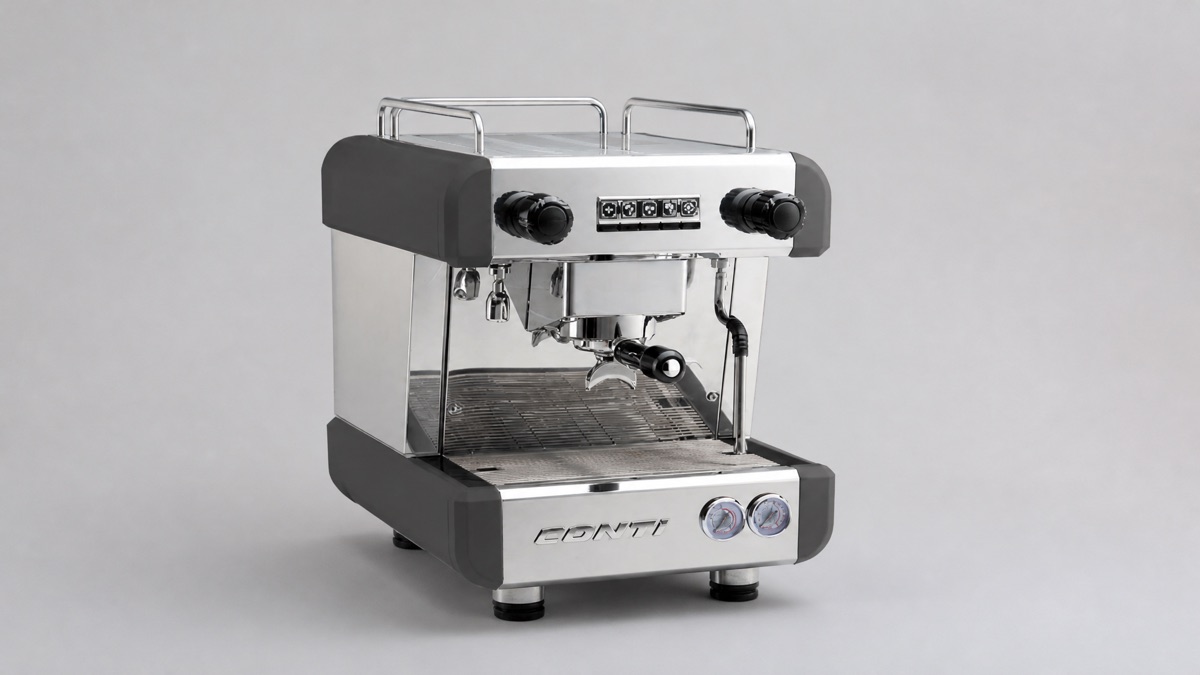
Hi, I'm Sam, and I make coffee all day. A Conti espresso machine is a commercial machine from Conti, a Monaco maker with over 65 years of history. The range runs from the single group ACE to 3 group cafe machines.
We have served the Toddy cold brew near the LIRR station for 14 years. Conti machines use PID temperature control, copper boilers and pre-infusion. The 110V ACE draws 2900 W at 26.3 amps, and a one group CC100 costs about $3,300.
The La Spaziale Mini Vivaldi II is lighter and plugs into a normal outlet. This review explains models, power needs and cost, sponsor free.
What Is a Conti espresso machine?
A Conti espresso machine is a commercial-grade machine from Conti, a Monaco maker with over 65 years of history. Conti builds its machines by hand in Monte Carlo and stays privately owned. Most models serve cafes, hotels and restaurants.
One model breaks that pattern. The ACE is a single group machine that Conti added for serious home baristas. Resellers list it as semi-commercial, with a compact footprint and a range of colors.
Because the ACE sits beside the commercial models, the name Conti covers a whole range, not one box. No independent owner review pool exists for these machines. The facts here come from maker pages, reseller pages and equipment catalogues.
Which Conti espresso machine Models Exist?
Conti espresso machine models include the CC100, CC202, NG-C, NG-E, NG-X, X-One TCi Evo, Monte Carlo, MC Ultima and ACE. The CC100 comes as a 1 group, 2 group compact, 2 group and 3 group machine. Colors are black, white and carmine red.
Conti Models at a Glance:
| Model | Groups | Use |
|---|---|---|
| CC100 | 1, 2 compact, 2, 3 | Cafe, retro design |
| CC202 | 2 | Cafe, replaced by NG-C |
| ACE | 1 | Serious home barista |
| MC Ultima | 2, 3 | Busy cafe or roaster |
Some of these models are on their way out. Conti announced in September 2024 that the NG-E would replace the CC100 and the NG-C would replace the CC202. The CC100 leaves the catalogue once that change is complete.
The Monte Carlo and the MC Ultima sit at the top of the range. Size grows with the group count. The MC Ultima 2 group measures 34 inches (86 cm) wide. The 3 group measures 43 inches (109 cm) wide.
How Does a Conti espresso machine Work?
A Conti espresso machine does its work by heating water in copper boilers, then pushing it through the coffee with a rotary pump. The CC100 compact adds a thermosyphon, a loop that moves hot water by heat alone. Heating is electric only.
On the ACE, water comes from the tank or the mains. The steam boiler preheats it on the way into the insulated brew boiler. A separate PID then sets the brew boiler temperature.
The ACE uses three heat zones. It has a 0.9 liter (0.24 gallon) coffee boiler, a 2.75 liter (0.73 gallon) steam boiler and a heated group. Water comes from the mains or a 1.7 liter (0.45 gallon) tank.
Eco mode drops the boiler to 60°C (140°F) when the machine idles. The machine then reaches working temperature faster at the next service. One reseller puts the power saving at up to 40%.
What Does PID Do in a Conti espresso machine?
A PID in a Conti espresso machine holds boiler temperature steady and lets the barista change it. PID stands for proportional-integral-derivative. The controller reads the boiler temperature and trims heater power to stay on target.
The group is the part of the machine that holds the portafilter. The Monte Carlo gives each group its own PID. Each group is controlled separately. So one group can run a light roast hotter than the next group runs a dark roast. The maker presents this as a way to suit coffees of different origin.
The maker rates the X-One TCi at plus or minus 1°C (1.8°F) at the cup. The CC100 range also uses a PID, and its temperature can be adjusted.
Does a Conti espresso machine Make Good Espresso?
Yes. A Conti espresso machine can make good espresso, because PID control and pre-infusion keep each shot steady. The claim rests on the design. No measured shot data from owners turned up in the sources found.
The Monte Carlo ships with competition-grade shower plates and baskets made by IMS. The maker says the tight hole sizes give an even extraction. The Monte Carlo's non-stick portafilters also resist coffee oil build-up.
The CC100 offers a tall cup option. The extra height under the group lets takeaway cups fit. The standard height suits ceramic cups.
Does a Conti espresso machine Pre-Infuse the Coffee?
Yes. The Conti espresso machine will pre-infuse the coffee, because the CC100 and the ACE both include a pre-infusion stage. The stage wets the coffee bed before full pressure arrives.
The ACE shows how the stage works. It uses a soft pre-infusion at 1 bar (14.5 psi), which comes from the remaining pressure inside the machine. The barista sets a pre-infusion time of up to 10 seconds.
Conti patented this soft infusion system. The maker says it copies the one-way pre-infusion of lever machines. A low pressure soak saturates the puck, and the maker claims more body and better mouthfeel.
Is a Conti espresso machine Good for Home Use?
No. A Conti espresso machine is not good for home use, apart from the single group ACE. Most models are 1 to 3 group commercial machines with large power needs.
Resellers pitch the CC100 to home enthusiasts for its retro design. The machine is still a commercial unit. Its size and power draw suit a cafe counter better than a kitchen.
The maker aims the ACE at the serious home barista. It comes as a 110V ACE-D and a 220V ACE-R. Both versions use the same compact body.
How Much Space Does a Conti espresso machine Need?
A Conti espresso machine needs counter space of 15.5 by 20.2 inches (39 by 51 cm) for the ACE. Larger models need more. The ACE footprint measures 394 by 512 mm.
Height limits where a machine can go, too. The CC100-1GR measures 15.7 inches (40 cm) wide and 20.2 inches (51 cm) deep. It stands 19.7 inches (50 cm) tall, so the height matters under wall cabinets.
Weight matters as well, because the counter must hold the machine. The 110V ACE weighs 112 pounds (51 kg).
The MC Ultima 2 group needs a 34 inch (86 cm) wide spot. The 3 group needs 43 inches (109 cm). A group is the spot where coffee is brewed.
What Power Does a Conti espresso machine Need?
A Conti espresso machine needs between 120V and 400V of power, depending on the model. The CC100-1GR runs on 120V single phase. The MC Ultima 2 group runs on 230V. The 3 group runs on 400V.
The 110V ACE draws 2900 W at 26.3 amps. A normal household circuit carries only 15 or 20 amps, which is less than the ACE pulls. The ACE therefore needs a dedicated circuit, and an electrician should check the panel before purchase.
The 220V ACE-R needs 220V power. A kitchen without a 220V outlet needs new wiring.
Plumbing is optional on the ACE because the tank can supply water.
Power by Model:
| Model | Voltage | Draw |
|---|---|---|
| CC100-1GR | 120V | Not listed |
| ACE-D | 110V | 2900 W, 26.3 A |
| MC Ultima 2 group | 230V | Not listed |
| MC Ultima 3 group | 400V | Not listed |
Is a Conti espresso machine Reliable?
Yes. A Conti espresso machine is reliable by design, though no long-term owner data confirms it. The build uses copper boilers and a metal casing and frame.
The maker calls the CC100 range solid, with easy maintenance. Hand assembly in Monte Carlo and 65 years of history add to the trust. These are maker claims, not test results, so they show intent rather than proof of how the machines last.
Warranty terms vary by seller. One dealer covers non-consumable parts for 12 to 24 months on new machines. Canadian dealers list 1 year. No long-term failure data from owners was found.
Can You Get Parts and Service for a Conti espresso machine?
Yes. Buyers can get parts and service for a Conti espresso machine through importers and trained engineers. The maker lists Conti engineers and technicians for servicing and a parts source for each model.
The CC100 manual includes a spare parts section with part diagrams. Each part in a diagram has a listed number. A buyer or engineer can order the exact part by that number.
Installation is a separate job from service. One UK reseller does not install machines. It connects buyers with local engineers instead.
No US factory service network turned up in the sources found.
How Does a Conti espresso machine Compare With Rivals?
A Conti espresso machine compares as a more commercial and costlier machine than home dual boiler rivals. Conti offers multi-group sizes and heavy builds. Home brands offer lighter bodies and plug-in power.
Home rivals in the dual boiler class include the Profitec Pro 700, the ECM Synchronika and the Lelit Bianca. Cafe rivals include the Nuova Simonelli Appia Life and the La Marzocco Linea PB.
The La Spaziale Mini Vivaldi II is a typical home rival. It is a dual boiler with a 3 liter (0.8 gallon) manual fill tank. It runs on a normal outlet.
The Conti ACE is the closest match. Both are single group machines with separate coffee and steam boilers. Their size, weight and power needs differ widely.
Is a Conti espresso machine Better Than the La Spaziale Mini Vivaldi II?
No. A Conti espresso machine is not better than the La Spaziale Mini Vivaldi II for most homes. The Vivaldi is lighter, cheaper and easier to power.
The Mini Vivaldi II weighs 62 pounds (28 kg). The Conti ACE weighs 112 pounds (51 kg).
Power use also differs. The Mini Vivaldi II draws 1250 W on 110V to 120V. The ACE draws 2900 W.
The ACE does have larger boilers. Its brew boiler holds 0.9 L (30 oz) and its steam boiler holds 2.75 L (93 oz). The Mini Vivaldi II has a 15 ounce (0.44 liter) brew boiler and a 40 ounce (1.2 liter) steam boiler. The brew boiler heats the water for the shot. The steam boiler makes steam for milk.
Retailers list the Mini Vivaldi II at $2,295 to $2,495, and it carries a 1 year limited warranty. No head-to-head test of the two machines was found.
ACE and Mini Vivaldi II Side by Side:
| Spec | Conti ACE | Mini Vivaldi II |
|---|---|---|
| Brew boiler | 0.9 L (30 oz) | 15 oz (0.44 L) |
| Steam boiler | 2.75 L (93 oz) | 40 oz (1.2 L) |
| Power | 2900 W | 1250 W |
| Weight | 112 lb (51 kg) | 62 lb (28 kg) |
How Much Does a Conti espresso machine Cost?
A Conti espresso machine costs about $3,300 for a one group CC100 and reaches five figures for big models. Prices differ by seller and country, so confirm the dollar price first.
These figures are US dollar listings seen in November 2026. Each seller changes its price over time, so the numbers can move.
The price buys a commercial build. It includes PID control, which holds the water temperature steady. It also includes copper boilers and pre-infusion, which wets the coffee gently before full pressure. A warranty covers the non-consumable parts.
The ACE is the exception. It had no final US dollar price at launch, and no US list price turned up. Dealers in Canada sell the 110V version at a clearly higher price than the CC100.
Where Can You Buy a Conti espresso machine?
You can buy a Conti espresso machine from specialty espresso dealers and commercial equipment suppliers. Conti sells through importers and resellers, not through its own shop.
US buyers can purchase the 110V ACE from resellers in Canada. Dealers in other countries sell the 220V and commercial models. Used machines also appear on marketplaces.
Installation is not included in the machine price. A dealer may arrange an engineer. Delivery of a heavy machine such as the 112 pound (51 kg) ACE needs a plan.
Is the Conti espresso machine Worth It?
Yes. The Conti espresso machine is worth it for a small cafe or office, not for a typical home. The build, PID control and pre-infusion justify the price in a working shop.
The price, weight and power draw count against it at home. The lack of US factory service and owner data adds risk. The ACE is the only model that fits a serious home setup.
A shop owner who wants a compact commercial machine gets a solid choice in the CC100 class. A home buyer gets better value from a lighter dual boiler.
Reasons to Buy:
- PID temperature control
- Copper boilers and a metal frame
- Pre-infusion on the CC100 and ACE
- Many sizes from 1 to 3 groups
Who Should Skip a Conti espresso machine?
Home buyers who want plug-in power skip a Conti espresso machine, because the 110V ACE draws 2900 W. A normal outlet cannot supply that load.
No US service network turned up, so buyers who want US factory service also skip it. Parts and repairs run through importers and local engineers instead.
No owner shot data or long-term failure reports turned up either. Buyers who want tested proof skip it as well. A rival with a long review history carries less risk.
Reasons to Skip:
- 2900 W power draw on the ACE
- Weight of 112 lb (51 kg)
- No US factory service found
- No owner test data found
Odradeks Coffee House is reader-supported. If you buy through a link on this page, we may earn a small affiliate fee at no extra cost to you.