Compak PK100 Grinder Review: Is It Worth It?
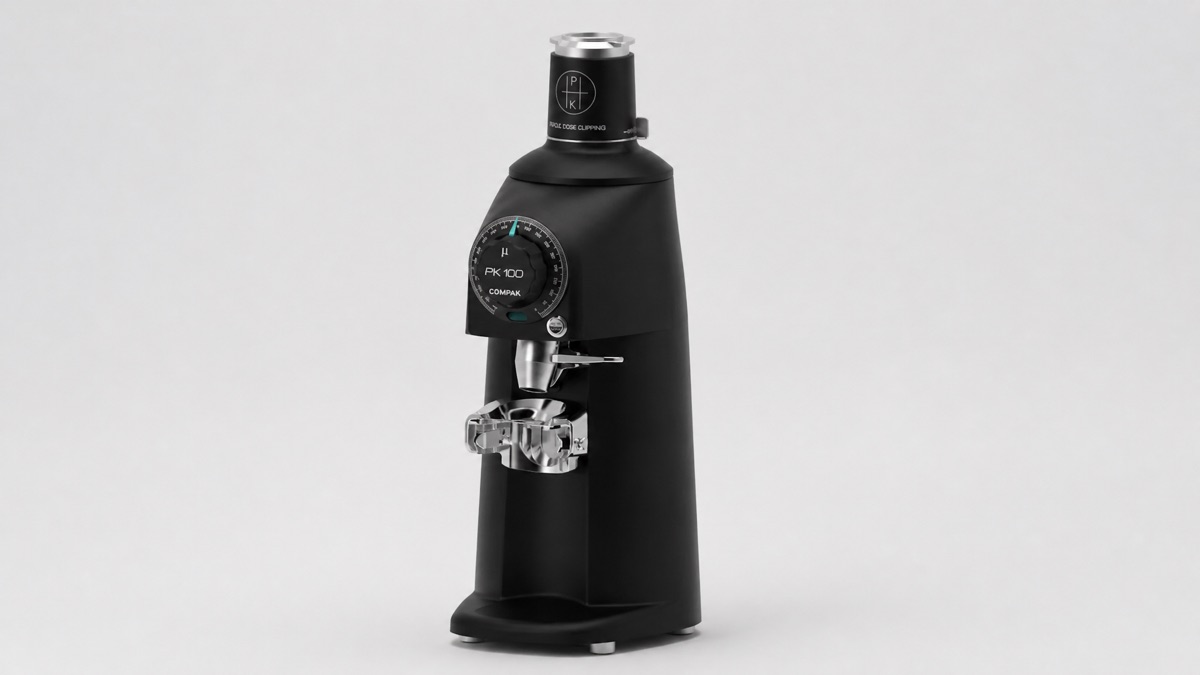
Thanks for finding this Compak PK100 review, I'm Sam. 14 years of running a shop help me judge the Compak PK100.
The Compak PK100 is a multipurpose flat burr grinder from the Spanish brand Compak. It uses 98 mm (3.9 in) burrs at a slow 900 RPM. The Shop version has a hopper, and the Lab version has a single dose cup. Cafes and coffee labs are its main buyers.
The PK100 grinds evenly for espresso, filter and cupping, with a clear and bright cup. Its retention is about 3 g (0.1 oz), well above the 0.5 g (0.02 oz) Compak claims. The grinder stands 62 cm (24.5 in) tall, weighs about 24 kg (53 lb) and runs at 75 dB.
The Kafatek Monolith Flat beats it on retention and price, and the Mahlkonig EK43S costs more. The Lab and Shop list for about $3,500 to $3,700 at US sellers, with a 12 month parts warranty. This review weighs those costs against the strengths and says who should buy it. This review is free of brand money, and link fees cost you nothing.
What Is the Compak PK100 Grinder?
The Compak PK100 grinder is a multipurpose flat burr grinder with 98 mm (3.9 in) burrs, built for espresso, filter, cupping and retail bags. Compak sells it in two versions, called Shop and Lab. Both run a slow motor and a stepless dial.
A stepless grinder has no fixed clicks, so the dial sets any grind size between its limits.
Flat burrs make a more even grind and a clearer cup than conical burrs. Conical burrs make more fines and a heavier body.
The PK100 is the first Compak grinder designed for single dosing. Single dosing means grinding one measured portion of beans at a time. The standard cup holds about 55 g (1.9 oz) of beans.
Compak launched the PK100 in 2019 as part of the PK line. The line has three machines:
- PKE: This model uses 83 mm (3.3 in) burrs at 350 RPM with a 950 W motor.
- PKF: Like the PKE, this model uses 83 mm (3.3 in) burrs at 350 RPM with 950 W motors.
- PK100: This model uses larger 98 mm burrs at 900 RPM.
Compak builds the PK100 for cafes and coffee labs. One owner database scores its beginner fit at 1 out of 5. A home buyer needs counter space and a large budget.
Who Makes the Compak PK100?
Compak makes the PK100, a Spanish grinder brand based in Barcelona with a United States office in New Jersey. The brand builds grinders for espresso bars, filter coffee and shops. The PK100 sits at the top of its range.
Jesus Ascaso founded Compak in Barcelona in 1952. He wanted quality coffee gear to be affordable. A 2019 trade report called Compak a 24-year-old company, so the sources disagree on its age.
Compak sells 22 espresso grinders in four classes. The multipurpose range holds the PK Series and the shop models R8, R120 and R140. The company lists ISO 14001, Food Contact and Ecotic certificates.
What Is the Difference Between the Compak PK100 Shop and Lab?
The Compak PK100 Shop and Lab differ mainly in how they hold beans. The Lab uses a single dose cup of 55 g (1.9 oz). The Shop adds a 750 g (26.5 oz) hopper. Both grind with the same 98 mm (3.9 in) burrs.
A hopper attachment is optional for the single dose model. The attachment suits filter batches and retail bags.
The hopper changes the size of the machine. The Lab stands 622 mm (24.5 in) tall. The Shop stands 690 mm (27.2 in) tall. The Lab weighs 25.4 kg (56 lb), and the Shop weighs 24.3 kg (53.6 lb). Both share a 252 x 328 mm (9.9 x 12.9 in) footprint, so counter width and depth stay the same. Only the height clearance differs.
Both versions share one duty cycle: 1 minute of grinding, then 3 minutes of rest.
PK100 Lab vs Shop:
| Spec | Lab | Shop |
|---|---|---|
| Bean holder | 55 g (1.9 oz) cup | 750 g (26.5 oz) hopper |
| Height | 622 mm (24.5 in) | 690 mm (27.2 in) |
| Weight | 25.4 kg (56 lb) | 24.3 kg (53.6 lb) |
| Burrs | 98 mm (3.9 in) flat | 98 mm (3.9 in) flat |
How Does the Compak PK100 Work?
The Compak PK100 works by grinding beans between horizontal flat burrs that turn slowly at 900 RPM. The slow speed keeps beans cooler than a fast grinder does. A constant cooling fan runs whenever the grinder is on.
Beans drop from the cup or hopper into the burrs, and a push button starts grinding. The grind takes time, so a universal fork holds the portafilter in place. The barista can step away and do other work during the grind.
The ground coffee then leaves through a chute. The chute has a static reducing clump breaker, which cuts down clumps as the grounds pass through. A lever knocker pushes the last grounds out of the chute. The chute is adjustable.
Compak's manual lists output for two grind types. Espresso grinds come out at about 350 g (12.3 oz) per minute. Filter grinds come out faster, at 600 g (21.2 oz) per minute. A 5.5 g (0.19 oz) espresso dose takes about 1 second.
PK100 Key Specs:
| Spec | Value |
|---|---|
| Burrs | 98 mm (3.9 in) flat steel |
| Burr speed | 900 RPM |
| Electrical power | 960 W at 110 V |
| Espresso output | 350 g (12.3 oz) per minute |
| Filter output | 600 g (21.2 oz) per minute |
| Sound level | 75 dB with coffee |
What Burrs Does the Compak PK100 Use?
The Compak PK100 uses 98 mm (3.9 in) flat steel burrs with a blind mounting design. The vendor lists the steel as high strength k100 steel. Compak says the burrs target high extraction yield.
Blind burrs have partial holes in their backs. The holes attach each burr to its carrier without screws. No screw hole interrupts the cutting surface. Compak says this lowers retention and evens out the particles.
Compak's manual suggests replacing steel burrs after about 9,000 kg (19,800 lb) of coffee. The figure assumes medium hardness bean mixtures. A qualified technician should change the burrs because the work needs precision.
The burrs lean toward clarity and sparkle in the cup. Bright washed single origins show this character best. Heavy, syrupy body is not the PK100's strength.
How Does the Compak PK100 Adjust Grind Size?
The Compak PK100 adjusts grind size with a stepless micrometric dial on the front. Stepless means the dial has no fixed stops, so the grind can be set at any point along its range. The dial has marked increments, and the range runs from Turkish grind to French press grind.
The grinder must be running when the dial moves. Owners set the dial while the burrs turn.
All settings count from a starting point, which is point 0. Compak's manual shows how to reset it. The user turns the dial until the burrs lightly touch and make a humming sound. Every later setting is measured from that spot.
The adjustment collar feels stiff. Very small changes take effort compared with smoother stepless designs. The scale still reaches much finer than regular espresso needs.
How Well Does the Compak PK100 Grind?
The Compak PK100 grinds well, with an even particle size across espresso, filter and cupping settings. Large slow burrs give a uniform particle size. The cup tastes bright and clear. Owner scores rate its brew versatility 5 out of 5.
Fines are very small bits of coffee that can cloud a cup. The PK100 produces some. One cafe measured more fines from it than from its old Mahlkonig EK43. That same cafe still rated the clarity of flavor as outstanding after more than a year of use.
A slow-turning grinder might be expected to work slowly, but the PK100 does not. A retailer lists 5.5 g (0.19 oz) per second for espresso and 10 g (0.35 oz) per second for filter. At those rates, a shop can fill a retail bag in minutes.
Does the Compak PK100 Grind Well for Espresso?
Yes. The Compak PK100 grinds well for espresso, with even shots and good crema. Owner scores rate its espresso suitability 4 out of 5.
The reason is the stepless dial, which reaches fine settings. A stepless dial has no fixed clicks, so the grind can change by tiny amounts. The scale also goes finer than regular espresso needs. A Mahlkonig EK43 often runs at its lowest setting for espresso. The PK100 leaves more room to dial in finer shots.
Even so, most cafes with a PK100 use it for filter, cupping or retail bags. They keep a separate on-demand grinder for espresso. The PK100 suits a shop that wants one grinder for many brew methods.
Bright light roasts and washed single origins suit the burrs best. A new owner should expect a week of dial-in, which means adjusting the grind until the shots taste right. Stale beans make dialing in harder.
How Much Coffee Does the Compak PK100 Retain?
The Compak PK100 retains about 3 g (0.1 oz) of coffee between doses in independent scoring. Compak claims under 0.5 g (0.02 oz). The two figures differ by a factor of six.
The grinder uses blind burrs, a clump breaker chute and a lever knocker to cut retention. This hardware helps. The burr chamber is large, though, and it still holds some grounds.
A cafe that owns a PK100 wrote that the grinder retains a bit of grind and can be messy. The same cafe praised its clarity.
Retained grounds matter most when the beans change. Old grounds mix with the new beans, so a swap needs a purge of a few grams. Compak's manual says to discard the first 2-3 doses after a deep clean. A user who changes beans daily wastes more coffee.
Is the Compak PK100 Too Big for Home Use?
Yes. The Compak PK100 is too big for most home kitchens, standing 622 mm (24.5 in) tall as the Lab. The Shop stands 690 mm (27.2 in) tall. The footprint measures 252 x 328 mm (9.9 x 12.9 in).
The Lab sits about 17 cm (6.7 in) too tall for standard upper cabinets. A buyer needs an open stretch of counter. The grinder weighs about 24 kg (53 lb), so moving it is a job.
The PK100 can shake while running. Its height also makes the hopper gate a long reach for shorter staff. A step stool may be needed with the hopper attachment.
The United States version runs on 110 to 120 V. Compak lists 960 W of electrical power at 110 V. A standard wall outlet supplies enough power.
How Loud Is the Compak PK100?
The Compak PK100 is moderately loud, rated at 75 dB with coffee in the hopper. Compak lists the figure in the manual. Owner scores rate its noise 2.5 out of 5.
The PK100 is far quieter than a Mahlkonig EK43. A cafe that tested both said the EK43 roars with any quantity of beans. The PK100 sounds close to a regular on-demand grinder.
The duty cycle limits running time. Compak sets 1 minute of grinding followed by 3 minutes of rest. A long grind run needs pauses.
NIOSH recommends an exposure limit of 85 dBA averaged over an eight-hour day. A PK100 espresso dose of 18 g (0.6 oz) runs about 3 seconds at 350 g (12.3 oz) per minute. Home use stays far below that limit.
How Do You Clean the Compak PK100?
The Compak PK100 needs a weekly chamber clean with Compak cleaning product. The user grinds out the beans, loads 60 g (2.1 oz) of cleaner into the cup and grinds it at a medium setting. Then the user refills with coffee.
Coffee oils and remains build up in the grinding chamber and spoil flavor. The cleaner removes them. The first 2-3 doses after a clean go in the bin. The user then sets the grind size again.
Oil also coats the cup and hopper once the beans run out. A damp cloth or soap and water removes this residue. The user must rinse and dry the cup before refilling.
The grinding system itself is a different matter. Compak does not recommend taking it apart except to change burrs, and a qualified technician should do that job. The user must never submerge the grinder or use a water jet.
Weekly Chamber Clean:
- Grind out the beans left in the chamber.
- Load 60 g (2.1 oz) of Compak cleaning product into the cup.
- Grind all of the cleaner at a medium setting.
- Clean the hopper or cup and refill with coffee.
- Discard the first 2-3 doses and set the grind size again.
How Often Should You Clean the Compak PK100?
The Compak PK100 needs cleaning often, so clean the chamber once a week and the nozzle at least once a month. Compak warns that skipped cleaning hurts flavor and aroma, so the weekly clean protects the taste of every cup.
The coffee outlet is where ground coffee exits the grinder. A tubular brush cleans it. A clean outlet keeps doses consistent.
The outside of the grinder needs care too. A dry brush removes loose grounds first. A cloth lightly moistened with soap and water then wipes the surface. The user must unplug the grinder before any cleaning.
The burrs wear down with use, so they need replacement about every 9,000 kg (19,800 lb) of coffee. A shop that grinds 20 kg (44 lb) a day reaches that mark in about 15 months. A busier shop reaches it sooner, and a slower shop takes longer.
Cleaning Schedule:
| Task | How often |
|---|---|
| Grinding chamber clean | Weekly |
| Coffee outlet brush | At least monthly |
| Burr replacement | About every 9,000 kg (19,800 lb) |
Compak PK100 vs Mahlkonig EK43S and Kafatek Monolith Flat?
The Compak PK100 costs less than the Mahlkonig EK43S and brews more ways than the Kafatek Monolith Flat. The Monolith retains less coffee, runs quieter and costs less. The EK43S has the longer service record.
The PK100 and EK43S share 98 mm (3.9 in) burrs. The Monolith Flat uses smaller 75 to 80 mm (3.0 to 3.1 in) burrs. The Monolith is also a true single-doser with a 40 g (1.4 oz) hopper.
The PK100 leads on brew range, scoring 5 out of 5 against 3.5 for the Monolith. The Monolith leads on espresso duty, retention and noise. Both lean toward a clear, sparkling cup.
Three Grinders Compared:
| Spec | PK100 | EK43S | Monolith Flat |
|---|---|---|---|
| Burr size | 98 mm (3.9 in) | 98 mm (3.9 in) | 75 to 80 mm (3.0 to 3.1 in) |
| Retention | About 3 g (0.1 oz) | Not stated | About 0.5 g (0.02 oz) |
| Hopper | 55 g or 750 g | About 800 g (28 oz) | 40 g (1.4 oz) |
| Price | US$2,000 to US$3,400 | US$3,899 to US$5,350 | US$2,650 |
Compak PK100 vs Mahlkonig EK43S?
The Compak PK100 runs quieter than the Mahlkonig EK43S and costs less. Both use 98 mm (3.9 in) flat burrs, the metal discs that grind the coffee. The EK43S adds a 1300 W motor. It also has a shorter body made to fit under a cabinet.
The EK43S costs US$3,899 to US$5,350. The PK100 spans US$2,000 to US$3,400 across sellers. The EK43S carries the longer service record and a bigger name.
The EK43S spins its burrs at 1,760 RPM on 60 Hz power. That is almost twice the 900 RPM of the PK100's horizontal burrs. A cafe that swapped an EK43 for a PK100 reported more fines, which are the tiny coffee particles. The same cafe liked the clarity better.
The EK43S weighs 24.5 kg (54 lb), close to the PK100. Its standard hopper holds about 800 g (28 oz).
Compak PK100 vs Kafatek Monolith Flat?
The Kafatek Monolith Flat retains less coffee than the Compak PK100 and costs US$2,650. The Monolith retains about 0.5 g (0.02 oz). The PK100 retains about 3 g (0.1 oz). Retention is the ground coffee that stays inside a grinder after use.
The Monolith is a CNC machined single-doser with 75 to 80 mm (3.0 to 3.1 in) Shuriken burrs. Its hopper holds 40 g (1.4 oz).
The two machines also differ in height. The Monolith tower stands 35.5 cm (14 in) tall. The PK100 Lab stands 62.2 cm (24.5 in) tall.
The PK100 leads on brew range and takes bigger batches. The Monolith leads on espresso, retention, noise and price. A buyer who brews only espresso at home gets more from the Monolith.
Burr size can change between Monolith units. Kafatek first sold the Monolith Flat with 75 mm (3.0 in) burrs. Later versions use 80 mm (3.1 in) burrs. A buyer should confirm the burr size of the exact unit.
How Much Does the Compak PK100 Cost?
The Compak PK100 costs $3,595.20 for the Shop at one US retailer. One price tracker lists US$2,000 to US$3,400. Prices vary by version, seller and region.
The PK100 Lab lists at $3,504 to $3,714 at US sellers. The optional 750 g (26.5 oz) hopper is sold as an add-on. The two versions and the add-on are priced separately. Buyers should price the Shop and the Lab on their own.
Freight shipping applies. One retailer ships the grinder on a pallet by truck.
After purchase, running costs stay modest. Compak cleaning product is needed weekly. Burrs, the parts that grind the beans, need replacing about every 9,000 kg (19,800 lb) of coffee. Burr changes require a technician.
What Does the Compak PK100 Warranty Cover?
The Compak PK100 warranty covers parts for 12 months on new grinders. The term suits commercial use, since Compak sells the PK100 mainly to shops.
One US retailer lists a one year parts-only warranty on commercial equipment. That means repairs cover replacement parts only. The same retailer adds a free one year warranty, a $99 value. Terms differ by seller, so a buyer should check them before ordering.
Plugging the grinder into a surge protector, power strip or extension cord voids that retailer's warranty. A new owner should plan to use a wall outlet. Commercial equipment also cannot be returned or exchanged. A buyer must be sure before the order ships.
Is the Compak PK100 Worth It?
Yes. The Compak PK100 is worth it for a shop or serious home user who brews several ways. The flat burrs give clarity, the build is strong, and the noise is lower than an EK43.
The PK100 earns 5 out of 5 for build and 5 out of 5 for brew versatility. The 98 mm (3.9 in) burrs and slow 900 RPM motor suit filter, cupping and retail bags.
The costs are real. The PK100 retains about 3 g (0.1 oz), stands 62 cm (24.5 in) tall and costs over $3,000 in some stores. The collar is stiff, and some buyers report alignment problems that need fixing.
Pros:
- Strong build and 5 out of 5 brew versatility
- Clear, bright cup from slow flat burrs
- Quieter than a Mahlkonig EK43
Cons:
- About 3 g (0.1 oz) of retention
- Tall, heavy and hard to move
- Stiff adjustment collar
- Price above $3,000 at many sellers
Total cost is the purchase price plus freight, weekly Compak cleaning product and a technician for burr changes. Commercial equipment cannot be returned, so a buyer must be sure before ordering.
Who Should Skip the Compak PK100?
Home espresso drinkers with small counters should skip the Compak PK100. The Kafatek Monolith Flat leads on espresso duty, retention and price. The PK100 fits a shop better than a kitchen.
Beginners should also skip it. Owner scores rate its beginner fit 1 out of 5. The PK100 expects a user who cleans weekly and dials in with patience. Dialing in means adjusting the grind until the shot tastes right.
Buyers who swap beans often should skip it too. Each swap needs a purge of a few grams, which clears the old beans left inside the grinder. That leftover amount is called retention. A grinder with lower retention wastes less coffee.
Odradeks Coffee House is reader-supported. If you buy through a link on this page, we may earn a small affiliate fee at no extra cost to you.