Comandante C40 Review: Is It Worth It?
Hey, coffee friends, Sam here. The batch brew on our Midwood menu tells me what hand coffee grinders need to do. I cover grind consistency, grinding speed and grind settings. Some links pay us a fee, but no brand bought my verdict.
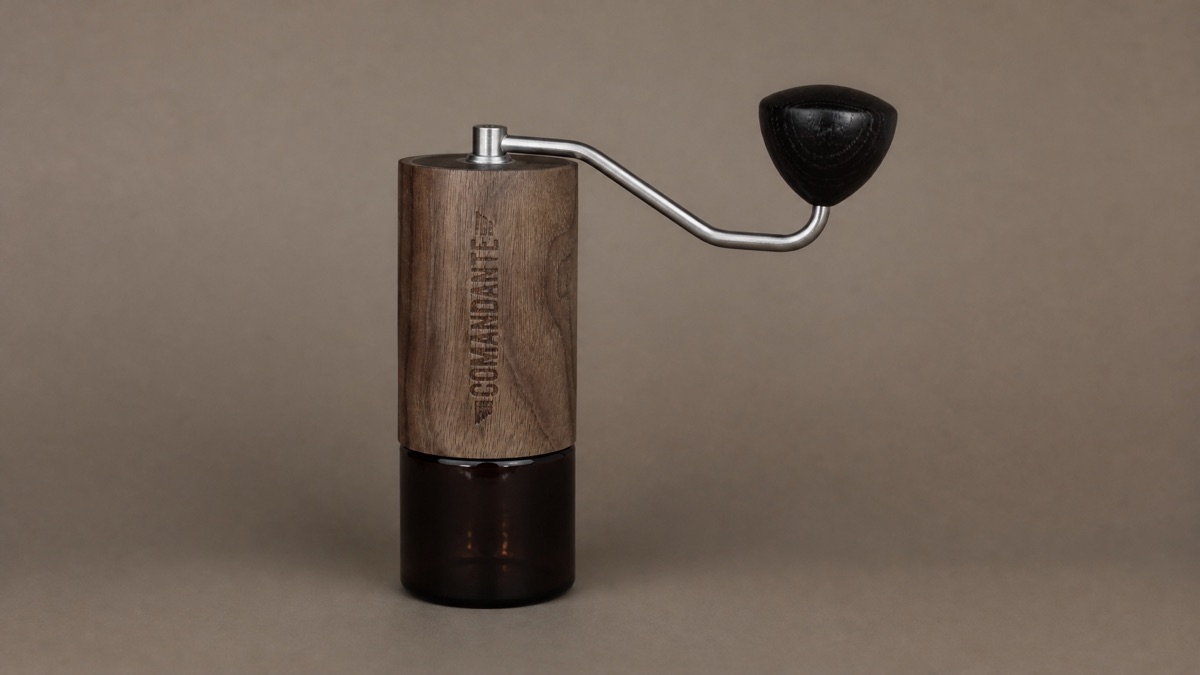
The Comandante C40 is a premium German hand coffee grinder with 39 mm conical burrs. The C40 first appeared in 2013, and the MK4 is the current version.
The C40 grinds very evenly and keeps little coffee behind. It also runs quietly and feels built to last for years. Speed is its weak point, and espresso needs the Red Clix upgrade. The wide body and the missing numbered dial annoy some owners.
Rivals such as the 1Zpresso J-Ultra cost less and adjust more easily. The C60 Baracuda grinds faster for far more money. Read on to learn who should buy the C40 and who should pick something else.
What Is the Comandante C40?
The Comandante C40 is a premium German hand coffee grinder with 39 mm conical burrs and a stainless steel body. The first C40 appeared in 2013. The name comes from its capacity of about 40 g (1.4 oz) of beans.
The Comandante brand grew out of a specialty roastery. Bernd Braune and his family founded the Supremo roastery outside Munich in 2005. The Comandante trademark was registered in 2012, and production began in 2013.
The first-generation C40 used different burrs and was not a big success. The MK3 version added Nitro Blade burrs in 2016. Nitro Blade is the maker's name for its burr set, cut from high-nitrogen stainless steel.
The C40 suits pour over, AeroPress and French press best. Espresso needs the optional Red Clix kit. The grinder is hand-cranked with no motor or battery, so it also works for travel.
What Changed in the Comandante C40 MK4?
The Comandante C40 MK4 changed the jars, the axle support and the finishes while keeping the MK3 core. The box now holds a brown glass jar and a clear polymer-glass jar. One screw-on lid fits both jars.
The MK3 trapped small beans in a hole near the handle lock. The MK4 redesigned the internal axle support so beans fall into the chamber. A single stuck bean could cost 1 g of an 18 g dose.
The core build is unchanged, so MK3 parts still fit. The clear glass catcher from an MK3 screws onto an MK4. Owners can mix jars and handles across both versions.
Main MK4 Changes:
- Two jars, brown glass and clear polymer-glass
- Redesigned axle support that stops small beans sticking
- Many finishes, including three wood veneers
The MK4 comes in many finishes. Three use real wood veneer: American Cherry, Liquid Amber and Virginia Walnut. Black, Alpine Lagoon, Copper Mountain and Sunset are the non-wood finishes.
What Are the Comandante C40 Specs?
The Comandante C40 specs include 39 mm heptagonal conical burrs, a 40 g bean capacity and a stepped grind dial. The burrs use high-nitrogen stainless steel with micro-teeth cut into each blade. Some listings round the burr size to 38 mm.
The capacity is about 40 g (1.4 oz). Large beans fill the jar sooner, and small beans fit more. Both included jars hold about 40 g of beans.
That small load fits a body that is still fairly big. The grinder stands about 16 cm (6.3 in) tall and 6 cm (2.4 in) across. Listed weight is about 740 g (26 oz), though some reviews give 600 g (21 oz). The wide body is chunkier than most rivals.
The grind dial sits under the grinder and gives 40 clicks of range. Each click moves the burrs 25 to 30 microns, so the grind changes in small, fixed steps. The wooden handle knob attaches to the body with a magnet.
Comandante C40 Specs:
| Spec | Value |
|---|---|
| Burrs | 39 mm heptagonal conical Nitro Blade |
| Capacity | About 40 g (1.4 oz) |
| Height | 16 cm (6.3 in) |
| Weight | 740 g (26 oz) listed |
| Click size | 25-30 microns |
Is the Comandante C40 Well Built?
Yes. The Comandante C40 is well built, with a stainless steel body, ball bearings and a wood or metal finish. Reviewers rank it among the best-made hand grinders. One owner reports no wobble after two years of daily use.
The internal stabilizing arms and the lid are plastic, and the glass jar can break if dropped. CoffeeGeek would prefer a metal lid. Another tester calls the plastic on the grinding arm flimsy.
Replacement parts are sold separately and cost little. A broken jar or handle does not end the grinder's life.
Warranty terms are less clear. Retailer listings disagree, from 2 years to lifetime cover on the burrs. A buyer should confirm the term with the seller.
Is the Comandante C40 Hard to Hold and Turn?
Yes. The Comandante C40 is hard to hold for small hands and hard to turn at fine settings. The body is wide and a little slippery. The box includes a rubber grip ring for that reason.
Turning effort depends on the setting. Grinding finer than about 20 clicks took real torque from one tester, who used the whole torso. Above 20 clicks, the crank turned easily.
Time also depends on the setting. A full jar at 20 clicks took 3 minutes 8 seconds in one test. The handle spins smoothly on double bearings. The grinder is also quiet, so early mornings are no problem.
How Does the Comandante C40 Perform?
The Comandante C40 performs best on filter coffee, with high consistency, low retention and slow speed. Reviewers score consistency between 9 and 9.5 out of 10. Pour over is the grinder's strongest use.
Cup quality is clean. Light roasts show clear acidity, defined fruit and clean sweetness. Low hand speed means less heat and fewer ultra-fine particles.
One tester compared the C40 with a 1Zpresso K-Max in A/B tests and could barely tell the cups apart. The Comandante showed a slight edge in clarity. The K-Max had a little more body.
Speed is the main weakness. The C40 is among the slowest premium hand grinders. Static is low, and the glass jar holds less charge than the polymer jar.
Is the Comandante C40 Grind Consistent?
Yes. The Comandante C40 grind is very consistent across its range. A Kruve sieve sorts grounds by particle size. A test on 5 g batches showed big jumps between sieve sizes. That pattern marks an even grind. At 20 clicks, 80% of grounds passed 500 microns and 100% passed 800 microns.
Fine settings stay tight too. At 12 clicks, 1% of grounds passed 300 microns and 95% passed 500 microns. Extra micro-teeth cut into the blades help at fine settings.
A second sieve test compared the C40 with other grinders. The C40 was more uniform than the Timemore Slim and slightly better than the 1Zpresso JX. It also beat the DF64 electric grinder.
A modified Wilfa Uniform with SSP burrs was more uniform than the C40. That grinder costs more and needs modifying. Cup quality between the top grinders differed little.
How Fast Is the Comandante C40?
The Comandante C40 is not fast, taking about 40 to 50 seconds for 20 g of AeroPress coffee. A 1Zpresso JX finished the same dose in 23 seconds. Testers call the C40 the slowest premium hand grinder.
Espresso settings take longer. An 18 g espresso dose takes about 1 minute 10 seconds. A 16 g dose took about 1 minute in another test.
A pour over dose takes 30 to 45 seconds. The C60 Baracuda finishes in about 20 seconds. Speed is the price of tight burr spacing and a small 39 mm burr.
Does the Comandante C40 Retain Grounds?
Yes. The Comandante C40 does retain grounds, but only about 2.75% of the dose in one test. An 18 g dose lost 0.4 g (0.014 oz). The full 50 g load lost 1.8 g (0.06 oz), or 3.6%.
A long-term owner reports almost no loss on 18 g doses. Because so little stays behind, most users need no purge between beans.
Knocking the grinder on the counter shakes off charged grounds. Empty the burrs by hand when switching between very different coffees.
A full 50 g load is not advised. The jar cannot hold that much ground coffee.
What Grind Settings Does the Comandante C40 Use?
The Comandante C40 uses grind settings counted in clicks from a zero point. Turn the dial finer until it stops. That stop is zero, and each click coarser is one click.
The dial has no numbers, so a tester must recount from zero to return to a setting. Counting to 65 clicks on the Red Clix dial is tedious and easy to miscount. Each click is 25 to 30 microns, so the steps are fairly wide.
Tested starting ranges are 9 to 12 clicks for espresso and 12 to 15 for the moka pot. AeroPress uses 14 to 24 clicks. Pour over uses 20 to 32 clicks, and French press uses 30 to 34. The table below lists these ranges.
Tested Starting Ranges:
| Brew Method | Clicks |
|---|---|
| Espresso | 9-12 |
| Moka pot | 12-15 |
| AeroPress | 14-24 |
| Pour over | 20-32 |
| French press | 30-34 |
The maker's own ranges differ a little. Turkish coffee runs 0 to 10 clicks, and cold brew runs 35 to 40.
Is the Comandante C40 Good for Espresso?
No. The Comandante C40 is not good for espresso without the Red Clix upgrade. Each click is 25 to 30 microns. Espresso needs very fine control, so the right setting often falls between two clicks. CoffeeGeek calls this the main flaw.
The Red Clix kit fixes that gap. It swaps in an upgraded axle and dial. Each click then drops to about 15 microns, and the number of settings doubles. The kit fits both the MK3 and MK4 and costs $45 to $49.
Speed also limits espresso. An 18 g shot dose takes over a minute. Competition baristas have still won titles with a C40 fitted with Red Clix.
How Do You Clean and Maintain the Comandante C40?
The Comandante C40 is easy to clean and maintain with a dry brush and an occasional teardown. Click the dial to zero, unscrew the dial and lift out the burr. Brush the chamber and burrs clean with a small brush.
Cleaning Steps:
- Click the dial to zero.
- Unscrew the dial.
- Lift out the burr.
- Brush the chamber and burrs clean.
- Wipe the parts with a dry cloth.
Keep water away from the burrs, and never use a dishwasher. Wipe the parts with a dry cloth. The fixed burr screws are too tight to remove often.
A quick brush every few grinds keeps oils from building up. A full teardown every 4 to 6 weeks keeps the grind fresh. Another guide suggests brushing the burrs every 30 days.
Comandante sells a Burr Care Set built around ADDINOL White Oil. The set is hard to find in the US. A plain brush and a little of the same oil do the same work.
How Long Do Comandante C40 Burrs Last?
The Comandante C40 burrs last for years of daily use, and some reviewers expect a lifetime. High-nitrogen stainless steel resists pressure and wear. The alloy holds an edge longer than standard stainless steel.
That durability shows up in the reviews. No review reports burr wear. One owner has ground almost daily for two years with no drop in quality.
A home user rarely grinds enough to wear out the steel.
One review lists missing replacement burrs as a con.
A warranty helps cover that gap. Retailer listings describe the burrs as covered by a warranty that runs from 2 years to lifetime. Confirm the exact term with the seller.
How Does the Comandante C40 Compare to Rivals?
The Comandante C40 must compare against cheaper, faster rivals from 1Zpresso, Timemore and Kingrinder. Those rivals add numbered external dials and finer steps. The Comandante keeps the edge in build feel and cup clarity.
The 1Zpresso K-Max has 22 micron steps and a magnetic catch cup. It also grinds faster. A tester found cups from the two grinders hard to tell apart.
The Comandante C60 Baracuda is the maker's own faster model. It weighs nearly 1 kg (2.2 lb) and costs far more. Cheaper picks include the Kingrinder K6 at about $109 and the Timemore C3 ESP Pro at about $79.
Approximate Prices:
| Grinder | Price |
|---|---|
| Comandante C40 MK4 | From $277 |
| 1Zpresso J-Ultra | About $199 |
| Kingrinder K6 | About $109 |
| Timemore C3 ESP Pro | About $79 |
| Comandante C60 Baracuda | $649 |
Comandante C40 vs 1Zpresso J-Ultra: Which Is Better?
The 1Zpresso J-Ultra wins on price, speed of use and adjustment, while the Comandante C40 may win on pour over cup quality. The J-Ultra costs about $199, against $277 or more for the C40.
The J-Ultra also wins on adjustment. It has 8 micron steps and an external numbered dial. Its 350 clicks of usable range are easy to navigate. Each setting has a number that can be found again.
The J-Ultra body is slimmer, which suits small hands. It covers the same brewing range.
The C40 may make a slightly better pour over cup, though taste is subjective. One reviewer prefers the Comandante for espresso flavor. Most reviewers still pick the J-Ultra for ease of use.
Comandante C40 vs Comandante C60: Which Is Better?
The Comandante C60 is better than the Comandante C40 for speed but costs far more. A C60 finishes a pour over dose in about 20 seconds. The C40 needs 30 to 45 seconds.
The C60 uses a larger Baracuda burr and a single block of stainless steel. The C60 weighs nearly 1 kg (2.2 lb), while the C40 weighs under 750 g (26 oz).
The C60 has no internal plastic and cleans more easily.
The C40 costs from $277. The C60 costs $649, and one source puts it near $1,000.
C40 vs C60:
| Trait | C40 | C60 |
|---|---|---|
| Pour over time | 30-45 seconds | About 20 seconds |
| Weight | Under 750 g | Nearly 1 kg |
| Price | From $277 | $649 |
How Much Does the Comandante C40 Cost?
The Comandante C40 costs from $277 for the cheapest finish and $323 for the walnut version. Prices come from the US Amazon listing. The finish sets the price.
European prices run from about 200 to over 270 euros. Older reviews quote $400 to $500. Prices have varied with currency and finish over the years.
Add-ons raise the total. Red Clix costs $45 to $49. With Red Clix the full system costs 30% to 35% more than a 1Zpresso K-Max.
Resale value stays strong because of the build. Owners recover a good part of the price when they upgrade. Spare jars and handles cost little.
Is the Comandante C40 Worth the Price?
Yes. The Comandante C40 is worth the price for filter brewers, and not for espresso drinkers. One review scores value 7 out of 10 and overall 8.2 out of 10. Another scores it 9 out of 10 overall.
Tom's Guide named it an Editor's Choice. The reviewer called the price of about $300 the one con. Build quality justified the cost for that tester.
Cheaper grinders perform as well in some tests, so the high price is the main reason to hesitate. The 1Zpresso J-Ultra costs about $199, the Kingrinder K6 about $109 and the Timemore C3 ESP Pro about $79. The C40 is also slow and has no numbered dial.
Is the Comandante C40 Worth It?
Yes. The Comandante C40 is worth it for filter coffee drinkers who want a durable, quiet grinder with low retention. It makes clean pour over, AeroPress and French press coffee. The build lasts for years.
The grind itself is clean and consistent. Low retention means little coffee stays stuck inside the grinder after use. The grinder is also quiet.
Who Should Buy the Comandante C40?
Filter coffee drinkers should buy the Comandante C40, and espresso drinkers and small hands are better served by other grinders. Espresso drinkers need Red Clix and a slow minute of cranking.
Small hands struggle with the wide body. The C40 has no numbered dial, so it is hard to note a setting and return to it.
Other grinders fit those needs better. Buyers who want a numbered dial should look at the 1Zpresso J-Ultra. Buyers who grind large doses should look at the C60. Everyone else gets an excellent filter grinder that costs more than it needs to.
Pros:
- Clean, consistent grind
- Low retention
- Durable build
- Quiet operation
Cons:
- Slow grinding
- No numbered dial
- Wide body for small hands
- Weak for espresso without Red Clix
Odradeks Coffee House is reader-supported. If you buy through a link on this page, we may earn a small affiliate fee at no extra cost to you.