Chefman Coffee Grinder Review: Is It Worth It?
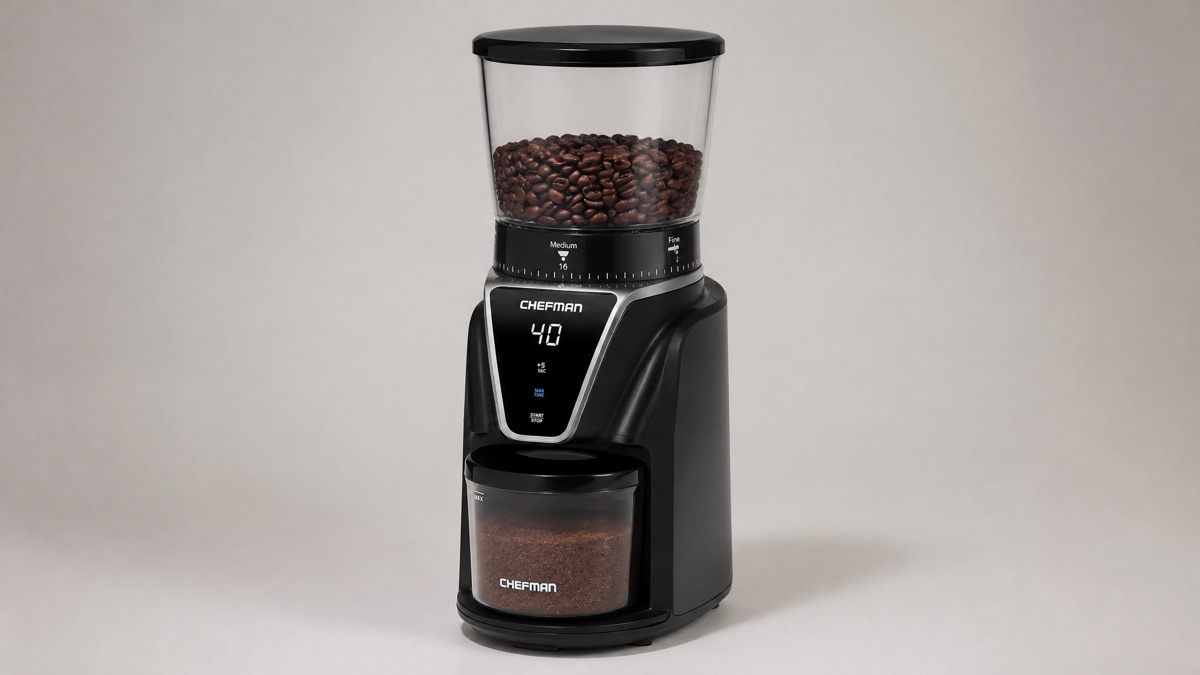
Hello, I'm Sam, from Odradeks. The Chefman grinder is a budget countertop burr grinder. Chefman sells it in several models, including the 31 setting RJ44-SS-TCB and the 40 setting RJ44-CB. This review covers the conical burr models, what they cost and how Chefman's older burr mill performed in testing.
Many years before my shop opened, Mahlkönig registered its name in Hamburg in 1924. The conical models grind fresh beans better than pre-ground coffee. They offer a countdown timer, a removable burr and, on one model, portafilter grinding. Static, fine dust and loud noise are the trade-offs. The grind is too uneven for espresso, which makes drip and press the right jobs.
Still not sure? I explain grind settings, static and noise and my verdict for home baristas. The Chefman grinder is worth it for drip, pour-over and French press on a low budget. Independent testing of the newer models is thin, so the review marks what is measured and what is only listed.
What Is the Chefman Grinder?
The Chefman grinder is a countertop electric burr grinder with a plastic and stainless steel body, sold under Chefman's coffee line. The conical burr versions hold 7.1 to 9.7 oz (200 to 275 g) of beans and carry a 1-year assurance.
A conical burr grinder crushes whole beans between a cone-shaped burr and a ring. Because the beans are crushed instead of chopped, the grounds come out more even. A blade grinder chops beans at random, so its grounds vary more in size.
Chefman sells several grinders under one brand, so the models differ. The newer conical burr models add a stainless steel burr, a countdown timer and a wider range of grind sizes. The older flat burr mill has none of these.
The conical burr models also carry cETL approval. They run on standard 120 V household power. Chefman rates them for household use only, not for shop use.
Which Chefman Grinder Models Exist?
Five Chefman grinder models exist in the document library: RJ44, RJ44-CB, RJ44-OPP, RJ44-SQ and RJ44-SS-TCB. The RJ44-CB and RJ44-SS-TCB are the two conical burr models.
The older RJ44 electric burr mill has 17 settings and an 8 oz (227 g) hopper. A cup dial sets the amount from 2 to 12 cups.
The RJ44-SS-TCB has 31 grind sizes and a digital timer. Its hopper holds 9.7 oz (275 g), and its listed motor power is 165 W.
The RJ44-CB has the most settings, with 40. Its hopper is smaller at 7.1 oz (200 g), and its grounds container holds 3.9 oz (110 g). Chefman rates its motor at 120 W.
Model Summary:
| Model | Settings | Hopper |
|---|---|---|
| RJ44 | 17 | 8 oz (227 g) |
| RJ44-SS-TCB | 31 | 9.7 oz (275 g) |
| RJ44-CB | 40 | 7.1 oz (200 g) |
How Does the Chefman Grinder Work?
The Chefman grinder works by crushing beans between a conical burr and a ring, then dropping the grounds into a container. A dial under the hopper sets the grind size.
The RJ44-SS-TCB adds an adjustable timer. The user sets the grind time and presses start. The display then counts down.
The container has a MAX line. Grounds above that line back up into the machine and block the grinding path.
An overheat cutoff powers the RJ44-SS-TCB off after 3 minutes of nonstop running. The user unplugs the grinder and waits 30 minutes before the next use.
How Many Grind Settings Does the Chefman Grinder Have?
The Chefman grinder has 31 grind settings on the RJ44-SS-TCB and 40 on the RJ44-CB. The older RJ44 mill has 17.
The RJ44-SS-TCB manual ties each number to a brew method. Lower numbers give finer grounds, so the finest settings suit the methods that need the smallest particles.
The manual groups the settings into six brew methods, as the table shows. French press uses 31 to 26, and pour-over uses 25 to 19. Drip uses 18 to 11, and siphon uses 10 to 6. Espresso uses 5 to 3, and Turkish coffee uses 2 to 1.
RJ44-SS-TCB Settings by Brew Method:
| Brew method | Setting |
|---|---|
| French press | 31 to 26 |
| Pour-over | 25 to 19 |
| Drip | 18 to 11 |
| Siphon | 10 to 6 |
| Espresso | 5 to 3 |
| Turkish | 2 to 1 |
Sources do not always agree on the count. One parts site lists 18 settings for the RJ44-SS-TCB. Chefman's own manual says 31, so the manual wins.
Can the Chefman Grinder Grind Into a Portafilter?
Yes. The Chefman grinder can grind straight into a 51 mm (2.0 in) or 58 mm (2.3 in) portafilter on the RJ44-CB model.
The RJ44-SS-TCB and the older RJ44 mill have no portafilter feature, so they drop grounds into a plastic container.
No independent test of the portafilter feature turned up. Because fit depends on the portafilter, owners should check clearance before buying.
How Well Does the Chefman Grinder Grind?
The Chefman grinder grinds well enough for drip and press, but it leaves fine dust. Testing of the older Chefman burr mill found only a moderate gain over pre-ground coffee.
TechGearLab scored that older mill 45 overall in 2018. Taste scored 5.0, ease of use 4.0, mess 5.0 and noise 3.0.
At coarse settings the burr in that test got loose. Larger chunks passed through next to the dust, and the cup tasted uneven.
These results apply only to the older mill. No independent grind test of the conical models turned up, so their grind quality is not yet measured.
Is the Chefman Grinder Good for Espresso?
No. The Chefman grinder is not good for espresso, because buyers report uneven and coarse grounds. The manual still lists settings 5 to 3 for espresso.
Budget burr grinders vary in grind size, meaning some grounds come out bigger than others. Drip, press and AeroPress hide that mix of sizes. Espresso exposes it.
The RJ44-CB adds a portafilter feature. It lets the user grind straight into the basket that holds coffee in an espresso machine. That feature only changes how the grounds are caught. A portafilter feature does not fix inconsistent grind size.
The Baratza Encore ESP is a step-up grinder made for espresso. It lists for $199.95 with 40 mm conical steel burrs and 40 settings, 20 of them for espresso.
Is the Chefman Grinder Good for Drip and French Press?
Yes. The Chefman grinder is good enough for drip and French press, where small size differences matter less.
The manual sets each brew method to a range of settings. Drip uses settings 18 to 11, and French press uses settings 31 to 26. Pour-over sits between them at 25 to 19. A method that forgives uneven grounds fits a budget grinder well.
Fresh beans ground at home taste better than pre-ground beans, even with a budget burr. The Chefman delivers that gain.
Fine dust still reaches the cup. Dust over-extracts, which means the water pulls out too much from the grounds. That adds bitterness to drip coffee. A paper filter or a coarser setting reduces it.
What Problems Does the Chefman Grinder Have?
Chefman grinder buyers have three problems to weigh: static cling, fine dust and loud operation. Each problem traces to the plastic bin and the budget burr.
The following are the three problems to weigh:
- Static: Grounds cling to the bin.
- Fine dust: Dust packs into the burr and chamber.
- Noise: The motor noise is loud and high-pitched.
The RJ44-SS-TCB shows two error codes on its display. E1 means the hopper is missing or not locked. E2 means the motor overheated.
A missing rubber mat causes a separate problem. The mat sits under the container and holds it steady. Without it, grounds can fly out of the container.
Does the Chefman Grinder Have a Static Problem?
Yes. The Chefman grinder has a static problem, because grounds cling to the plastic bin and scatter when tapped.
TechGearLab blamed fine dust, static build-up and a bin with sharp corners. Banging the bin to free the grounds sent them flying across the counter.
The RJ44-CB lists anti-static technology on its product page. No independent test confirms how well the feature works, so the static problem may still show up in daily use.
One fix is the Ross Droplet Technique, or RDT. It adds a very small amount of water to the beans before grinding. A 2023 University of Oregon study found that small amounts of water neutralize the static charge.
The same study found the right amount of water varies from grinder to grinder. No Chefman page recommends the technique, so it carries a small risk to the burrs.
How Loud Is the Chefman Grinder?
The Chefman grinder is loud, with a high-pitched whine that can wake others in the house.
TechGearLab compared the older mill to a broken helicopter trying to take off. That test scored its noise 3.0 out of 10.
One listing claims 75 dB for the RJ44-SS-TCB. No decibel test confirms that figure, so it stays unverified.
The RJ44-SS-TCB also shuts off after 3 minutes of nonstop running. A normal dose finishes long before that.
How Do You Clean the Chefman Grinder?
The Chefman grinder needs cleaning by brushing the burrs and washing the container, hopper and lids. The included brush clears dust from the grinding chamber.
The steps for brushing the burrs and chamber follow in order:
- Empty the hopper and run the grinder until the chamber is empty.
- Unplug the unit and detach the hopper.
- Turn the upper burr counterclockwise and lift it out.
- Brush dust from both burrs and the chamber.
Wash the container, hopper and lids in warm soapy water. Chefman says not to use the dishwasher or abrasive pads on those parts.
Never place the base, cord or plug in water. Wipe the base with a damp cloth.
Can You Remove the Chefman Grinder Burr?
Yes. The upper burr of the Chefman grinder can be removed by turning it counterclockwise and lifting it out. Cleaning needs that step.
The upper burr is dishwasher safe, and so is the rubber mat. The container and hopper are not.
Sometimes the upper burr will not lock back in place. Coffee particles on the lower burr cause that, and a second brushing fixes it.
Budget burr grinders pack dust into the burr. TechGearLab found the older Chefman needed more frequent cleaning than the OXO Conical Burr.
How Much Does the Chefman Grinder Cost?
The Chefman grinder costs about $20 to $70, depending on the model and the seller. The older mill launched near $50 in 2018 and sold for $20 to $23 on deals later.
A deal post listed the 9.7 oz conical model at $27.50. Woot listed it at $33.99.
The top of the range comes from a different product. Listing summaries put the 40 setting RJ44-CB near $60 to $70.
These prices are only snapshots, and they move often. The wide spread means the lowest price is usually a sale. Waiting for a deal can cut the conical model's price roughly in half.
What Does the Chefman Grinder Warranty Cover?
The Chefman grinder warranty covers the product for 1 year under Chefman's limited assurance. The terms sit in a PDF on Chefman's site.
Owners register the product on Chefman's site to claim coverage. Keep the receipt with the registration.
Even a registered product can lose its coverage. Chefman warns that grinding nuts or spices may damage the burrs, which are the parts that crush the beans. That misuse can void the warranty.
How Does the Chefman Grinder Compare to Rivals?
The Chefman grinder compares poorly to rival budget grinders from OXO and KitchenAid in older tests. Both rivals beat the Chefman mill.
TechGearLab rated the KitchenAid Blade above the Chefman burr mill at the same $50 price. The blade grinder made fewer uneven grounds and less mess.
The OXO Brew Conical Burr also needed less cleaning than the older Chefman. Those tests covered the 17 setting mill, not the newer conical models, so the results may not apply to them.
The OXO Brew Conical Burr usually lists for about $100 to $110 and drops to the $70s and $80s on sale. It has 15 grind settings.
Chefman Grinder vs OXO Conical Burr: Which Is Better?
The OXO Conical Burr is a better grinder than the Chefman in older head to head testing, but no test covers the newer Chefman conical models.
| Feature | Chefman RJ44-SS-TCB | Chefman RJ44-CB | OXO Brew Conical Burr |
|---|---|---|---|
| Grind settings | 31 | 40 | 15 |
| Typical price | $27 to $34 on sale | $60 to $70 | $100 to $110 list |
| Timer | Digital, adjustable | Time button on display | One-touch start |
| Portafilter use | No | 51 mm and 58 mm | Not listed |
Chefman costs less and lists more settings. OXO costs more and has the stronger test record for consistency and cleaning.
Is the Chefman Grinder Worth It?
Yes. The Chefman grinder is worth it for drip, pour-over and French press on a tight budget, but not for espresso.
The conical models cost $27 to $70 and grind fresh beans better than pre-ground coffee. Static, fines and noise stay as trade-offs.
Independent testing of the conical models is thin. The only tested Chefman, an older mill, scored low.
Pros:
- Low price on sale
- Wide range of grind settings
- Digital timer on the RJ44-SS-TCB
- Removable burr for cleaning
Cons:
- Static cling in the plastic bin
- Fine dust at every setting
- Loud, high-pitched motor
- Weak for espresso
Buyers who want espresso should spend more, for example on the $199.95 Baratza Encore ESP. Buyers who want a cheap upgrade for drip can start here.
Who Should Buy the Chefman Grinder?
Shoppers should buy the Chefman grinder for drip, French press and AeroPress on a low budget.
The RJ44-SS-TCB has a timer, and that makes repeat doses easy. The user sets a time once, and the grinder runs for the same length each morning.
Espresso fans should look elsewhere. Households that want a quiet morning will find the motor too loud. Anyone who hates static should also skip it.
Odradeks Coffee House is reader-supported. If you buy through a link on this page, we may earn a small affiliate fee at no extra cost to you.