Capresso Infinity Review: Is It Worth It?
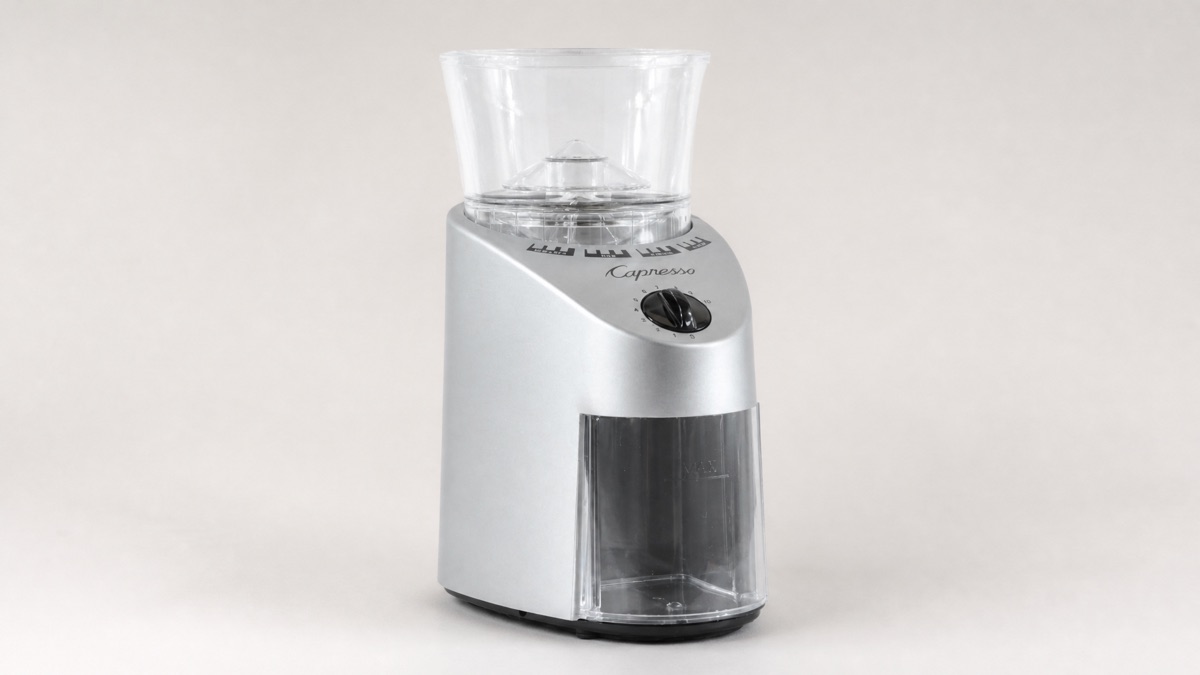
Hi, I'm Sam, and I make coffee all day. Our wine bar shares a room with the espresso machine, so noise and mess matter.
The Capresso Infinity is an entry-level electric conical burr grinder from Capresso, a Swiss-based brand marketed in the United States by Jura Inc. It uses 40 mm (1.6 in) stainless steel burrs and a gear reduction motor that turns at about 450 RPM. Home brewers buy it to leave blade grinders behind.
The grinder produces an even grind from about setting 2 through setting 15. It has 16 settings, a timer dial and a safety lock. The motor runs at about 70 to 78 dB, quieter than most grinders. The plastic bin causes static, and the timer is only a rough guide. Espresso works only with a pressurized portafilter.
Thinking about the Capresso Infinity? I explain grind settings and timer dial, with zero sponsor money. The Infinity costs about $100 and can last 3 to 5 years with regular cleaning. The Infinity Plus adds a bigger hopper, and the Baratza Encore adds more settings.
What Is the Capresso Infinity Conical Burr Grinder?
The Capresso Infinity is an entry-level conical burr grinder with 40 mm (1.6 in) stainless steel burrs and a timer. Home brewers use it to step up from a blade grinder.
Capresso, the brand behind it, is Swiss-based and was founded in 1994. Jura Inc. owns it and markets the Capresso line in the United States. The company makes espresso machines, grinders, coffee makers and kettles, mostly for the American market.
Inside the grinder, a gear reduction motor turns the burrs at about 450 RPM. One listing gives 420 RPM. The motor draws 100 watts on 120 V household power. The slow speed keeps heat and noise low.
The Infinity has been a Capresso best seller for more than 10 years. Buyer ratings stay above 4 stars.
Which Capresso Infinity Model Should You Buy?
The Capresso Infinity model to buy is the black plastic 560.01, because the motor and burrs match every other model. The 560.04 adds a silver finish.
The 560 series uses ABS plastic housing. ABS is a hard, light plastic. Both 560 models cost less than the metal models.
The 565 series has a heavy metal body. The body is described as zinc die-cast or stainless steel. Listings disagree on which number carries which finish, so the product page should be checked before ordering.
The Infinity Plus line adds two more models, the 570 in plastic and the 575 in metal. Both Plus models share the same motor and burrs. What sets them apart is a hopper that holds more beans. The hopper is the bin on top that holds the beans before grinding.
Model Comparison:
| Model | Line | Body | Hopper |
|---|---|---|---|
| 560.01 | Infinity | Black ABS plastic | 8.8 oz (250 g) |
| 560.04 | Infinity | ABS plastic, silver finish | 8.8 oz (250 g) |
| 565 series | Infinity | Heavy metal body | 8.8 oz (250 g) |
| 570 | Infinity Plus | ABS plastic | 11 to 12 oz (312 to 340 g) |
| 575 | Infinity Plus | Metal body | 11 to 12 oz (312 to 340 g) |
How Well Does the Capresso Infinity Grind Coffee?
The Capresso Infinity grinds coffee evenly from about setting 2 through setting 15. The result is a clear step up from any blade grinder.
The finest and coarsest settings turn less uniform. The coarsest step is also not very coarse, so it falls short for French press. Fans of that brew may want a coarser grinder.
The even middle of the range suits drip, pour over, AeroPress and moka pot brews, which turn out best. The Infinity also handles French press at the coarse end.
The 100 watt motor limits the finest settings. It can stall on dense light roasts when the grind is very fine.
Slow burr speed also makes the Infinity grind slower than rivals. Expect about 30 seconds where a faster grinder takes 20.
How Many Grind Settings Does the Capresso Infinity Have?
The Capresso Infinity has 16 grind settings in four groups of four. The groups are extra fine, fine, regular and coarse.
The range runs from about 240 to 1,220 microns (0.01 to 0.05 in). The span covers roughly espresso size to French press size. Each step shifts the grind by about 65 microns (0.003 in) on average.
Counting 1 as finest and 16 as coarsest, pressurized espresso sits at 1 to 2 and moka pot at 3 to 6. AeroPress runs 2 to 8, and pour over and drip run 4 to 9. French press runs 10 to 15.
Settings by Brew Method:
| Brew Method | Setting |
|---|---|
| Pressurized espresso | 1 to 2 |
| AeroPress | 2 to 8 |
| Moka pot | 3 to 6 |
| Pour over | 4 to 9 |
| Drip machine | 4 to 9 |
| French press | 10 to 15 |
Twist the hopper until the black dot lines up with a setting. Capresso prints no numbers on the ring.
Sixteen steps limit fine tuning. Hobbyists chasing exact extraction find the steps too large.
Can the Capresso Infinity Grind for Espresso?
Yes. The Capresso Infinity can grind for espresso, but only for a pressurized portafilter.
The finest step reaches espresso size, yet the grind is uneven there. The second-finest step is a bit more consistent. It suits a budget machine better.
A pressurized basket forgives uneven grounds, so the uneven grind causes less harm. Budget machines such as the De'Longhi Dedica use this kind of basket. That is why the pairing works.
A non-pressurized portafilter, as on the Rancilio Silvia, gives no such forgiveness. It needs steady, fine steps to dial in a shot. The Infinity steps are too large for that, so it cannot work well on this kind of machine.
The extra fine end gets close to Turkish coffee but does not reach a true Turkish grind.
How Loud Is the Capresso Infinity?
The Capresso Infinity is less loud than most grinders, at about 70 to 78 dB. Typical grinders measure 80 to 85 dB.
A gear reduction motor and slow burrs keep the sound to a low hum. The result is a low hum. The pitch rises as the setting gets finer.
Compared with the Baratza Encore, the Infinity runs quieter. Even so, the sound is still clearly audible in a quiet kitchen.
That mix of low but audible sound shapes who benefits most. Apartment dwellers and early risers get the most from the low sound. Light sleepers near the kitchen still hear the grinder.
How Do You Use the Capresso Infinity?
The Capresso Infinity is easy to use: fill the hopper, twist to a grind size and turn the timer dial. Grinding starts when the dial is released.
The grinder has no screen, menu or buttons. The front shows the grind marks and the timer dial.
To stop early, twist the hopper counterclockwise until the black dot leaves the grind range. Do not twist so far that the hopper comes off, or beans spill across the counter.
A safety lock blocks the motor unless the hopper is locked in place. Because the motor cannot run without the hopper, removing it for cleaning is safe.
The grounds container has a Max-Line mark. Never fill it above that mark, because overfilling clogs the grinder and overheats the motor. Unplug the grinder and let it cool before removing parts.
The clear plastic hopper is not UV-protected or airtight. Beans left in it for more than a day or two lose flavor.
How Does the Capresso Infinity Timer Work?
The Capresso Infinity timer works as a rough dosing dial that runs from about 5 to 60 seconds in 5 second steps.
The Infinity dial reads 0 to 10 and the Plus dial reads 1 to 12. The numbers are not seconds, grams or exact cups. They only mark positions on the timer.
Because the dial sets run time, the amount of coffee depends on how much the grinder delivers each second. That rate changes with grind setting, bean density and roast. A fine setting delivers less coffee per second than a coarse one. The same dial number can therefore give different doses.
The grinder also cannot remember a past result. The dial does not save a setting, so the user must find a favorite number and repeat it each time.
A scale solves this. Weigh one dose, note the dial number and reuse it. Switching bean type or roast changes the output per second, so it calls for a fresh check.
How Do You Clean the Capresso Infinity?
The Capresso Infinity is easy to clean because the hopper, upper burr and grounds bin all come off without tools.
Sweep grounds out with a soft brush, a toothbrush or compressed air. A Q-tip dipped in isopropanol lifts stubborn residue. The small brush in the box is weak.
Never use water on the burrs, because moisture rusts steel. The manual says never to immerse the cord, plug or body in water. Wipe the hopper, bin and body with a damp cloth. Skip the dishwasher, since listings disagree on whether the parts are safe in one.
Capresso suggests a weekly clean. Light use can stretch the gap to every few months. Dark oily roasts and flavored beans call for more frequent cleaning.
Grounds build up in the chute behind the bin. The spot is hard to reach with the supplied brush.
How Well Is the Capresso Infinity Built?
The Capresso Infinity is well built with 40 mm (1.6 in) stainless steel conical burrs, which wear over time. Ceramic burrs chip more easily than steel.
The 560 and 570 models use ABS plastic housing. The 565 and 575 models use a heavy metal body that vibrates less and feels sturdier.
The plastic casing and timer dial feel flimsy.
Listings give different sizes and weights. One lists 5 by 7.75 by 10 inches (12.7 by 19.7 by 25.4 cm) and 3 pounds (1.4 kg). Another lists 7.5 pounds (3.4 kg).
The power cord folds into the underside of the base. A retail listing gives the weight as 3.3 pounds (1.5 kg).
The metal die-cast 565.05 is listed as made in China. Its plug has three prongs for grounding, and the manual says not to modify the plug.
How Long Does the Capresso Infinity Last?
The Capresso Infinity can last a long time: 3 to 5 years of daily use with regular cleaning. Entry-level grinders rarely run longer.
A 1-year limited warranty covers defects in materials and workmanship. Accident, abuse, neglect and poor maintenance fall outside the cover. A grinder that fails from careless use is not repaired under the warranty.
Capresso rates the grinder for home use only. Office or commercial use voids the warranty.
The motor has no auto shutoff for overheating. It keeps running even when it gets too hot. For that reason, the motor needs a rest between timer runs when grinding large amounts.
What Are the Problems With the Capresso Infinity?
The main problems with the Capresso Infinity are static, a vague timer, only 16 steps and weak espresso precision.
Main Problems:
- Static from the plastic grounds bin
- A vague timer that forgets its setting
- Only 16 grind steps
- Weak espresso precision
The plastic grounds bin is not anti-static. Grounds cling to the bin and drift onto the counter. Tap the bin and keep a cloth nearby.
The timer is a rough guide, not a dose, and it forgets its setting.
Some beans and grounds stay trapped in the grinding chamber. Cleaning the chamber after each use is messy.
Only 16 steps exist, and the ends are less uniform. The 100 watt motor can stall on dense light roasts at fine settings.
Who Should Skip the Capresso Infinity?
Buyers who should skip the Capresso Infinity are those who dial in espresso shots. Three other groups of buyers skip it for different reasons:
- Buyers with some budget room: They skip it for the Baratza Encore. The Encore costs a little more and adds 40 settings and a 240 watt motor.
- Design-minded buyers: They find the plastic models plain. The Bodum Bistro offers color choices. The Fellow Ode II offers a showpiece look at a higher price.
- Office buyers: They skip it because office use voids the warranty.
Espresso buyers find the Baratza Encore ESP and the Baratza Sette 270 better suited to the job.
How Does the Capresso Infinity Compare to Other Grinders?
The Capresso Infinity compares well with other grinders at about $100, namely the Baratza Encore and the Bodum Bistro. The Infinity wins on noise and lands about on par for drip and pour over.
Three other grinders differ from the Infinity in price, features, or how they work:
- Bodum Bistro: This grinder costs less than the Infinity and has 12 settings. Its hopper holds 7.75 oz (220 g). It also adds an anti-static feature and rubber seals.
- Breville Smart Grinder Pro: This grinder offers 60 preset settings and handles espresso. The price is much higher.
- 1Zpresso JX-Pro: This manual grinder gives better burrs per dollar and the quietest operation. Hand cranking takes effort.
Capresso Infinity vs Baratza Encore: Which Is Better?
The Baratza Encore beats the Capresso Infinity on coarse grinding and setting count, while the Infinity wins on noise.
The Encore has 40 mm (1.6 in) stainless steel conical burrs, a 240 watt motor and 40 settings. Its hopper holds 8 oz (227 g) and its bin holds 5 oz (142 g).
US listings put the Encore near $150, with a 250 to 1,200 micron range and a 1-year warranty.
The Encore gives a better French press grind. The Encore runs louder than the Infinity, and the Encore is not built for espresso.
The Infinity grinds fine enough for pressurized espresso and runs quieter, but it has only 16 steps. The price gap is small, so the Encore suits buyers who can stretch the budget.
Infinity vs Encore:
| Spec | Infinity | Encore |
|---|---|---|
| Settings | 16 | 40 |
| Motor | 100 watts | 240 watts |
| Hopper | 8.8 oz (250 g) | 8 oz (227 g) |
| Grounds bin | 4 oz (113 g) | 5 oz (142 g) |
| Noise | Quieter | Louder |
Capresso Infinity vs Infinity Plus: What Changes?
The Infinity Plus changes the hopper size, body and dial of the Capresso Infinity, but not the motor or burrs.
The Plus hopper holds 11 to 12 oz (312 to 340 g) of beans against 8.8 oz (250 g). The grounds bin stays at 4 oz (113 g).
The Plus stands a bit taller and weighs about a pound (0.45 kg) more. Its dial has a curved grip and reads 0 to 12.
The black plastic Plus costs about the same as the Infinity, or up to $10 more. Metal versions run about $60 more.
Infinity vs Plus:
| Feature | Infinity | Infinity Plus |
|---|---|---|
| Hopper | 8.8 oz (250 g) | 11 to 12 oz (312 to 340 g) |
| Grounds bin | 4 oz (113 g) | 4 oz (113 g) |
| Timer dial | Reads 0 to 10 | Reads 1 to 12 |
| Motor and burrs | Same | Same |
How Much Does the Capresso Infinity Cost?
The Capresso Infinity costs about $100, within a $75 to $150 range by finish and seller.
Zinc and stainless models run about 50% more than the black plastic model.
The black plastic Plus costs $2 to $10 more than the Infinity.
Buyers find the grinder at Walmart, Amazon and the Capresso site.
Is the Capresso Infinity Worth the Price?
Yes. The Capresso Infinity is worth the price at about $100, because steel burrs and a gear motor are rare at that cost.
Burrs are the parts that crush the beans, and a gear motor turns them slowly. Few grinders at this price have both. Testers back this up. They score value at 4.5 out of 5 and 9 out of 10.
The black plastic model gives the best value. Its internals match those of the metal models, so the cheaper body does not change how the grinder works.
Metal models earn their extra cost only through a sturdier body and style. Someone who cares about those can pay more. Someone who cares about grinding gets the same parts for less.
The price also looks small when spread over time. At $100 over 3 to 5 years, the grinder costs about $20 to $33 per year.
Is the Capresso Infinity Worth It?
Yes. The Capresso Infinity is worth it as a first burr grinder for drip, pour over and AeroPress.
Testers back this up with scores of 4.0 out of 5, 4.4 out of 5 and 8 out of 10.
Its burrs are 40 mm (1.6 in) stainless steel conical burrs. Burrs are the parts that crush the beans. A quiet gear reduction motor spins them. The machine is also easy to use and has a small body.
Static builds up in the plastic grounds bin. The timer is vague. The grinder has only 16 steps, which limits how finely the grind can be adjusted. The warranty lasts 1 year. Espresso precision is also weak.
Pros:
- 40 mm (1.6 in) stainless steel conical burrs
- Quiet gear reduction motor
- Easy use and a small body
Cons:
- Static from the plastic grounds bin
- A vague timer
- Only 16 steps
- A 1-year warranty
The Baratza Encore is the better pick when noise is not a concern.
Who Should Buy the Capresso Infinity?
Buyers who should buy the Capresso Infinity are people upgrading from a blade grinder. First-time electric burr grinder owners fit the same profile.
Three other groups of buyers also fit this grinder:
- Drip and pour over drinkers: Those on a tight budget get a good fit.
- Apartment dwellers: The low noise suits shared walls. The short body also clears upper cabinets.
- Budget espresso owners: Anyone with a budget espresso machine that has a pressurized basket can use the finest settings.
Odradeks Coffee House is reader-supported. If you buy through a link on this page, we may earn a small affiliate fee at no extra cost to you.