Calphalon Temp iQ Espresso Machine Review: Is It Worth It?
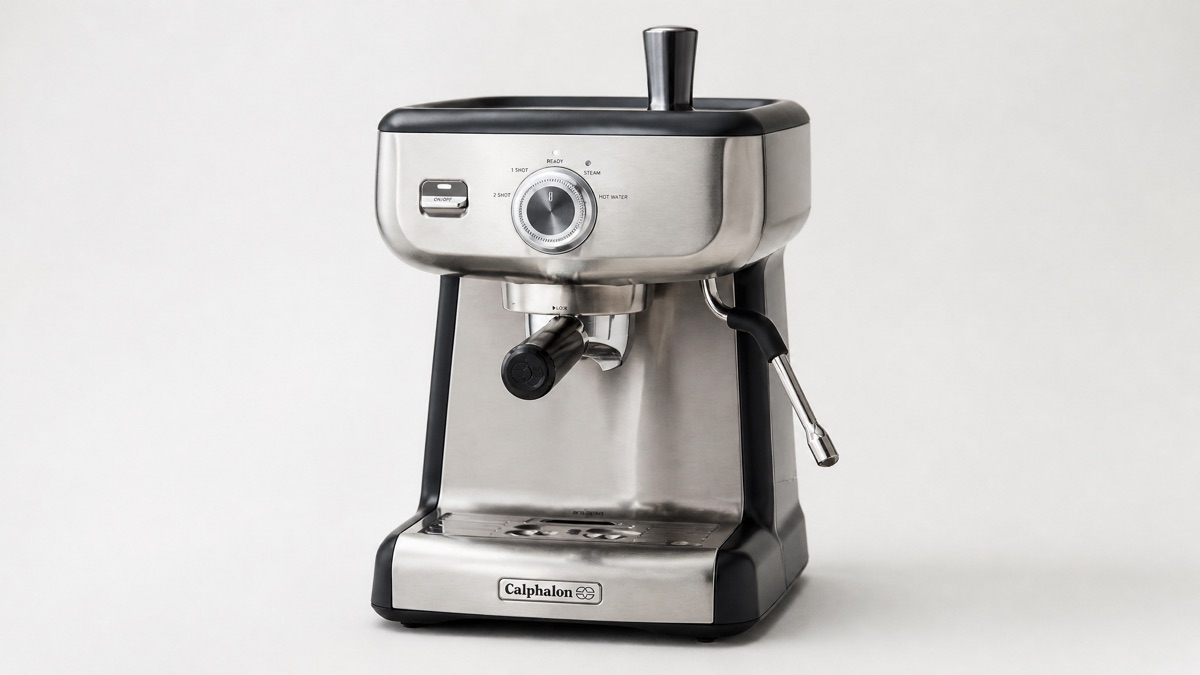
Hi, I'm Sam, and I make coffee all day. Running a coffee shop is my job, so I judge semi-automatic espresso machines by daily use. The Calphalon Temp iQ has a thermoblock heater, PID temperature control and a 58 mm portafilter.
The steam wand is the star. It makes microfoam fine enough for latte art. The espresso is average, because the machine has no over-pressure valve and ships with pressurized baskets only. This review covers the version without a grinder.
The Temp iQ costs about the same as the Breville Bambino, which pulls better shots. On steam wand, I set the Calphalon Temp iQ next to the Breville Bambino. No brand read this review first.
What Is the Calphalon Temp iQ Espresso Machine?
The Calphalon Temp iQ is a semi-automatic espresso machine with a thermoblock heater, PID temperature control, a 15 bar pump and a 58 mm portafilter. A single dial sets shots, steam and hot water. The machine suits home beginners.
Semi-automatic means the machine controls water heat and pressure. The user grinds, doses, tamps and starts the shot. The Temp iQ takes ground coffee, not pods. It is a portafilter machine, not a super-automatic, so the user also steams milk by hand. Its name points to the PID temperature control.
The box holds a stainless steel milk pitcher, a plastic tamper, two pressurized baskets and a cleaning pin. The pitcher is for steaming milk, and the tamper presses the ground coffee into the basket.
The version without a grinder measures 13.9 x 11.6 x 15.3 in (35 x 29 x 39 cm) and weighs 15.4 lb (7 kg). The front is stainless steel. The sides, top and drip tray are plastic.
Calphalon lists the model without a grinder as BVCLECMP1 and rates it at 1350 W. The grinder version is a separate product with its own listing.
Calphalon is an American appliance and cookware brand. Ronald M. Kasperzak founded it in 1963 as Commercial Aluminum Cookware, based in Perrysburg, Ohio. Newell Brands bought the company in 1998. The brand first became known for hard-anodized aluminum cookware.
How Do the Temp iQ Versions With and Without a Grinder Differ?
The Temp iQ comes in two versions, and the grinder model adds a burr grinder, a bigger tank and menu controls. The grinder model has a conical burr grinder with 30 settings and a 94 oz (2.8 L) tank. TechGearLab listed it at $800 in 2024.
The menu controls give the user control over the brew itself. Brew temperature can be set from 190 to 205°F (88 to 96°C) in 2 degree steps. The machine offers three pre-infusion modes and programmable shot volumes. A Clean light prompts a 7 minute cleaning cycle.
The version without a grinder has a 67 oz (2 L) tank and fixed shot sizes of about 1 oz (30 ml) and 2 oz (60 ml). The volumes cannot be reprogrammed. It is narrower and uses pressurized baskets only.
Temp iQ Versions Compared:
| Feature | Without grinder | With grinder |
|---|---|---|
| Grinder | None | Conical burr, 30 settings |
| Water tank | 67 oz (2 L) | 94 oz (2.8 L) |
| Shot volumes | Fixed, about 1 oz and 2 oz | Programmable |
| Brew temperature | Not adjustable | 190 to 205°F (88 to 96°C) |
| Pre-infusion | Yes | Three modes |
| Baskets | Pressurized only | Single-wall reported |
Testers doubt the built-in grinder, though. Cicada says the grinder cannot grind a set dose, so every shot needs a scale. TechGearLab found the grinder slow and hard to dial in. Both prefer a separate grinder.
How Does the Calphalon Temp iQ Work?
The Calphalon Temp iQ works by heating water in a thermoblock, holding the temperature with a PID and pushing the water through the coffee with a 15 bar pump. A thermoblock is an aluminum block with a stainless steel pipe wrapped inside. Water heats as it flows through the pipe.
The machine is ready in about 25 to 40 seconds. A single thermoblock cannot brew and steam at the same moment. The wait between brewing and steaming is about 15 seconds.
A PID is a controller that adjusts the heater in small steps. The Temp iQ uses it to keep the water stable through the shot. Cicada puts the water near 198°F (92°C) as it meets the coffee.
The pump then pushes that water through the grounds. It is rated at 15 bar, but the machine has no over-pressure valve. An over-pressure valve, or OPV, vents extra pressure so the shot runs near 9 bar. Cicada estimates real brew pressure at 11 to 13 bar, above the ideal 9 bar. Higher pressure makes channeling more likely, so the grind has to be coarser.
The pressurized baskets make up for the missing valve. Their single exit hole builds back pressure for the user.
The machine also runs a pre-infusion step. Pre-infusion wets the grounds with gentle water before full pressure arrives. The soak helps the water flow evenly through the puck.
How Do You Use the Temp iQ?
Use the Temp iQ in a few short steps to pull a shot. Fill the tank, flip the toggle and wait up to 40 seconds for the Ready light to turn solid. Then add ground coffee to a pressurized basket and tamp it evenly.
Lock the portafilter into the group head. A hand on the machine keeps it from sliding on the counter. The lock takes some force.
- Turn the dial to one shot or two shots.
- Wait for the pre-infusion to start the flow.
- Let the machine stop the shot by volume.
A blank shot or a splash of hot water through the empty portafilter warms the metal first. The group head and steam wand get hot, so keep hands clear. Never run the pump with an empty tank.
The dial has four positions: single shot, double shot, steam and hot water. Turning the dial past the single shot position on the way to the double can cut the pour short. For an Americano, pull the shot and then turn the dial to hot water over the cup.
What Features Does the Calphalon Temp iQ Have?
The Calphalon Temp iQ has a 58 mm portafilter, PID and a steam wand as its main features. The portafilter is the commercial size. Most home machines use 51 or 54 mm.
The portafilter is about 2.5 in (6.4 cm) deep and holds a wide puck of grounds. The metal head is reportedly glued to the plastic handle. The three-lug lock is unusual, and the wide spouts dribble down small espresso cups.
The water for each shot comes from a tank at the back. It holds about 2 L (67 oz), which is enough for roughly 40 double shots. The grinder version holds 94 oz (2.8 L).
Milk drinks need steam, and the manual steam wand supplies it. The wand sits on a ball joint and is ready in about 15 to 20 seconds. The tip can be loose out of the box and spray milk. Tightening the tip fixes the spray.
The milk then goes into a pitcher. The stainless steel pitcher holds about 6 oz (180 ml), which one tester calls small. A plastic cup warmer on top holds two cups and the tamper. The drip tray has a floater that pops up when the tray is full.
Key Features:
- 58 mm portafilter
- Thermoblock with PID
- Single-hole manual steam wand
- Removable 2 L (67 oz) water tank
- Plastic cup warmer with tamper storage
- Drip tray with a full-tray floater
Does the Temp iQ Come With Non-Pressurized Baskets?
No. The Temp iQ does not come with non-pressurized baskets, only one single and one double pressurized basket. The grinder version is reported to include single-wall baskets as well.
A pressurized basket has one exit hole that builds back pressure. Because of that pressure, a decent shot comes out even with pre-ground coffee or an uneven tamp. The same feature makes a great shot hard to reach.
A buyer who wants to move past pressurized baskets must find a replacement. That is harder here than with Breville machines. The three-lug portafilter is not a mainstream design. Standard 54 mm Breville baskets do not fit.
Craft Coffee Spot tested a single-wall basket at grind setting 17 on a Baratza Encore ESP. The shot had flavor and acidity but a thin body and low heat. The Breville Bambino made a richer shot at a coarser setting.
Does the Calphalon Temp iQ Make Good Espresso?
No. The Calphalon Temp iQ makes drinkable but average espresso with crema. Cicada scores espresso quality 5 out of 10. Craft Coffee Spot gives performance 5.5, and TechGearLab gives 5.0 for the grinder model.
TechGearLab pulled 19 g (0.7 oz) of coffee into 30 g (1 oz) of espresso in 24 seconds on the grinder model. A refractometer, a tool that measures how much coffee dissolved into the cup, read the extraction yield at 16.2%. The ideal range is 18 to 22%.
In that test, the shots tasted acidic and harsh, with stiff, lumpy crema. Craft Coffee Spot pulled consistent shots with a nice crema. Both found the cup short of a good cafe.
The Specialty Coffee Association puts a good espresso at 18 to 22% extraction, a 1:2 ratio and 25 to 30 seconds. TechGearLab's 19 g in and 30 g out is a 1:1.6 ratio. A 16.2% yield is under range, which fits the sour, thin cup.
A common starting recipe is 18 g (0.6 oz) of coffee for 36 g (1.3 oz) of espresso in 25 to 30 seconds. Pressurized baskets blur that target. A fresh medium-dark roast and a separate burr grinder help more than any setting on the machine.
Three limits cap the flavor of this machine:
- No over-pressure valve: The machine lacks this valve.
- Pressurized baskets: These baskets blur the recipe target.
- Cool thermoblock: The heating part runs cool.
Cicada sums it up as easy to get an average shot and impossible to get a great one.
Does the Temp iQ Brew Hot Enough?
Yes. The Temp iQ brews hot enough by one test at 198°F (92°C), but another measured only 160°F (71°C). The ideal range is 190 to 196°F (88 to 91°C).
Cicada says the PID holds the water near 198°F at the coffee. A PID is a controller that keeps the heater at a steady set temperature. Craft Coffee Spot measured a peak of 160°F and called the espresso thin and flat. RoastAroma also lists cool shots as a common complaint. Neither test states where the water was measured, so neither settles the question.
Scale is one thing that can pull the heat down. Scale is the mineral crust that builds up inside a thermoblock, the small heater that warms the water. Over time it cools the water and slows the flow. Descaling on schedule keeps flow and heat steady.
Heat can also be lost after the water leaves the heater. Warm cups on the top tray keep the drink from cooling. A blank shot warms the portafilter and group head before the real shot. The grinder version lets the user raise the temperature to 205°F (96°C).
Does the Temp iQ Steam Milk Well?
Yes. The Temp iQ steams milk well and makes microfoam fine enough for latte art. The single-hole wand is its best feature. Cicada scores it 8 out of 10, and TechGearLab scores milk steaming 8.0.
The wand is ready in about 15 to 20 seconds. TechGearLab made a cappuccino in 3 minutes 49 seconds. Craft Coffee Spot steamed 200 g (7 oz) of milk in just over a minute.
The wand is manual, so the person using it controls the result and must learn the skill. Cicada needed about ten practice pitchers to get consistent milk. The steam is forgiving, and scalded milk is rare, which makes that practice easier.
Craft Coffee Spot found the wand weaker than the Breville Bambino or the De'Longhi Dedica Arte. Its milk came out thinner and more watery. Most testers still rank it above the plastic panarello wands at this price.
What Do Calphalon Temp iQ Reviews Say?
Calphalon Temp iQ reviews praise the milk steaming, the simple dial and the price, and mark down the espresso and the build. Cicada scores espresso 5, milk 8, features 8, ease of use 8, build 5 and value 7. All are out of 10.
Craft Coffee Spot gives an overall 6.6. TechGearLab gives the grinder model 64 out of 100. An owner on The Worktop, a food blog, made delicious coffee after a few tries and found the manual detailed.
RoastAroma sums up owner threads with a low score for reliability, 2.5 out of 5. It scores parts and serviceability 1.5. Owners often outgrow the pressurized baskets within 6 to 12 months.
Review Scores:
| Source | Score | What it rates |
|---|---|---|
| Cicada | 7 out of 10 | Value for money |
| Craft Coffee Spot | 6.6 out of 10 | Overall, no-grinder model |
| TechGearLab | 64 out of 100 | Overall, grinder model |
| RoastAroma | 2.5 out of 5 | Owner-reported reliability |
What Are the Common Temp iQ Complaints?
The most common Temp iQ complaints are flat espresso, plastic parts, scarce spares and a clumsy dial. The shots turn out thin and acidic because of the cool thermoblock and the pressurized baskets.
The sides, top, cup warmer, drip tray and tank are plastic. The portafilter head is reportedly glued to its handle. Replacement portafilters are hard to find.
A few owners report leaks where the water tank meets the machine. Those reports are a small share of thousands of Amazon reviews. Cicada does not call the problem common.
The single dial needs care, because turning past one shot to reach two can cut the pour short. The version without a grinder cannot reprogram shot volumes. The manual focuses on the grinder model.
Main Complaints:
- Flat, thin espresso
- Plastic sides, top and tray
- Scarce replacement parts
- Occasional tank leaks
- Single dial that can cut a shot short
- Fixed shot volumes on the no-grinder model
How Does the Calphalon Temp iQ Compare to the Breville Bambino?
The Breville Bambino beats the Calphalon Temp iQ on espresso quality, while the Temp iQ has the bigger tank and the larger portafilter. Cicada picks the Bambino and notes the two usually cost about the same.
The Bambino has a ThermoJet heater that is ready in about 3 seconds. It has a PID, a 15 bar pump and an over-pressure valve. The valve lets the user grind finer, and finer grinding gives better shots.
The Bambino has a 1.4 L (47 oz) tank and a one-year Breville warranty. The Temp iQ has the bigger tank and a three-year warranty. Cicada credits the Bambino with easier parts and better support.
The Bambino uses a 54 mm portafilter and standard baskets that are cheap and easy to find. Cicada says it also has easier parts and better support. The wand swivels 360 degrees.
The Temp iQ counters with a 58 mm portafilter and a 2 L tank. A two-cup spout fills two cups from one double shot. The De'Longhi Dedica Arte is another rival, with a 51 mm portafilter and a 40 second heat-up.
Temp iQ Versus Bambino:
| Feature | Calphalon Temp iQ | Breville Bambino |
|---|---|---|
| Heater | Thermoblock with PID | ThermoJet with PID |
| Heat-up | 25 to 40 seconds | About 3 seconds |
| Over-pressure valve | No | Yes |
| Portafilter | 58 mm | 54 mm |
| Water tank | 2 L (67 oz) | 1.4 L (47 oz) |
| Warranty | 3 years | 1 year |
How Does the Temp iQ Compare to the Breville Barista Express?
The Breville Barista Express is the sturdier and more expensive machine, while the Temp iQ is the easier one. The Barista Express has a full stainless steel body and a built-in conical burr grinder. It measures 13.2 x 12.5 x 16 in (34 x 32 x 41 cm).
The Barista Express has a steeper learning curve. It needs cleaning by hand about every two weeks. Its water tank sits at the back and holds 67 oz (2 L).
The Temp iQ asks less of a new user. RoastyCoffee finds the Temp iQ simpler for beginners.
The comparison depends on which Temp iQ version is meant. RoastyCoffee likens the grinder Temp iQ to the Barista Express. CoffeeAtoZ likens the version without a grinder to the Breville Infuser. TechGearLab lists the Barista Express as the main all-in-one alternative.
How Do You Clean the Calphalon Temp iQ?
The Calphalon Temp iQ needs a short daily clean and a periodic descale. After every shot, wipe the grounds off the group head and knock out the puck. After every steaming session, wipe the wand and purge it with a few seconds of steam or hot water.
The Temp iQ has no three-way solenoid valve, so backflushing does not apply. Pucks come out wet and sloppy.
Hard water leaves limescale, a mineral crust, inside the thermoblock. The thermoblock is the part that heats the water. The periodic descale targets this buildup.
The drip tray has two compartments. One catches spilled grounds. The other takes the purge from the steam wand.
On the version without a grinder, the drip tray cover and the basket are dishwasher safe. The drip tray, tank and portafilter are not. TechGearLab reports that the grinder version allows the pitcher, drip tray and baskets in the dishwasher.
Dishwasher-Safe Parts, No-Grinder Model:
| Part | Dishwasher safe |
|---|---|
| Drip tray cover | Yes |
| Basket | Yes |
| Drip tray | No |
| Water tank | No |
| Portafilter | No |
The grinder version prompts a deep clean with a Clean light. Add a cleaning disc and tablet to the portafilter and run a 7 minute cycle. The cleaning pin clears a clogged basket or steam tip.
How Often Does the Temp iQ Need Descaling?
The Temp iQ needs descaling often, about every 4 to 6 months, per Calphalon. Water hardness and use change the interval. The machine has no reminder, so a calendar note helps.
The descaling cycle on the version without a grinder starts with the power button. Pressing it four times makes the On and Ready lights flash together. The machine then runs 1 L (34 oz) through the group head and 1 L through the wand in about 10 minutes.
The cycle needs a descaler to dissolve the mineral buildup in the water path. The manual lists three choices:
- Tablets: These are the descaler form named first in the manual.
- Liquid descaling solution: This is a ready-made product made for the job.
- White vinegar with warm water: This is a household option that is mixed with warm water.
How Much Does the Calphalon Temp iQ Cost?
The Calphalon Temp iQ without a grinder costs about the same as the Breville Bambino, and the grinder version lists at $800. TechGearLab recorded that list price in 2024. Cicada makes the Bambino comparison.
Listings for the version without a grinder have shown US prices from about $280 to $475. Calphalon's own page lists the machine as out of stock. Prices swing with sales, so check the seller before buying.
The machine is sold at Amazon, Walmart, Home Depot, Best Buy and BJ's, and at Calphalon's own store.
A separate burr grinder adds to the total for the version without one. A scale and descaler add a little more. A refurbished or open-box unit can cut the cost.
Cicada rates value 7 out of 10. Craft Coffee Spot rates it 6 out of 10. Both mark the price down for weak shots and scarce parts.
Does the Temp iQ Have a Warranty?
Yes. The Temp iQ does have a three-year limited warranty from Calphalon. Cicada calls it a multi-year warranty. Calphalon lists the term as a 3 Year Limited Warranty.
Claims go through Calphalon customer service. Some owners say support can be slow to respond. Retailer return windows are separate from the warranty and shorter.
Spare parts are the weak spot. A broken portafilter can mean a long wait for a replacement. The Breville Bambino has easier parts, so repairs on it are simpler.
The manual says the machine is made in China.
Is the Calphalon Temp iQ Worth It?
Yes. The Calphalon Temp iQ is worth it for beginners who want lattes and cappuccinos at a low price. The steam wand, the PID and the simple dial earn the score.
The weaknesses are plain. There is no over-pressure valve. Only pressurized baskets ship in the box. Several parts are plastic, and spares are scarce.
Pros:
- Strong single-hole steam wand
- PID keeps temperature steady
- Quick switch from brewing to steaming
- Large water tank
- Simple labeled dial
Cons:
- No over-pressure valve
- Pressurized baskets only
- Plastic parts
- Scarce replacement parts
Cicada would buy the Breville Bambino instead at a similar price. The Temp iQ stays a sound pick when found at a good price. The best setup is the version without a grinder plus a separate burr grinder.
Who Should Buy the Temp iQ?
New home users who mostly drink lattes should buy the Temp iQ. It also suits shoppers on a budget who already own a burr grinder and accept pressurized baskets.
Buyers who want to improve their espresso should choose the Breville Bambino. The Bambino takes standard baskets, has an over-pressure valve and has easier parts.
The Barista Express suits buyers who want a built-in grinder and a sturdier body, and who accept a steeper learning curve.
Odradeks Coffee House is reader-supported. If you buy through a link on this page, we may earn a small affiliate fee at no extra cost to you.