Breville Barista Express Review: Is It Worth It?
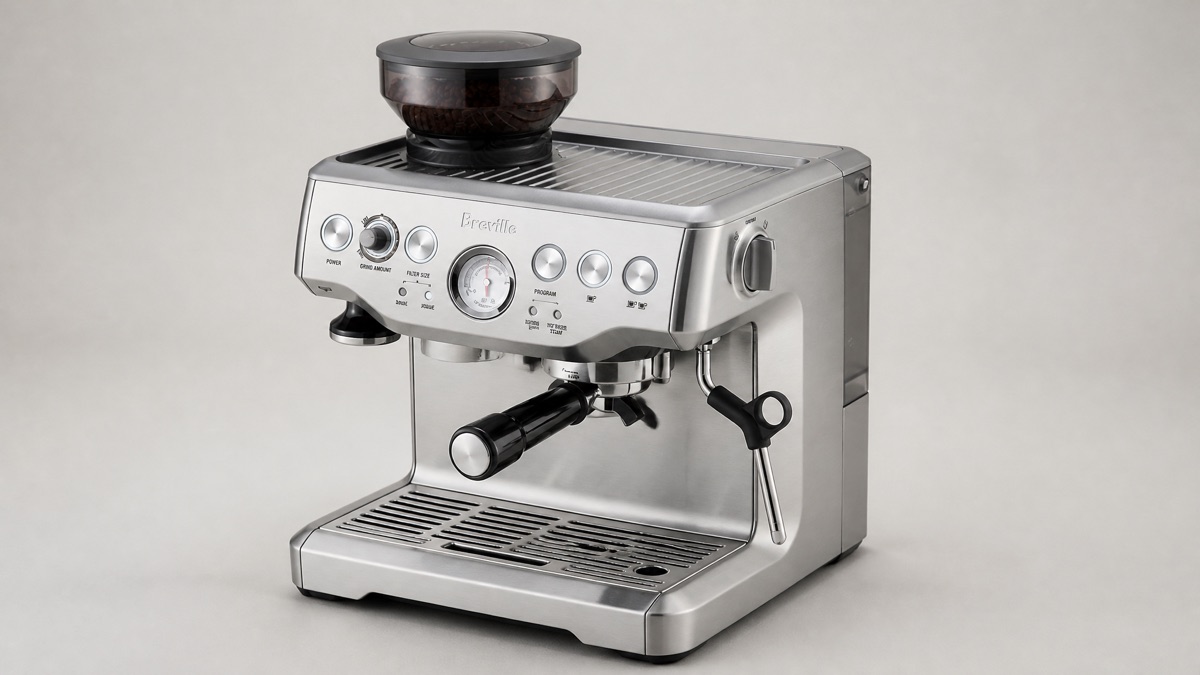
The Breville Barista Express is a semi-automatic espresso machine with a built-in conical burr grinder, sold as the BES870XL. It lists at $699.95. One 23 lb (10.4 kg) unit grinds, doses, brews and steams milk, so a buyer needs no separate grinder to start.
Hi, I'm Sam, writing from a busy New York coffee shop. Running the Midwood shop, near Di Fara Pizza, taught me how to judge semi-automatic espresso machines with grinders. My shop pays for every piece of coffee gear, and my reviews take no brand money.
The machine pulls strong shots with thick crema, and PID control holds the water temperature steady. The grinder is good but not great, and one heating circuit blocks brewing and steaming at once. Cleaning, noise and a one-year warranty count against it. This review covers the grinder, heating, milk, cleaning, lifespan, price and who should skip the machine.
What Is the Breville Barista Express?
The Breville Barista Express is an all-in-one semi-automatic espresso machine with a built-in conical burr grinder. Breville sells it as the BES870XL. One unit grinds the beans, doses the grounds, pulls the shot and steams the milk.
The Barista Express sits in the middle of the Breville line. The Bambino costs $299.95 at the low end. The Oracle Dual Boiler costs $2,995.95 at the high end. The Barista Express is the least expensive Breville with a built-in grinder.
Breville designed the machine in Australia and assembles it in China. An Italian pump drives the water. Sage Appliances sells the same machine as the Sage Barista Express in the UK. Sage is the same Australian brand as Breville. Breville UK is an unrelated company. North American sales rank it among the best sellers for close to 10 years.
The machine is semi-automatic, which means it automates only part of the work. The pump and the water temperature run on their own. Grinding, tamping and milk texturing stay with the owner. A buyer who wants a one-button drink needs a super-automatic machine.
The machine takes whole beans or pre-ground coffee. Capsules and pods do not fit. A removable tank holds the water, so no plumbing is needed.
The machine stands about 12.5 in (32 cm) wide and 15.9 in (40 cm) tall, with a depth of 13 to 14 in (33 to 36 cm). Retail listings give a weight of 22 to 23 lb (10 to 10.4 kg).
Key Specs:
| Spec | Value |
|---|---|
| Model code | BES870XL |
| Type | Semi-automatic with built-in grinder |
| Pump | 15 bar, 9 bar extraction |
| Portafilter | 54 mm |
| Grind settings | 16 |
| Water tank | 67 oz (2 L) |
| Bean hopper | 250 g (0.5 lb) |
| Weight | About 23 lb (10.4 kg) |
What Comes in the Box With the Barista Express?
The Barista Express box comes with everything needed to pull a shot except beans. The brewing kit has a 54 mm stainless steel portafilter and four baskets. Those baskets cover 1 cup and 2 cup sizes in single wall and dual wall styles. A magnetic tamper, a coffee scoop and a Razor dose trimming tool complete the set.
In the Box:
- 54 mm stainless steel portafilter
- Four baskets in 1 cup and 2 cup sizes
- Magnetic tamper and coffee scoop
- Razor dose trimming tool
- Dosing Funnel attachment
- Stainless steel milk jug (480 ml, or 16 oz)
- Cleaning disc and cleaning tablets
- Brush tool with Allen key
- Water filter and filter holder
The milk and cleaning kit adds a stainless steel milk jug (480 ml, or 16 oz), a cleaning disc and cleaning tablets. A brush tool with an Allen key comes along. Breville also packs a water filter and a filter holder. A Dosing Funnel attachment snaps onto the portafilter and keeps grounds off the counter.
A compartment under the drip tray stores the cleaning tools and spare baskets. The top of the machine works as a cup warmer. Both details keep the counter tidy.
Several useful items are missing. Beans, a scale, a knock box and a better tamper cost extra. Owners often spend about $85 to $150 on these upgrades.
How Does the Breville Barista Express Make Espresso?
The Breville Barista Express grinds beans straight into the portafilter to make espresso through a 15 bar pump. The portafilter rests in a cradle under the grinder chute. The user levels and tamps the grounds, locks the handle in and presses the 1 cup or 2 cup button.
Pressing the button starts the pump, an Italian Ulka vibration unit rated at 15 bar. An over-pressure valve holds the extraction near 9 bar. The 15 bar rating gives the pump spare power, so it always reaches 9 bar. The valve sends the extra water back to the tank.
Water does not hit the grounds at full pressure right away. Low-pressure pre-infusion wets the puck first, so the water flows evenly through it.
An analog pressure gauge shows each shot as it runs. A needle that stays low points to a coarse grind. A needle that shoots high points to a grind that is too fine. The user can read the gauge and adjust the next shot.
The user also controls how much espresso the machine pours. The 1 cup and 2 cup volumes are programmable. A manual override lets the user stop the shot at any moment.
The steam wand dial also sends hot water for an Americano or a pre-warmed cup. The machine cannot brew regular drip coffee. An Americano is the closest option.
How Good Is the Barista Express Grinder?
The Barista Express grinder is good for most home users but less precise than a standalone grinder. It uses stainless steel conical burrs, which are the two metal parts that crush the beans. It has 16 main grind settings, and an internal adjustment adds finer steps. A hopper holds 250 g (0.5 lb) of beans.
Two separate dials control the grind. One sets the grind size, and the other sets the grind amount. A dose control cradle delivers about 18 to 22 g (0.6 to 0.8 oz) per dose. The user changes the grind time to change the dose.
Standalone grinders at $300 and up give a tighter spread of particle sizes. The built-in grinder has only 16 steps, and that is coarse for light roasts. Enthusiasts feel that limit first.
The steel burrs also run loud and rattle at start-up. The chute can scatter grounds on the counter. A dry cloth after each use keeps the mess small.
A user who is unhappy with the built-in grinder has two options. Pre-ground coffee works if the user skips the grinder. A buyer can also add a separate grinder later and keep the machine for extraction.
How Does the Barista Express Heat Water?
The Barista Express heats water with a thermocoil under PID digital temperature control. Water passes through a metal coil inside an aluminum block. The PID sensor keeps the temperature steady during the shot.
The default brew temperature sits near 200 F (93 C). The Program button moves it up or down in 4 F (2 C) steps. Those steps are fairly large, so finer ones would suit light roasts better.
Warm-up time depends on the source. The thermocoil itself heats in 30 to 60 seconds. The machine brews well after about 2 minutes. The Barista Pro, by comparison, reaches temperature in 3 seconds.
One heating circuit serves both brewing and steam. The circuit can only do one job at a time. A shot and steamed milk cannot happen at the same time. The switch from brew to steam takes about 10 to 15 seconds.
Does the Breville Barista Express Make Good Espresso?
Yes. The Breville Barista Express makes good espresso with thick crema and balanced flavor once the user dials it in. Testers at Tom's Guide liked the shots so much that they asked to keep the machine after the test ended.
The PID holds the water temperature within about 1 F (0.6 C) from shot to shot. That consistency is rare at this price. It lets a user repeat a good recipe on demand.
A repeatable recipe needs a place to start. A good starting recipe uses grind setting 5, 18 g (0.6 oz) of coffee and 36 g (1.3 oz) of liquid in 25 to 30 seconds. The flow should start after 4 to 7 seconds. The full extraction runs 25 to 35 seconds.
A shot that runs fast and tastes sour needs a finer grind. A shot that drips slowly and tastes bitter needs a coarser grind. Change one variable at a time. Writing down the grind setting and dose makes the good shot easy to repeat.
The basket also changes how much the grind and tamp matter. Dual wall baskets forgive grind and tamp errors and suit pre-ground coffee. Single wall baskets give clearer flavor but demand a correct grind and tamp. Most owners switch to single wall after a few weeks.
The machine does have limits. It offers no manual pressure profiling. The 4 F temperature steps are also coarse. Machines above $1,500 add that finer control.
Does the Barista Express Steam Milk Well?
Yes. The Barista Express steams milk well enough for microfoam and latte art with practice. The manual wand swivels 360 degrees and has a one-hole tip. A dial opens the steam.
Good milk needs two steps. Stretching adds air with the tip just under the surface. Texturing spins the milk in a whirlpool with the tip deeper. The result is microfoam, a glossy milk with no visible bubbles.
The wand steams 8 to 12 oz (240 to 355 ml) of milk in 30 to 60 seconds. Stronger dual boiler machines finish in about 30 seconds. For one or two drinks, the extra time is a minor issue.
The machine also needs 10 to 15 seconds to switch from the shot to steam. Making one or two milk drinks is easy. Four drinks in a row mean waiting between each one.
The wand has no temperature control and no automatic mode, so the user must judge the heat. A thermometer helps, with a target of 140 to 160 F (60 to 71 C). Steaming water first teaches the wand position without wasting milk.
Because the wand is fully manual, skill decides the pour. Basic hearts and tulips take roughly 30 to 50 attempts. The user matters more than the machine here.
How Hard Is the Breville Barista Express to Use?
The Breville Barista Express is easy to learn for a buyer who wants to practice, and hard for one who wants a button. The first week brings shots that run too fast or too slow. Some taste bitter and some taste sour.
After 10 to 20 shots the grind and tamp settle into a routine. About a month in, most owners pull good shots on a regular basis. The pressure gauge guides each adjustment.
A normal morning takes about 5 to 7 minutes from power-on to a finished latte. That covers warm-up, grinding, tamping, the shot and steaming. Practice shortens the time.
First use needs a short setup. Flush the system, install the water filter and discard the first 20 to 30 g (0.7 to 1.1 oz) of ground coffee. A blank shot then pre-heats the portafilter and group head.
Easier options exist inside the Breville line. The Barista Express Impress assists the tamp and remembers the dose. The Bambino Plus has no grinder to adjust. Only a super-automatic machine offers one-button espresso.
How Do You Clean the Barista Express?
The Barista Express needs a quick daily clean and a scheduled deep clean. After every drink, purge and wipe the steam wand. Empty the drip tray when the indicator shows full. Knock out the puck, then rinse the portafilter and baskets.
Daily Clean-Up Steps:
- Purge and wipe the steam wand after every drink.
- Empty the drip tray when the indicator shows full.
- Knock out the used puck.
- Rinse the portafilter and baskets.
The cleaning cycle starts when the user holds the 1 cup and 2 cup buttons and then the power button for 10 seconds. The cycle runs about 5 minutes with a cleaning tablet and the cleaning disc. Two beeps signal the end.
Descaling starts when the user presses the 2 cup button and power together. The coffee, steam and water stages take about 25, 13 and 8 seconds. The Clean/Descale light shows when the job is due.
Replace the water filter about every 2 months. A fresh filter lowers how often descaling is needed. Brush the grinder burrs weekly to clear oil build-up.
What Do Reviews Say About the Breville Barista Express?
Published reviews rate the Breville Barista Express highly. Corner Coffee Store gives it 4.7 out of 5. Roasty Coffee gives it 4.5 out of 5. Tom's Guide calls it one of the best espresso machines around.
Praise centers on four points. Those points are the shot quality, the built-in grinder, the pressure gauge and the accessory kit. Complaints center on the learning curve, the cleaning and the single heating circuit.
Opinions on Breville support are mixed. Some owners report hold times of 15 to 30 minutes. The staff are described as helpful once a call connects.
What Do Owners Like About the Barista Express?
Owners like the Barista Express most for the built-in grinder. The grinder drops grounds straight into the portafilter, the handle that holds the coffee. It saves counter space and a separate grinder that would cost $200 to $500.
The pressure gauge shows how the shot is extracting while it runs. The PID, a controller that holds the water at a steady heat, makes the temperature repeatable. A beginner can see the pressure and trust the heat. This makes it easier to find why a shot went wrong.
The brushed stainless steel body feels solid at 23 lb (10.4 kg). The cup-warmer top adds comfort. The footprint stays compact for an all-in-one machine.
A large user base keeps tutorials plentiful. Accessories for the 54 mm portafilter and replacement parts are easy to find.
What Do Owners Dislike About the Barista Express?
Owners dislike the Barista Express most for the cleaning workload. The machine needs more upkeep than many rivals. Grounds scatter and water splashes while the user learns.
The outside of the machine also shows wear. The stainless finish picks up fingerprints. The black finish scratches easily. The top and side panels are plastic.
The water tank sits at the back and has no low-water warning. Because of this, owners check the level by looking behind the machine. Refilling is hard when the machine sits under an overhead cabinet.
The grinder is louder than many expect and rattles at start-up. The display is analog with no shot timer. The 4 F temperature steps also disappoint some buyers.
How Does the Breville Barista Express Compare to Rivals?
The Breville Barista Express compares to rivals as a mid-priced pick in the middle of the Breville line. List prices run from $299.95 for the Bambino to $1,599.95 for the Dual Boiler.
Breville List Prices:
| Model | List price |
|---|---|
| Bambino | $299.95 |
| Bambino Plus | $499.95 |
| Barista Express | $699.95 |
| Barista Express Impress | $799.95 |
| Barista Pro | $849.95 |
| Barista Touch | $999.95 |
| Dual Boiler | $1,599.95 |
The Barista Express itself costs $699.95 and includes a grinder. The Barista Express Impress costs $799.95 and adds automatic tamping, 25 grind settings and dosing memory. The Barista Pro costs $849.95. The Barista Touch costs $999.95.
The Bambino Plus has no grinder. The Bambino Plus costs $499.95. It offers automatic milk frothing, a 3-second heat-up and a smaller footprint. A separate grinder costs $200 to $400. The total then reaches $700 to $900.
The Gaggia Classic Pro follows the same pattern. It costs about $449 and has no grinder. It has a traditional design and easy modding. A grinder of $200 to $500 lifts the total to $649 to $949.
The De'Longhi La Specialista is the closest all-in-one rival, since it also has a built-in grinder. Its design is very close to the Barista Express. Its water tank also sits at the back.
The Breville Dual Boiler sits at the top of the Breville line. It uses a 58 mm portafilter and two boilers. It brews and steams at once. It costs about $1,600 and has no grinder.
Is the Barista Express Better Than the Barista Pro?
No. The Barista Express is not better than the Barista Pro on features, but it costs less. The Pro heats in 3 seconds with ThermoJet. The Barista Express uses a thermocoil. The Pro has 30 grind settings and an LCD. The Barista Express has 16 settings and dials.
Both machines share a 54 mm portafilter and low-pressure pre-infusion. Both extract at 9 bar from a 15 bar pump. Both use a manual steam wand.
Barista Express vs Barista Pro:
| Feature | Barista Express | Barista Pro |
|---|---|---|
| Heating | Thermocoil | ThermoJet, 3 seconds |
| Grind settings | 16 | 30 |
| Controls | Dials and pressure gauge | LCD |
| List price | $699.95 | $849.95 |
| Warranty | One year | Two years |
The Pro costs about $150 more at list price, at $849.95 against $699.95. Espresso quality is described as near identical.
Daily brewers who change beans often gain from fast heat-up and finer grind steps. Occasional users get enough from the Barista Express.
How Long Does the Breville Barista Express Last?
The Breville Barista Express lasts about 5 to 10 years with good care. Everyday People Coffee and Tea says 3 to 5 years of daily use is common. Some owners reach 7 to 10 years.
Four parts wear first. The grinder motor often tires after 5 or more years. The group head gasket, the steam wand tip and the Ulka vibration pump follow.
Three factors set the lifespan. Those are water hardness, cleaning frequency and drinks per day. Filtered water and scheduled descaling help.
Replacement parts are widely available. A group head gasket is an easy swap at home.
What Does the Barista Express Warranty Cover?
The Barista Express warranty will cover manufacturing faults for one year under a limited term. Several newer Breville models carry two years.
The Barista Pro and the Barista Express Impress are two of those newer models, and both carry two years.
The warranty covers defects and not wear. A defect is a fault present from manufacture. Wear comes from daily use. Scale damage and worn parts therefore fall outside the warranty. Scale is the mineral buildup left by water. Breville advises its own descaler and cleaning tablets.
Warranty claims go through Breville support. Hold times of 15 to 30 minutes are reported. Some retailers sell extended warranties.
How Much Does the Breville Barista Express Cost?
The Breville Barista Express costs $699.95 at list price. Breville lists that price for the brushed stainless steel model. Tom's Guide lists $749. Street prices often fall to $599 to $649 on sale.
The machine sells at Amazon, Best Buy, Williams Sonoma and Sur La Table. Buying from an authorized seller matters because the one-year warranty applies only then.
Sales cut the price further. Black Friday and Prime Day take $50 to $150 off. Breville's own refurbished units run $100 to $150 less and carry a warranty.
The machine alone does not finish the budget. Add-ons raise the cost:
- Tamper: A better tamper costs $20 to $50.
- Bottomless portafilter: This costs $30 to $40.
- IMS precision basket: This costs $20 to $30.
- Knock box: This costs $15 to $30.
A separate espresso machine and grinder would cost $900 or more. A Gaggia Classic Pro with a grinder lands near $650 to $950. The all-in-one saves money and counter space. The Breville also needs less counter space because the grinder is built in.
Is the Barista Express Worth the Price?
Yes. The Barista Express is worth the price at the usual $600 to $700. Newer models give the same espresso quality for more money. None offers better value per dollar.
Machines at twice the price add finer temperature control, stronger steam and dual boilers. These parts make a better machine on paper. One source says the Barista Express delivers 85 to 90 percent of their quality. The extra spend buys small gains.
The sticker price is not the full cost, though. Accessories and tablets add to the bill. A street price above $750 pushes buyers toward the Barista Pro.
Is the Breville Barista Express Worth It?
Yes. The Breville Barista Express is worth it for a buyer who wants to learn espresso and owns no grinder. It pulls strong shots and has PID, a gauge and a full accessory kit for $699.95 at list price. Corner Coffee Store and Roasty Coffee rate it 4.7 and 4.5 out of 5.
The strengths are clear. The list includes the built-in grinder, PID, the pressure gauge, 54 mm accessories, a solid steel body and a large community.
Pros:
- Built-in conical burr grinder
- PID temperature control
- Analog pressure gauge
- 54 mm accessories
- Solid steel body
- Large community
The weaknesses are just as clear. The learning curve, mess, loud grinder, single heating circuit, 2 minute warm-up and one-year warranty count against it.
Who Should Skip the Barista Express?
Buyers who want one-button espresso should skip the Barista Express. A super-automatic machine fits them better. The same goes for drip-only drinkers and owners of a good grinder.
Skip it for four or more milk drinks back to back. Skip it for a tight counter under cabinets. Skip it when quiet matters.
Better fits exist. The Bambino Plus suits a small kitchen with a grinder. The Barista Pro suits fast daily use. The Dual Boiler suits tinkerers.
Odradeks Coffee House is reader-supported. If you buy through a link on this page, we may earn a small affiliate fee at no extra cost to you.