Breville Smart Grinder Pro Review: Is It Worth It?
Nice to see you, I'm Sam. I have followed Breville since 2020, when Breville bought Baratza.
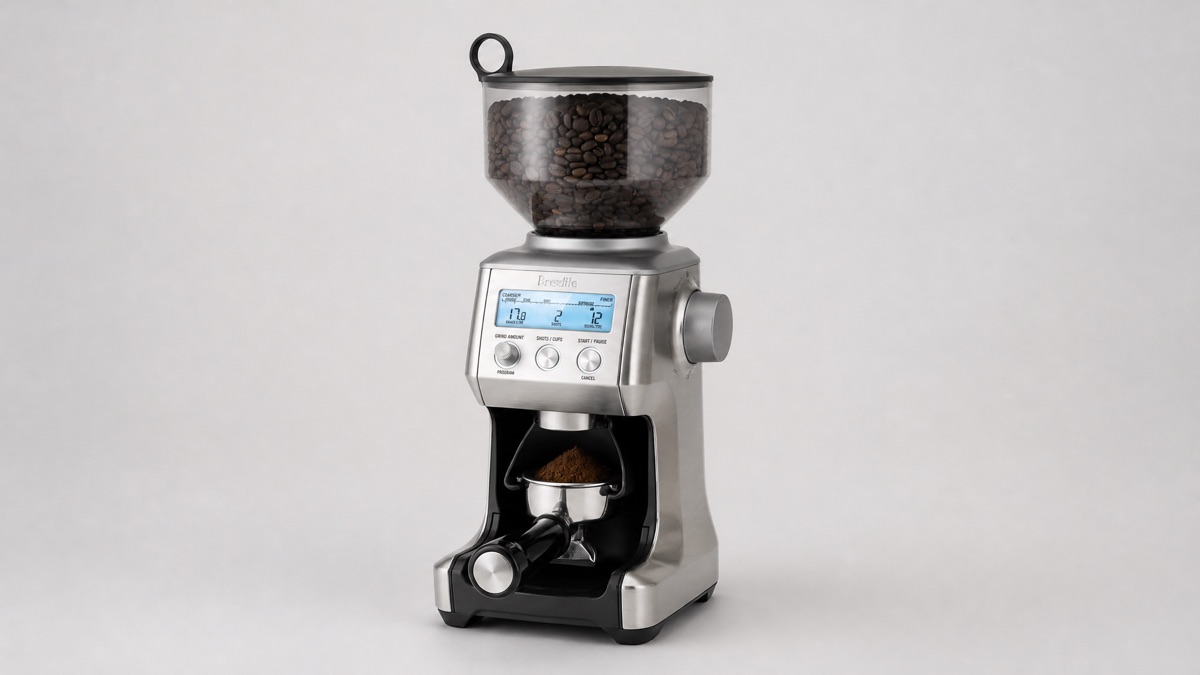
The Breville Smart Grinder Pro is a conical burr coffee grinder with 60 settings, an LCD and a digital timer. Breville sells the BCG820 for $199.95. The grinder covers espresso, drip and French press from one dial, so one machine serves every brew method.
A Coffee Review lab test ranked its grounds most even among four grinders. Dosing IQ sets each dose by time, and a cradle grinds straight into a portafilter. The coarse end is weaker, retention is about 3 g (0.1 oz), and the motor sounds strained at espresso grinds.
The Baratza Encore ESP beats it for pure espresso, while the Smart Grinder Pro wins for mixed brewing. Cleaning takes about 20 minutes a month, and the warranty runs 1 year. Just like the coffee I serve, this Smart Grinder Pro review comes with no hidden deals.
What Is the Breville Smart Grinder Pro?
The Breville Smart Grinder Pro is a programmable conical burr coffee grinder with 60 grind settings, an LCD and a digital timer. Breville sells it as model BCG820 for $199.95. The grinder covers espresso, drip and French press from one dial.
Breville launched the grinder around 2014 to replace the older Smart Grinder. The new model cut the timer step from 1 second to 0.2 seconds. Settings rose from 25 to 60, and a new burr set arrived.
The body is mostly plastic under a brushed stainless finish. A steel plate covers the back. The grinder measures 8.5 x 6.3 x 15.3 inches (21.6 x 16 x 38.9 cm) and weighs 6.39 pounds (2.9 kg).
Sage Appliances sells the same grinder in the UK and Europe as the Sage Smart Grinder Pro, model SCG820. Sage units are rated for 220-240 volts.
Breville aims the machine at coffee drinkers moving up from pre-ground coffee. CoffeeGeek calls it a jack of all trades that suits most home coffee lovers. The grinder comes in seven colors.
What Comes in the Box With the Smart Grinder Pro?
The Smart Grinder Pro box holds two portafilter cradles, a grounds container with a lid, and a cleaning brush. The small cradle fits 50-54 mm (2.0-2.1 in) portafilters. The large cradle fits 58 mm (2.3 in) portafilters.
In the box:
- Small 50-54 mm portafilter cradle
- Large 58 mm portafilter cradle
- Grounds container with lid and sealing cap
- Conical burr cleaning brush
Magnets snap both cradles and the grounds container into place. The container has cup lines on three sides for drip, French press and espresso. The lid screws on three ways to show the right set of lines.
The small cradle suits the Breville Bambino Plus and Barista Express portafilters. The box holds no scale and no portafilter.
A rubber cap on the lid seals the container to keep some freshness. A removable tray under the container catches stray grounds. Cleaning steps are printed under that tray.
The brush has no storage spot on the grinder. The manual is long and detailed. The manual covers espresso extraction and French press method as well as the controls.
How Does the Breville Smart Grinder Pro Work?
The Breville Smart Grinder Pro works by running its burrs for a set time, and that time sets the dose. A 165 watt motor turns 40 mm (1.6 in) stainless conical burrs at 450 RPM. Some listings give the burr size as 38 mm.
The slow burr speed limits heat in the beans. A side dial picks the fineness. Then a time or a cup count is set. Pressing start runs the burrs, and the grinder stops when the timer reaches zero.
Beans enter the burrs through the hopper, which locks in place. The grinder will not run if the hopper sits loose. A shutter closes the hopper chute when the hopper is unlocked. Beans stay in the hopper during removal.
A switch on the back wall starts the grind without the start button. Pressing a portafilter against it begins the grind. The switch works only with a cradle installed. The grounds container ignores that switch.
The LCD shows grind time, dose and fineness setting. The screen reads well from above. At eye level or below, the display fades out.
How Does Dosing IQ Work on the Smart Grinder Pro?
Dosing IQ on the Smart Grinder Pro sets grind time in 0.2 second steps for the cups or shots chosen. The timer measures seconds, not grams. The grinder has no scale, so the amount of grounds depends on how long the motor runs.
The grinder stores 46 timer settings. Press, perc and drip each hold 1 to 12 cups, and espresso holds 1 to 8 shots. With a cradle fitted, only 1 or 2 shots are available.
Times do not scale in a straight line. A drip time of 3.4 seconds for 1 cup becomes 26.6 seconds for 8 cups, not 27.2 seconds. Motor start-up and wind-down take time, and the math adjusts for that.
CNET programmed 22 g (0.8 oz) of grounds at setting 55 for 11.2 seconds. Asking for 8 cups produced about 180 g (6.4 oz) of grounds. A 40 oz (1.2 L) carafe needs only 66 g (2.3 oz). The 8 cup setting grinds far too much for it.
Setting 3 cups gave CNET the right amount for that carafe. Holding the start button grinds until release and counts up the time. This manual mode helps find the time for a target weight.
How Many Grind Settings Does the Smart Grinder Pro Have?
The Smart Grinder Pro has 60 main grind settings on the side dial. Four zones on the display are labeled press, perc, drip and espresso. Most of the 60 steps sit in the drip and espresso zones.
The dial alone does not set the full range. Lifting out the top burr carrier opens 10 more steps per setting. That gives up to 600 grind sizes. The carrier adjustment is fiddly, but it moves the whole range finer or coarser.
A fine range only helps if the grinder returns to the same spot. Settings repeat well. Going from setting 8 for espresso to setting 32 for drip, then back to 8, gives near identical grinds each time.
Only a handful of steps fall in the true espresso zone. The espresso side of the dial also covers moka pot grinds.
How Good Is the Grind Quality of the Breville Smart Grinder Pro?
The Breville Smart Grinder Pro delivers consistent fine and medium grinds, with a weaker coarse end. CoffeeGeek says output from espresso through V60 matches most grinders under $300. Spruce Eats saw powdery fine grounds.
Coffee Review tested this with a lab method called laser diffraction, run by Horiba Instruments. Four grinders were tested. The Smart Grinder Pro landed the highest share of grounds in the target range. The best result was 58.1 percent inside a 400 micron range at a fine grind of a light roast.
Taste of Home checked consistency with a Kruve sifter, a tool that sorts grounds by particle size. The site called the result beautiful. A fine grind took nearly 20 seconds. A coarse grind took 8 seconds.
Consistency drops at the coarse end, where fines mix with larger chunks. Roasty Coffee points to uneven extraction in French press as the result.
Scores vary by source. CoffeeGeek rates performance 7.5 out of 10 and the grinder 8.5 overall. CNET scores it 7.4 out of 10. The burr design is more than 10 years old.
Is the Smart Grinder Pro Good for Espresso?
Yes. The Smart Grinder Pro grinds well enough for good espresso, though it is not the best espresso grinder. Taste of Home pulled shots at settings 20, 15 and 10, and all came out weak.
Setting 7 ran 23 seconds in that test and made a shot close to perfect. That result shows the grinder can reach a good espresso grind. It suits beginners who want an espresso option inside an all-round grinder.
The limit shows up in the size of each step near the fine end. These steps are coarser than on the Baratza Encore ESP, which moves about 20 microns per click. CoffeeGeek ranks the Baratza ahead for pure espresso.
The Smart Grinder Pro also saves a step at the machine. Its cradle fills a portafilter directly, so no transfer is needed. It fits baskets from 50 mm to 58 mm (2.0-2.3 in). Lever machines from La Pavoni and Elektra with 48-49 mm baskets do not fit.
Dosing is the last weak spot. The grinder doses by time, and timed doses drift as beans age and the hopper empties. A scale stays necessary for dialing in shots.
Does the Smart Grinder Pro Grind Coarse Enough for French Press?
No. The Smart Grinder Pro grinds too fine for proper French press at its coarsest setting. CNET reached that verdict for French press, cold brew and siphon brewing.
Results differ on cold brew. Spruce Eats used the coarse setting in a cold brewer. The liquid drained cleanly, and the fine residue matched commercially ground coffee.
Fines rise at coarse settings. Independent testing found more fines than the Baratza Encore ESP produces, which can leave a slightly silty cup.
CoffeeGeek says press pot performance drops off, but less than on the Baratza Encore. Buyers who mainly brew French press or siphon coffee do better with a cheaper all-purpose burr grinder, as CNET advises.
What Are the Downsides of the Breville Smart Grinder Pro?
The Breville Smart Grinder Pro has downsides in retention, motor sound, screen angle and dose accuracy. Grounds collect around the vanes of the cone burr. Retention is heavy.
Weak spots:
- Heavy retention
- Strained AC motor
- LCD that fades at eye level
- Doses timed in seconds, not grams
- No full pot setting
The AC motor sounds strained at espresso grinds and runs louder with an empty hopper. The LCD fades at eye level and below. The timer measures seconds, so doses drift with bean age and hopper level.
The grinder has no scale. CNET adds that manual mode needs the start button held down the whole time.
Programming counts cups and shots only. A full pot of drip has no setting, so large batches need a trial run to find the right time.
The burr set and motor are old designs. CoffeeGeek wants a DC motor and a new burr set in a future model.
How Much Coffee Does the Smart Grinder Pro Retain?
The Smart Grinder Pro retains about 3 g (0.1 oz) of coffee after grinding. Coffee Review found that amount, mostly very fine powder under the cone burr, when it cleaned out the grinder. CoffeeGeek calls the retention massive.
The coffee stays in the grinder because of its shape. Gaps around the vanes of the cone burr hold ground coffee, and fine powder packs into them.
Leftover grounds cause trouble for owners who grind for espresso. They wipe the chute every few days to stop clumps from forming there.
Old grounds also end up in the next dose. A quick purge of a gram or two before the real dose clears them out.
Single dosing, which means grinding only the beans for one drink, makes this worse. CoffeeGeek advises against single dosing this grinder for espresso. Old grounds mix with fresh ones in the burr chamber. A hopper full of beans suits the grinder better.
How Loud Is the Smart Grinder Pro?
The Smart Grinder Pro is loud at about 80 dB, but quieter than the Baratza Encore ESP. CoffeeGeek also finds it quieter than the Baratza Virtuoso+.
Serious Eats finds it quieter than the Baratza and OXO grinders tried there. No decibel meter backs that up, so the finding rests on listening alone. Taste of Home called the noise fairly muffled at its peak.
The AC motor sounds strained at espresso grinds. The grinder also gets louder when the hopper holds no beans.
How Do You Clean the Breville Smart Grinder Pro?
Cleaning the Breville Smart Grinder Pro takes a brush, a damp cloth and about 20 minutes. The hopper lifts off first. The top burr carrier then lifts out by its metal handle.
Cleaning steps:
- Lift the hopper off the grinder.
- Lift the top burr carrier out by its metal handle.
- Brush the grounds out of the burr chamber with the supplied brush.
- Wipe the body with a damp cloth.
- Rinse the grounds bin and hopper in water.
The supplied brush clears the grounds from the burr chamber. A damp cloth wipes the rest of the body. The grounds bin and hopper rinse clean in water. The manual says no part goes in the dishwasher.
A 10 mm socket wrench removes the nut under the bottom burr for a deeper clean. Roasty Coffee vacuums the chamber with a hose attachment every month or two.
The machine makes little static, so few grounds cling to the chute and bin. Serious Eats says the catch bin keeps the counter clean.
How Often Should You Clean the Smart Grinder Pro?
The Smart Grinder Pro needs a deep clean about once a month. Home Coffee Expert runs a monthly deep clean. Serious Eats cleans its grinder every four to six weeks.
Espresso use calls for more care. Wiping the chute every few days stops clumps from building.
Skipped cleaning has a cost. Residue gums up the parts, and old grounds add sour flavors to the coffee. Roasty Coffee brushes the machine out regularly for that reason.
Breville Smart Grinder Pro vs Baratza Encore ESP: Which Is Better?
The Baratza Encore ESP beats the Breville Smart Grinder Pro for espresso, while the Breville wins for mixed brewing. The Encore ESP spreads 40 settings over two ranges, with 20 for espresso.
Each espresso click on the Encore ESP moves the burr about 20 microns. Its 40 mm M2 burrs are made in Liechtenstein. The Smart Grinder Pro instead spreads 60 steps across every brew method.
Specs side by side:
| Spec | Smart Grinder Pro | Encore ESP |
|---|---|---|
| Grind settings | 60 time-based settings | 40 stepped settings |
| Burr speed | 450 RPM | 550 RPM |
| Motor power | 165 W | 70 W |
| Hopper | 18 oz (510 g) | 300 g (10.6 oz) |
| List price | $199.95 | $199.95 |
| Warranty | 1 year limited | 1 year limited |
The Smart Grinder Pro wins on controls. Timers, a portafilter trigger and a larger hopper make daily use easier. CoffeeGeek counts about 35 usable clicks from AeroPress to press pot, against about 20 on the Encore ESP.
Outside espresso the two are close. In CoffeeGeek blind taste tests, the nod went slightly to the Encore ESP.
Repairs are where the two differ, even though Baratza belongs to Breville. Baratza stocks parts and supports self repair. Breville replaces units in warranty, then offers little help afterward, though its parts cost little.
Since the price and warranty are the same, the choice depends on how much espresso is made. CoffeeGeek picks the Smart Grinder Pro unless 75 percent of brewing is espresso.
How Does the Smart Grinder Pro Compare to the Dose Control Pro?
The Smart Grinder Pro compares well to the Dose Control Pro, with finer timer steps and an LCD. The Smart Grinder Pro adjusts time in 0.2 second steps. The Dose Control Pro adjusts in 1 second steps.
The Dose Control Pro, model BCG600SIL, also has 60 grind settings. It has no LCD, so a timer dial replaces the screen. The price drops only slightly, with US listings near $160.
CoffeeGeek advises skipping the Dose Control Pro. A few extra dollars buy the added features of the Smart Grinder Pro. The Dose Control Pro portafilter forks also lack the magnets of the Smart Grinder Pro.
How Much Does the Breville Smart Grinder Pro Cost?
The Breville Smart Grinder Pro costs $199.95 at Breville and most major retailers. Taste of Home lists the same $199.95 at Walmart, Crate & Barrel and Williams Sonoma.
The grinder launched around 2014 at about $230. The price has dropped to $200. Sales often cut it to $175 or less.
Rival prices:
| Grinder | Price |
|---|---|
| Breville Smart Grinder Pro | $199.95 |
| OXO Brew Conical | about $99 |
| Baratza Encore | about $139 |
| OXO On Barista Brain | about $200 |
CoffeeGeek rates the grinder best of class near $150 and scores value 10 out of 10. Used units keep value, and CoffeeGeek estimates a seller can recover up to 65 percent of retail.
CNET priced rivals for comparison. The OXO Brew Conical costs about $99, the Baratza Encore about $139, and the OXO On Barista Brain about $200.
What Warranty Does the Smart Grinder Pro Have?
The Smart Grinder Pro carries a 1 year limited warranty from Breville. Some retail listings advertise 2 years. Breville's own page and Taste of Home state 1 year, so the length should be confirmed before buying.
CoffeeGeek says Breville often replaces a broken unit that is still in warranty. It sometimes does so without getting the broken one back. After warranty, repairs are hard, and the motor cannot be swapped.
Reports on service conflict. Spruce Eats and Home Coffee Expert praise Breville support. Roasty Coffee calls it unreliable and notes few replacement parts. CoffeeGeek says Breville sells parts cheaply.
Is the Breville Smart Grinder Pro Worth It?
Yes. The Breville Smart Grinder Pro is worth it for coffee drinkers who brew more than one way. Taste of Home ranked it best overall among tested grinders.
Other reviewers agree. Serious Eats calls it a favorite after years as the office grinder. CoffeeGeek scores it 8.5 out of 10, and CNET scores it 7.4 out of 10.
Flaws hold the grinder back. Retention is heavy. The motor sounds strained. Coarse grinds carry fines, which are tiny dust-like particles. Doses are timed instead of weighed.
The price offsets those flaws. CoffeeGeek rates the grinder very recommended at $200 and best of class near $150. At those prices, the features are a bargain in today's grinder market.
The design is about 10 years old. CoffeeGeek wants a refresh with a new burr set, a DC motor and less retention. Until then, the grinder stays a solid all-rounder.
Who Should Skip the Smart Grinder Pro?
Espresso-only buyers skip the Smart Grinder Pro in favor of a finer stepped or stepless grinder. Home Coffee Expert points espresso fans to a stepless grinder such as the Eureka Mignon Specialista.
The Baratza Encore ESP also fits that buyer. Single dosers lose grounds to retention. The hopper design suits full-hopper use.
Mostly French press or siphon brewers do better with a cheaper all-purpose burr grinder, as CNET advises. The OXO Brew Conical costs under $100.
Home Coffee Expert recommends a manual grinder such as the 1Zpresso J Max for travel.
Odradeks Coffee House is reader-supported. If you buy through a link on this page, we may earn a small affiliate fee at no extra cost to you.