Bonsenkitchen Espresso Machine Review: Is It Worth It?
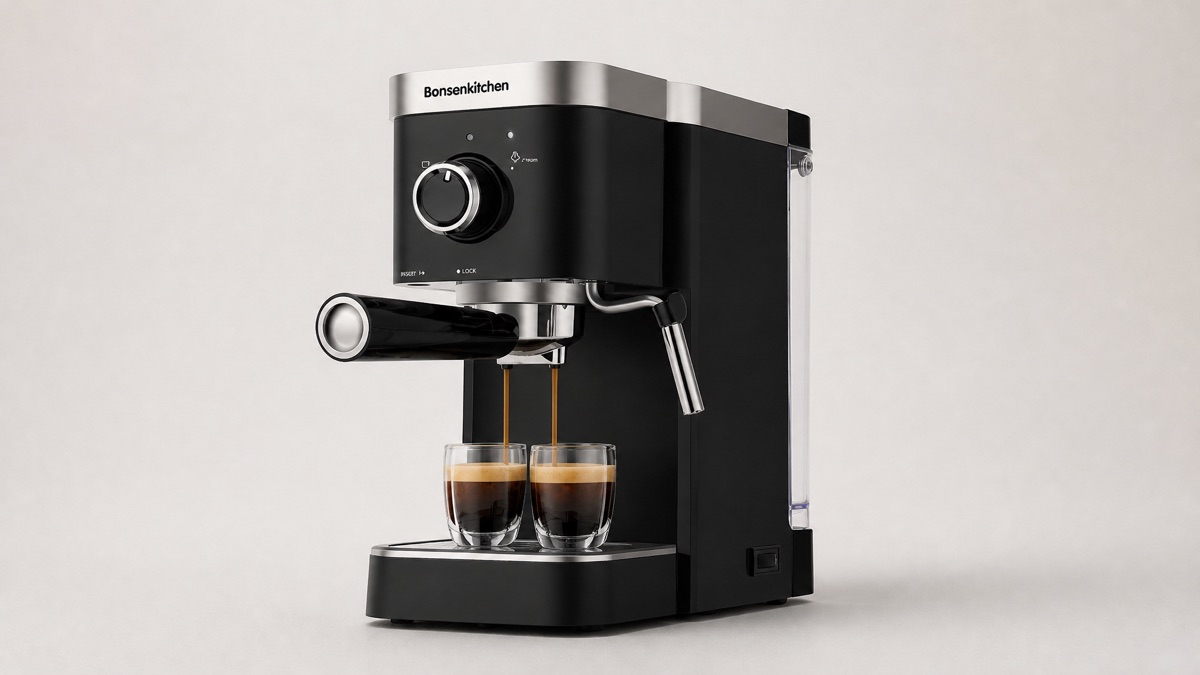
Hey there, Sam here, with a fresh pot brewing. The Bonsenkitchen espresso machine is a compact pump espresso maker with a steam wand and a metal funnel. The tank holds 1.25 liters (42 oz). Regulars who brew at home ask me about Bonsenkitchen often.
Bonsen Electronics Inc. sells the CM8001 and CM8008 models from Norcross, Georgia. The CM8001 prints 1350 W and heats in 30 to 35 seconds. Espresso quality draws 74 owner mentions. Leaks draw 48 mentions, and reliability draws 110 mixed ones.
The Amazon listing holds 3.9 stars from about 1,600 ratings. This review covers the models, brewing, leaks, reliability, descaling, rivals, price and warranty. I wrote this Bonsenkitchen espresso machine review the way I run my shop, on my own terms.
What Is the Bonsenkitchen Espresso Machine?
The Bonsenkitchen espresso machine is a compact pump espresso maker with a metal funnel, a steam wand and a froth device. The tank holds 1.25 liters (42 oz). The body measures 12.28 in (31.2 cm) wide, 6.1 in (15.5 cm) deep and 12.24 in (31.1 cm) tall.
The machine is a semi-automatic espresso maker. The user doses, tamps and stops each shot by hand. The metal funnel is a portafilter, the handled holder that carries the steel mesh basket.
Bonsen Electronics Inc. sells the machine from Norcross, Georgia. The brand also sells juicers, vacuum sealers and drip coffee makers. The espresso machine brews ground coffee only.
The Amazon listing shows a 3.9 star average from about 1,600 ratings.
The machine drops into standby after 25 minutes of no use, with every light off. Pressing any button wakes the machine again.
What Comes With the Bonsenkitchen Espresso Machine?
The Bonsenkitchen espresso machine comes with a metal funnel, a steel mesh filter, a froth device and a spoon. The manual lists a removable shelf, a drip tray and a detachable water tank as well.
Parts List:
- Metal funnel with handle
- 2-cup steel mesh filter
- Froth device for the steam wand
- Spoon for dosing ground coffee
- Removable shelf and drip tray
- Detachable water tank with a cover
The manual also names a 1-cup steel mesh. The parts diagram shows only the 2-cup mesh.
The tank cover opens for filling, and the tank slides out for easy washing. The manual also names a water float.
Which Models Make Up the Bonsenkitchen Espresso Machine?
The Bonsenkitchen espresso machine sells under at least two US model codes, the CM8001 and the CM8008. The CM8001 manual prints 120 V, 60 Hz and 1350 W. The CM8008 manual prints 120 V, 60 Hz and 850 W.
The two models also differ in how the user runs them. The CM8001 uses a coffee and steam knob. The CM8008 uses Power, Pump and Coffee/Steam buttons plus a steam knob.
Pressure claims differ by listing. One eBay page lists the CM8001 at 20 bar. The Amazon page for the same CM8001 manual says 15 bar. Both numbers are pump maximums, not brewing pressure.
A 220 V version also exists, rated at 1450 W and weighing 3 kg (6.6 lb). Its listing carries the warning NOT FOR USA. A US kitchen outlet needs the 120 V models.
Model Comparison:
| Model | Power | Pressure listed | Controls |
|---|---|---|---|
| CM8001 | 1350 W | 15 or 20 bar | Coffee and steam knob |
| CM8008 | 850 W | 15 bar | Three buttons and a steam knob |
| 220 V version | 1450 W | 15 bar | Control knob, not for USA |
Listings name ground coffee as the only coffee type. ESE pods, the flat pre-dosed paper pods, are not listed as supported.
How Does the Bonsenkitchen Espresso Machine Work?
The Bonsenkitchen espresso machine works by heating tank water and pushing the hot water through ground coffee in the metal funnel with an electric pump. The steam wand runs from the same heater. A knob opens and closes the steam.
The 220 V version lists an aluminum alloy thermo block with a stainless steel heating channel. A thermo block heats water on demand as the water flows past. This is how the machine gets water hot enough to brew.
Heating takes time, so the CM8008 shows its state with lights. The Pump light flashes while the machine preheats. The light stays solid once the water is hot enough to brew.
Pressing Pump before the light turns solid triggers an alarm, because the water is not hot enough yet. The Pump light flashes fast. The machine returns to preheating after another press of Pump.
The pump also has a time limit. It stops by itself after 90 seconds of continuous pumping. Pressing Pump again clears that alarm. The brew time for one shot stays well under that limit.
How Do You Make Espresso With the Bonsenkitchen Espresso Machine?
The Bonsenkitchen espresso machine makes espresso by pumping hot water through one level spoon of tamped ground coffee in the metal funnel. The manual says one spoon of ground coffee makes about one cup.
Steps:
- Rinse the machine with plain water on first use and with no coffee in the mesh.
- Preheat the funnel, the filter and the cup with hot water.
- Fill the steel mesh with ground coffee and press the grounds down with the tamper.
- Insert the funnel, then turn the funnel anticlockwise until the funnel locks.
- Press Pump once the Pump light shines.
- Press Power when the coffee color turns weak.
Noise on the first pumping is normal. The air inside escapes, and the noise fades after about 20 seconds.
The manual warns against leaving the machine alone while a shot runs. The user stops the shot by hand. Funnel removal while brewing is also banned.
How Do You Froth Milk With the Bonsenkitchen Espresso Machine?
The Bonsenkitchen espresso machine froths milk with a steam wand that needs about 100 ml (3.4 oz) of cold whole milk for each cappuccino. Whole milk at fridge temperature gives the manual's best result.
Milk doubles in volume while frothing, so the jug matters. It needs a diameter of at least 70 mm (2.8 in), give or take 5 mm.
The steam knob controls how fast steam builds. It turns slowly anticlockwise, because a fast turn builds steam too quickly and the manual flags a risk of explosion. The froth device sits about 2 cm (0.8 in) deep in the milk.
The machine needs 5 minutes to cool before the next espresso. A shorter wait leaves a burnt smell in the cup. A wet sponge cleans the steam outlet right after steaming.
Weak froth has three listed causes:
- Indicator: The white indicator is not lit.
- Jug: The jug is too wide.
- Milk: The milk is skimmed.
A high, narrow cup and whole or half-skimmed milk fix the problem.
Does the Bonsenkitchen Espresso Machine Make Good Espresso?
Yes. The Bonsenkitchen espresso machine makes good espresso for a budget pump machine, and espresso quality draws 74 mentions from owners. Another 38 mentions praise the coffee taste, and the frothing and latte results earn praise too.
No timed shot, cup temperature or yield figure exists for the machine, and no lab or hands-on test turned up. Every quality claim rests on owner comments.
The box lists 15 bar and 20 bar, but these numbers describe the pump maximum. Espresso extracts at about 9 bar at the coffee, the long-standing standard. A bigger number on the box therefore does not mean a better shot.
The machine brews ground coffee only, so grind size is the biggest quality lever. A burr grinder gives a more even grind than a blade grinder.
The machine has no pressure gauge, no pre-infusion and no temperature control. Pre-infusion is a gentle first wetting of the grounds before full pressure starts. Without these features, the user times each shot by eye and stops the pump by hand.
How Fast Does the Bonsenkitchen Espresso Machine Heat Up?
The Bonsenkitchen espresso machine heats up in 30 to 35 seconds on the CM8001 spec sheet. Heating time draws 33 owner mentions.
Some owners report coffee that is not hot enough. The manual advises preheating the funnel, the filter and the cup. Cold metal parts pull heat out of the first shot.
Steam leaves the machine too hot for coffee. The lights flash fast after frothing when the unit runs too hot. Pressing Coffee/Steam then Pump cools the unit with water.
What Do Owners Say About the Bonsenkitchen Espresso Machine?
Owners rate the Bonsenkitchen espresso machine 3.9 stars out of 5 across about 1,600 ratings. The praise centers on espresso, froth and quick heating. The complaints center on leaks, reliability and value.
Topic Mentions:
- Reliability: 110 mentions
- Value for money: 88 mentions
- Espresso quality: 74 mentions
- Ease of use: 55 mentions
- Leakage: 48 mentions
- Coffee taste: 38 mentions
- Heating time: 33 mentions
- Durability: 32 mentions
Reliability and value both get mixed verdicts. Some owners say the machine works well. Others say the machine never worked and was not worth the money.
The handle is hard to turn for some buyers. A used CM8001 on eBay holds 4.5 stars, but only 2 ratings back that score.
Does the Bonsenkitchen Espresso Machine Leak?
Yes. The Bonsenkitchen espresso machine leaks for some owners, and leakage draws 48 mentions. Some report water gushing out from underneath the machine.
The manual lists two causes for water at the base. The drip tray holds too much water, or the machine has a fault. Emptying the drip tray fixes the first cause.
A fault needs an authorized service center. The manual bans taking the machine apart without a known cause.
A leak around the outside of the filter has a separate cause. Coffee powder sits on the filter edge and breaks the seal. Wiping the edge clean solves the leak.
Is the Bonsenkitchen Espresso Machine Reliable?
No. The Bonsenkitchen espresso machine is not reliable for every owner, and reliability draws 110 mixed mentions. Another 32 mentions flag durability problems.
Some units failed within four weeks of normal use. Others never worked at all. Other units keep brewing without trouble.
A failed unit is hard to fix at home. The housing has no user serviceable parts, and the manual sends every repair to an authorized service center. An owner with a broken machine must therefore go through the company. Support runs through support@bonsenkitchen.com and 1-888-965-8032.
How Do You Clean the Bonsenkitchen Espresso Machine?
Cleaning the Bonsenkitchen espresso machine starts with an unplugged, fully cooled machine and a moisture-proof sponge for the housing. The manual bans alcohol and solvent cleaners. The housing never goes under water.
Cleaning Checklist:
- Wipe the housing with a moisture-proof sponge
- Wash the water tank, the drip tray and the removable shelf
- Dry every part before the next use
- Rinse the funnel under clear water
- Wipe the steam outlet with a wet sponge
The funnel comes off by turning clockwise. Cleanser works on the funnel, but a final rinse in clear water follows. The press bar knocks the used grounds out of the mesh.
Long storage needs one extra step. The manual says to power the machine on and release steam for 3 minutes before leaving it unused.
How Often Do You Descale the Bonsenkitchen Espresso Machine?
The Bonsenkitchen espresso machine needs descaling every 2 to 3 months. Mineral deposits slow the internal piping and dull the coffee flavor.
The manual gives two solutions. A household descaler mixes at 4 parts water to 1 part descaler. Citric acid mixes at 100 parts water to 3 parts acid.
Descaling Steps:
- Fill the tank to the MAX line with the solution.
- Preheat, then brew two cups, about 2 oz (60 ml) in total.
- Release steam for 2 minutes, then switch the machine off.
- Let the solution soak for at least 15 minutes.
- Repeat the brew, steam and soak cycle at least 3 times.
- Rinse with tap water at the MAX line, repeating at least 3 times.
Mineral deposits are limescale, a hard crust of calcium and magnesium salts. The manual lists a household descaler and citric acid. The manual does not list white vinegar.
The wrong descaler harms the machine. The manual warns that an unlisted type may rust the metal parts in the tank. A vinegar taste in the espresso means the rinse was too short.
How Does the Bonsenkitchen Espresso Machine Compare With Rivals?
The Bonsenkitchen espresso machine compares with rivals such as De'Longhi, Gevi and Mr. Coffee. The Bonsenkitchen pairs the largest tank with the least feature detail.
Rival Specs:
| Machine | Pump | Tank | Extras |
|---|---|---|---|
| Bonsenkitchen espresso machine | 15 or 20 bar | 1.25 L (42 oz) | Steam wand, auto standby |
| De'Longhi Stilosa EC260BK | 15 bar | 1 L (34 oz) | Manual steam wand |
| CASABREWS CM5418 | 20 bar | 34 oz (1 L) | Steam wand, $139.99 list price |
| Gevi ECMG0 | 20 bar | Not confirmed | Temperature control, pre-infusion |
| Mr. Coffee compact | Not confirmed | Not confirmed | 4.4 stars from 66 ratings |
The CASABREWS CM5418 is a 20 bar machine with a 34 oz (1 liter) removable tank and a $139.99 list price. Its tank is smaller than the Bonsenkitchen tank, and its list price is higher.
The Gevi lists temperature control and pre-infusion. The Bonsenkitchen lists neither feature in its manual or its specs.
How Does the Bonsenkitchen Espresso Machine Compare With the De'Longhi Stilosa?
The Bonsenkitchen espresso machine holds a larger tank than the De'Longhi Stilosa EC260BK, at 1.25 liters (42 oz) against 1 liter (34 oz).
The De'Longhi Stilosa has other strengths on paper. It lists a 15 bar pump, which is the pressure that pushes hot water through the coffee. It also lists a stainless steel boiler, the part that heats the water.
The Stilosa sold for $82 in a December 2024 deal, down from a $100 list price. That price sets the bar for any Bonsenkitchen offer.
The Stilosa is not free of problems. Some find it loud, and one buyer saw a unit die within a year. Both machines show mixed durability, so neither one is a clearly safer pick.
How Much Does the Bonsenkitchen Espresso Machine Cost?
The Bonsenkitchen espresso machine costs about $89.99 in its last known US deal, with no confirmed current price. That deal dated from 2022, covered the 20 bar version and has expired. Prices on new units move often.
Used units sell for less, but shipping can cost more than the machine. One used CM8001 on eBay listed at $37.90 plus $43.29 in shipping. Another listing asked $59.87 plus $110.98 in shipping.
The 220 V version listed at $248.18 and showed Not In Stock. That unit carries the warning NOT FOR USA, so a US buyer skips it.
The machine takes ground coffee only, so a buyer without a grinder pays extra. A burr grinder, a milk jug and citric acid for descaling add to the first-year cost.
Whether the total is worth it depends on the unit that arrives. Value for money draws 88 mixed mentions. Owners who got a working unit call the price fair. Owners with a failed unit call the price a loss.
Does the Bonsenkitchen Espresso Machine Come With a Warranty?
No. The Bonsenkitchen espresso machine does not state a warranty length in its espresso manuals. The manuals only describe the steps for making a claim.
A claim needs the till receipt and the item number. The item number sits on a sticker at the rear or bottom of the machine. Support handles claims at support@bonsenkitchen.com or 1-888-965-8032.
The brand's K-cup coffee maker manual lists a 1 year limited warranty that does not transfer to a later owner. That term belongs to a different model, so it cannot be assumed for the espresso machine. A buyer should confirm the term for the espresso machine before relying on it.
Is the Bonsenkitchen Espresso Machine Worth It?
Yes. The Bonsenkitchen espresso machine is worth it only as a low-cost first machine for a buyer who accepts some reliability risk. Strong espresso and froth praise sits next to leak and failure reports.
Pros:
- Low price on most listings
- Quick heating in about 30 to 35 seconds
- Steam wand for milk drinks
- Large 1.25 L (42 oz) tank
Cons:
- Leaks reported by owners
- Mixed reliability, with some early failures
- No temperature control or pre-infusion
- No warranty term in the espresso manual
The machine is a low-risk try at a low price. A higher price makes the failure reports harder to accept.
Who Should Buy the Bonsenkitchen Espresso Machine?
A first-time espresso buyer should buy the Bonsenkitchen espresso machine, especially with a small counter and a ground coffee habit. The machine needs hands-on shot timing and a manual stop.
A buyer who wants one shot at a time should look elsewhere. The CM8001 brews two shots every time, per the brand FAQ.
Three other types of buyers should skip the machine:
- Pod users: The machine takes ground coffee, so pods do not fit it.
- Buyers who want set temperature control: The machine does not offer it.
- Buyers who need a long track record: The machine does not have one.
A drip coffee maker or a stovetop pot suits those buyers better.
Odradeks Coffee House is reader-supported. If you buy through a link on this page, we may earn a small affiliate fee at no extra cost to you.