Bodum Bistro Grinder Review: Is It Worth It?
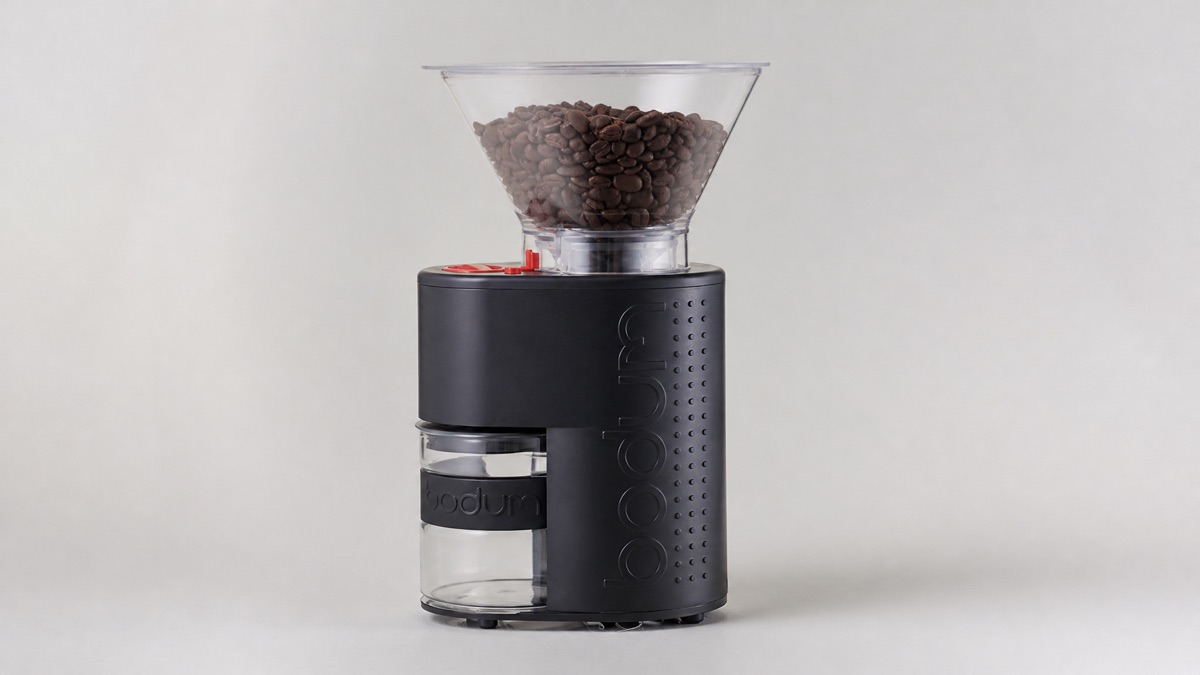
Have a seat, I'm Sam, and the Bodum review starts now. The Bodum Bistro is an entry-level electric burr grinder from the Danish brand Bodum. It has 35 mm (1.4 in) stainless steel conical burrs, 12 grind settings and a glass catcher. The 10903 model adds a 5 to 20 second timer and costs about $80.
After 14 years of running a shop, Colombian Nariño is still my favorite test coffee. The Bistro grinds well for the price, with 73% of pour over grounds in the ideal size range. The glass catcher cuts static but does not stop it. A 20 second run limit and a 5 minute rest slow big batches. Coarse grounds come out uneven. Bodum sells only the glass catcher and the outer burr as parts.
The Bistro fits budget drip, pour over and AeroPress brewing. The grinder falls short for French press, non-pressurized espresso and repairs. This review covers the timer, cleaning, grind quality, problems, rivals such as the Baratza Encore, and a final verdict. What you read here comes from my shop and my research, not from Bodum.
What Is the Bodum Bistro Grinder?
The Bodum Bistro grinder is an entry-level electric burr grinder from the Danish brand Bodum. Bodum started in Copenhagen in 1944 and made its name with the Chambord French press.
Jørgen Bodum, the founder's son, took over in 1974. The company moved to Switzerland in 1978 and is based in Triengen today.
The grinder crushes beans between 35 mm (1.4 in) stainless steel conical burrs. A 160 W motor turns the burrs at about 720 rpm. A dial offers 12 grind settings from fine to coarse. The settings are fixed clicks, not a continuous dial.
The body is mostly matte plastic and measures about 7.6 x 7.1 x 12.5 in (19.3 x 18 x 31.8 cm). The hopper holds 7.8 oz (220 g) of beans.
The buyer is usually a drip, pour over or AeroPress drinker who is leaving a blade grinder behind.
Which Bodum Bistro Is the Burr Grinder?
The Bodum Bistro 10903 is the premium burr grinder, with a glass catcher, a timer and a friction clutch. The lid also carries a printed grind guide.
The Bistro Standard, model 11750, is a simpler burr grinder. The Standard has a plastic catcher and no timer, no friction clutch and no grind guide. The Standard costs about $30 less.
Bistro Burr Models:
| Model | Catcher | Timer | Friction Clutch |
|---|---|---|---|
| Bistro 10903 | Glass | Yes | Yes |
| Bistro Standard 11750 | Plastic | No | No |
Bodum also puts the Bistro name on blade grinders such as the 11160 and the C-Mill. A blade chops beans and has no grind settings. A listing must say burr and show a glass catcher before the grinder is the 10903.
The 10903 comes in black, white, red, chrome and copper finishes. Some colors cost a few dollars more. The color does not change the burrs or the motor.
How Does the Bodum Bistro Grinder Work?
The Bodum Bistro grinder works by crushing beans between two stainless steel conical burrs. The gap between the burrs sets the grind size.
A blade grinder chops beans at random, so the pieces vary in size. A burr grinder crushes beans to a set gap, so the grounds come out more even.
Because the gap sets the grind size, the user needs a way to change it. Twisting the hopper picks one of 12 settings. Markers on the collar point to espresso, drip and French press zones.
The burrs are turned by a 160 W motor at about 720 rpm. The speed delivers about 1.5 to 2 g (0.05 to 0.07 oz) of ground coffee each second.
Hard objects in the beans can damage the gears. A friction clutch protects the gears from stones. A stone makes a rattling noise, and the owner then switches the grinder off.
How Do You Use the Bodum Bistro Timer?
The Bodum Bistro timer is simple to use: set 5 to 20 seconds, then press the start button. A second press stops the grind early.
Steps:
- Add beans to the hopper.
- Twist the hopper to a grind size.
- Switch the power on at the side.
- Set the timer between 5 and 20 seconds.
- Press the start button.
A full 20 seconds grinds about 32 to 40 g (1.1 to 1.4 oz) of coffee. Twenty seconds is enough for two to four cups. The timer counts seconds, not grams.
Bodum asks for a 5 minute rest after a full 20 second run. The rest keeps the motor from overheating. A 12 cup batch of drip coffee therefore takes more than 10 minutes.
A chart on the lid lists grind size and time for each brew method. The dial does not hold its place, so the owner resets it for each batch.
How Do You Clean the Bodum Bistro?
The Bodum Bistro is easy to clean because the hopper and adjustment ring lift off to expose the burrs.
The owner unplugs the grinder before any cleaning. With the burrs exposed, a soft brush clears them every couple of weeks. This matters because coffee oils turn rancid, and old grounds flatten the taste of fresh beans.
The glass catcher and the lid are dishwasher safe. Hand washing is gentler, though. Every part must dry fully before the grinder is put back together.
Brushing handles the surface, but a deeper clean every 3 to 6 months helps the grinder last. Grinder cleaning pellets work well for this, and Urnex Grindz is a common brand. Removing the top burr is not advised, and the lower burr is hard to pull out.
The motor base never goes in water. The burrs are steel, so they can rust if they stay wet.
What Features Does the Bodum Bistro Have?
The Bodum Bistro does have the key features: a 7.8 oz (220 g) hopper, a glass catcher, a timer and 12 grind settings. The features suit a first burr grinder.
The hopper holds the beans before they are ground. It is clear plastic with no UV tint, so light reaches the beans inside. For that reason, beans should not sit in it for long. The rubber lid carries a printed grind chart. The lid is flimsy and sits loose on top of the hopper.
The ground coffee falls into a glass container made of borosilicate glass. This is the same family of glass used in Bodum French presses. A silicone band gives grip. The container holds about 3 oz (85 g) of grounds.
The controls are simple. A power button sits on the side, and a timer dial and a start button sit on top. The timer sets how long the grinder runs. The grinder stops by itself when the timer ends, and it stores its cord.
The body is matte plastic that resists scratches. The red buttons and dial can fade with time.
Does the Bodum Bistro Glass Catcher Stop Static?
No. The Bodum Bistro glass catcher cuts static but does not stop it. Glass holds far less charge than a plastic bin, so the counter stays cleaner.
Static starts during grinding. Beans rub against the burrs and the chute, and this builds a charge called the triboelectric effect. Plastic holds that charge, so grounds cling to it. Glass holds much less.
Less charge still leaves some mess. TechGearLab scored the Bistro 5.8 out of 10 for cleanliness. Grounds cling to the cup and the chute, and a quick wipe of the counter clears the spill.
About 1 to 1.5 g (0.04 to 0.05 oz) of coffee stays in the chute after each run. A light knock on the side while the last beans grind pushes most of it out.
Moisture on the beans also lowers the charge. One drop of water on the beans before grinding cuts static further. The method is called the Ross Droplet Technique, and David Ross is credited with it from a 2005 coffee forum post. Dry air and dark roasts raise static.
How Well Does the Bodum Bistro Grind?
The Bodum Bistro grinds well for the price, with 73% of pour over grounds in the ideal size range. TechGearLab measured that share with a stack of sieves.
TechGearLab scored grind consistency 6.9 out of 10. The Bistro scored 61 overall and ranked fifth of 16 grinders.
TechGearLab Scores:
| Test | Score Out of 10 |
|---|---|
| Grind consistency | 6.9 |
| Ease of use | 7.0 |
| Cleanliness | 5.8 |
| Noise | 3.5 |
Pour over runs finished in 2:33 to 2:48, close to the 3 minute target. Doses at one setting varied by about 1 g (0.04 oz).
The 27% of grounds outside the ideal range still matters. Pour over grounds carry many fines, which are very small particles. Fines make the cup harsh with little sweetness. A slightly coarser setting and a stronger ratio, such as 1:14, soften the harshness.
Noise is the other weak spot. The motor whine is high pitched, and TechGearLab scored noise 3.5 out of 10. A 20 second maximum run keeps the sound short.
Setting choice depends on the brew method. Drip, pour over and AeroPress sit in the sweet spot. The second finest setting suits a moka pot.
Is the Bodum Bistro Good for French Press?
No. The Bodum Bistro is not good for French press because its coarse grounds come out uneven. Coarse settings leave many boulders, which are large chunks of bean.
Boulders extract slowly, so the water pulls less flavor from them than from smaller grounds. As a result, some particles taste sour and thin. Consistency drops fast just above the pour over mark.
The grinder has only 12 settings across its whole range. Each step is therefore big, and the jump from fine to too coarse is short. Finding a setting that suits French press is hard.
Bodum is best known for French presses, yet the grinder is weakest at French press sizes. Immersion brewing, where the grounds soak in the water the whole time, hides fines better than pour over does. The cup is acceptable for that reason.
A stronger ratio such as 1:14 (1 g of coffee to 14 g of water) offsets the uneven particles.
Can the Bodum Bistro Grind for Espresso?
No. The Bodum Bistro cannot grind for a non-pressurized espresso basket because its 12 settings lack fine steps.
The fine settings sit far apart, so one click changes the shot time too much.
The finest settings give uniform grounds. Uniform fine grounds work in a moka pot. They also work in an espresso machine with a pressurized portafilter basket.
TechGearLab improved the espresso results with some tinkering. The grinder then suffices for occasional espresso on a simple machine, but not for daily shots.
A Baratza Encore ESP or a Breville Smart Grinder Pro suits espresso better.
What Problems Does the Bodum Bistro Have?
The Bodum Bistro does have four main problems: a short run limit, a loose lid, fading trim and a fragile glass catcher.
Main Problems:
- A 20 second run limit with a 5 minute rest
- A loose plastic lid
- Fading red trim
- A fragile glass catcher
The motor runs 20 seconds at most, then needs a 5 minute rest. The grinder also warms up after repeated runs, so large batches take patience.
The plastic lid does not lock. The lid floats on top of the hopper.
The red buttons and dial fade over time. Faded trim makes the grinder look cheaper than it is.
The glass catcher can crack if set down hard. The warranty does not cover glass. A replacement catcher is easy to order from Bodum.
The 12 settings trail the 15 on the OXO Brew and the 16 on the Capresso Infinity.
How Long Does the Bodum Bistro Last?
The Bodum Bistro lasts about three years with regular cleaning, which is long enough for its price.
The stainless steel burrs are built to last. The switches and buttons feel less durable than the burrs.
Owners report lives from about one year to many years.
The internal drive gear is plastic. A plastic gear can fail with heavy use, and Bodum sells no replacement for it.
Most listings state a two year limited warranty, and a few state one year. The warranty does not cover the glass catcher.
Can You Buy Bodum Bistro Replacement Parts?
Yes. The Bodum Bistro has replacement parts for the glass catcher and the outer burr only.
A broken catcher can be ordered from the Bodum website. The owner does not need a new grinder.
Bodum lists the replacement conical burr under part number 01-10903-16-1.
Motor, wiring and gear parts are not sold. A failed motor or gear usually ends the life of the grinder.
Baratza sells parts for the Encore and runs a repair program. Bodum parts are harder to find, which lowers the long-term value.
How Does the Bodum Bistro Compare With Rivals?
The Bodum Bistro compares well on price and cleanliness but trails its rivals on grind settings.
The Baratza Encore has 40 settings and costs $149.95. The OXO Brew has 15 settings and costs $109.95. The Capresso Infinity has 16 settings and costs about $98.99.
The Breville Smart Grinder Pro has 60 settings and costs $199.95. The Bistro lists at $79.95 with 12 settings.
The OXO Brew grinds drip coffee well at middle settings but struggles at coarse ones. The Capresso Infinity has 40 mm (1.6 in) steel burrs but controls static less well than the Bistro.
Grinder Comparison:
| Grinder | Settings | Price |
|---|---|---|
| Bodum Bistro | 12 | $79.95 |
| Capresso Infinity | 16 | About $98.99 |
| OXO Brew | 15 | $109.95 |
| Baratza Encore | 40 | $149.95 |
| Breville Smart Grinder Pro | 60 | $199.95 |
The Cuisinart Supreme Grind has flat burrs and lists at $75. TechGearLab scored the Cuisinart Supreme Grind 55 against 61 for the Bistro. The Cuisinart scored 4.0 for cleanliness, against 5.8 for the Bistro.
Is the Bodum Bistro Better Than the Baratza Encore?
No. The Baratza Encore beats the Bodum Bistro on flavor clarity, grind range and repair support.
The Encore has 40 grind settings and 40 mm (1.6 in) burrs, the parts that crush the beans. The Encore gives clearer flavor and better coarse results. That quality has a price. The Encore costs $149.95, close to twice the Bistro price.
The Bistro has a timer and a glass catcher. The Encore has no timer, so the owner stops it by hand.
Baratza sells Encore parts and repairs units. A grinder that can be fixed stays in use longer, so the Encore lasts longer. A buyer who keeps a grinder five years or more gets more from the Encore.
The Bistro wins for price and a cleaner counter. The Encore wins for flavor and longevity.
How Much Does the Bodum Bistro Cost?
The Bodum Bistro costs about $80 to $100 in the US, and some colors cost more.
Lists show $79.95 and $80.99 for the black model. TechGearLab used a $100 list price. Some colors cost $100 to $130.
Buyers who want to spend less can pick the Bistro Standard. It is a burr grinder without the timer or glass catcher, and it costs about $30 less. Bodum blade grinders start near $24.
At $80 and a three year life, the Bistro costs about $27 a year to own.
Where Can You Buy the Bodum Bistro?
Shoppers can buy the Bodum Bistro where coffee gear sells: the Bodum US site, Amazon and Walmart.
Crate and Barrel and several coffee roasters also carry the grinder.
The Bistro name is shared by two kinds of grinder, and that makes a listing easy to misread. Blade models carry the Bistro name and cost much less. A listing must say burr and show a glass catcher to be the right model.
Is the Bodum Bistro Worth It?
Yes. The Bodum Bistro is worth it as a budget grinder for drip, pour over and AeroPress.
For about $80 the Bistro gives more even grounds than any blade grinder. The Bistro also keeps the counter cleaner than most grinders at that price and includes a timer.
The Bistro also suits a moka pot on the second finest setting. The weak points are uneven coarse grounds, a high pitched whine, 12 settings, no espresso dialing and few replacement parts.
TechGearLab ranked the Bistro fifth of 16 and called it a good value. The Coffee Chronicler prefers the Baratza Encore for flavor clarity.
Pros:
- More even grounds than a blade grinder
- A clean counter from the glass catcher
- A timer for repeat doses
- A price near $80
Cons:
- Uneven coarse grounds
- Only 12 settings
- No non-pressurized espresso dialing
- Few replacement parts
Who Should Skip the Bodum Bistro?
Espresso drinkers, French press fans and big-batch brewers should skip the Bodum Bistro.
Three kinds of buyers have a clear reason to pass on this grinder:
- Espresso drinkers: Owners of a non-pressurized espresso machine need a grinder with finer steps. The Bistro has 12 settings that sit too far apart.
- French press fans: A French press drinker who cares about clarity gets uneven coarse grounds from the Bistro.
- Big-batch brewers: The Bistro has a 20 second limit and a 5 minute rest, so large batches strain it. A 12 cup pot takes over 10 minutes of grinding.
Buyers who want a repairable grinder do better with the Baratza Encore, which has parts and a repair program.
Odradeks Coffee House is reader-supported. If you buy through a link on this page, we may earn a small affiliate fee at no extra cost to you.