binROC Coffee Grinder Review: Is It Worth It?
Glad you came by, I'm Sam. I run a coffee shop in Midwood, close to Di Fara Pizza.
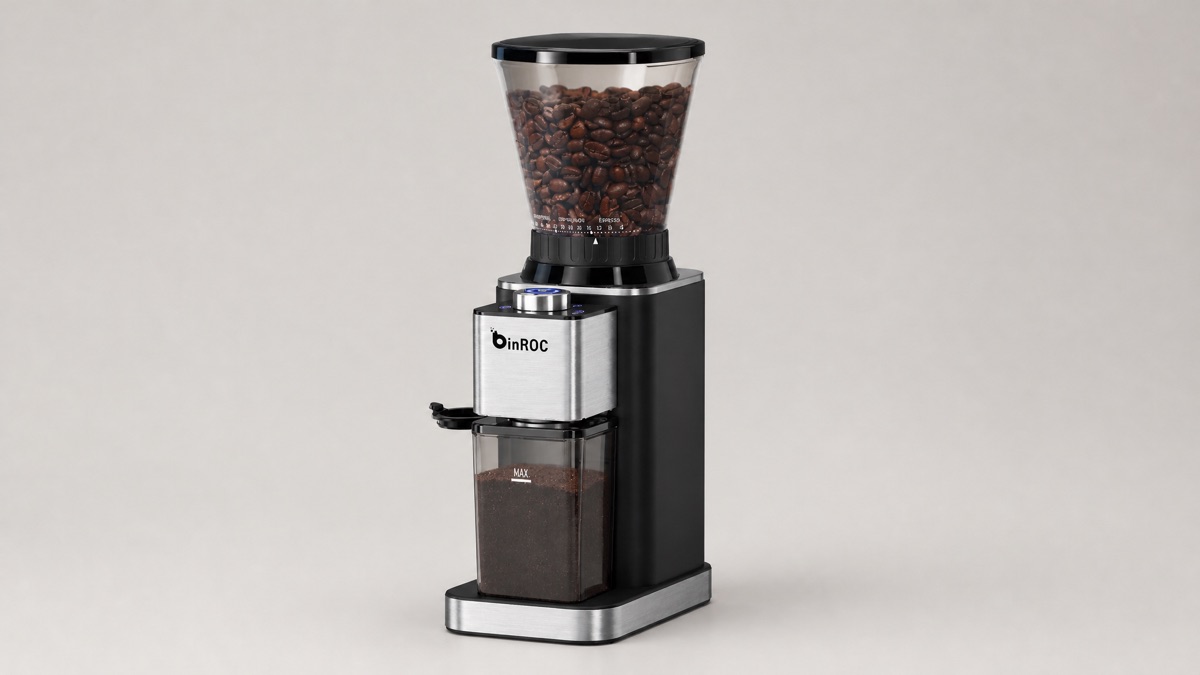
The binROC coffee grinder is a 150 watt electric conical burr grinder with 48 settings. The black CG203 sells for $59.99 on Amazon and holds 4.2 stars from 123 ratings. A cup knob sets doses from 2 to 12 cups for drip, pour over, French press and espresso.
The grinder has three setting bands and a built-in cleaning brush. The anti-static cup keeps most grounds off the counter. Noise is rated at 55 to 65 decibels. Grind quality mentions are mostly positive, but dose size can drift between units.
Durability is the weak spot. Failure reports fall between 2 and 11 months, and the older CG202 has 83 negative durability mentions out of 88. Read on for rival prices, the Cuisinart DBM-8P1 comparison and a clear verdict. BinROC sent no money and no coffee gear to my shop for this review.
What Is the binROC Coffee Grinder?
The binROC coffee grinder is a 150 watt (W) electric conical burr grinder that sells for $59.99 on Amazon. It holds 8.82 ounces (250 grams) of beans and offers 48 grind settings. The body measures 7 by 4.4 by 14.1 inches (18 by 11 by 36 centimeters).
The grinder targets home cooks who want one machine for espresso, drip, pour over and French press. The CG203 listing describes a cup selection knob that sets the dose from 2 to 12 cups, and the unit stops on its own. A built-in brush sweeps leftover grounds from the chamber.
A conical burr grinder crushes beans between two burrs. A blade grinder chops them with a spinning blade and leaves a mix of fines and boulders. Fines are tiny bits of coffee, and boulders are large chunks. The binROC times each dose and has no scale, so the dose is set by time and not by weight.
The housing is 304 brushed stainless steel. The hopper and grounds cup are plastic. Both parts lift off the base for washing.
The black model averages 4.2 stars from 123 ratings. That base is small beside the 49,417 ratings behind the Cuisinart DBM-8P1.
Which binROC Model Is Sold Today?
The binROC model sold today is the CG203, which costs $59.99 in black. It holds 4.2 stars from 123 ratings. Amazon marks it as an Amazon's Choice item.
The older CG202 in silver is listed as unavailable. It holds 4.0 stars from 1,129 ratings. Its manual lists 4.6 pounds (2.1 kilograms) and 12 cups. The size is 6.7 by 4.3 by 13.8 inches (17 by 11 by 35 centimeters).
Two other versions exist. A CG202-2 in an espresso color weighs 5.3 pounds (2.4 kilograms). A portafilter holder version adds a 35 second timer for $69.99 and holds 4.4 stars from 82 ratings.
Model Comparison:
| Model | Color | Price | Rating |
|---|---|---|---|
| CG203 | Black | $59.99 | 4.2 stars, 123 ratings |
| CG202 | Silver | Unavailable | 4.0 stars, 1,129 ratings |
| Portafilter holder version | Black | $69.99 | 4.4 stars, 82 ratings |
Units sold under one binROC name can differ in output. At the 2 and 4 cup setting, a 2022 unit dropped 0.65 ounces (18 grams) in 10.5 seconds. A newer unit dropped 0.40 ounces (11 grams) in the same time.
How Does the binROC Grinder Work?
In the binROC grinder, the burr set and motor work together to crush beans between two burrs. One is a stainless conical burr. The other is a removable ring burr. Beans fall from the hopper into the burrs, and the ground coffee drops into the cup below.
The gap between the burrs sets how fine the grounds come out. A finer setting moves the burrs closer together. A coarser setting moves them farther apart. A dial on the hopper base picks one of 48 settings.
The CG202 manual describes a row of LED buttons that pick 2, 4, 6, 8, 10 or 12 cups. The start button runs the motor until the timed dose ends.
The motor stops on its own if the grinder overheats. The manual says to unplug the unit and wait at least 30 minutes before use. The same stop can follow a jam in the burrs.
The grounds cup holds the finished coffee. It has a snug silicone lid and a small port for storing extra grounds. The anti-static build keeps grounds from clinging to the cup walls.
What Grind Settings Does the binROC Have?
The binROC does have 48 grind settings, split into three bands of 16. The hopper turns to select each step. Each step changes the burr gap by a small amount.
Settings 1 to 16 cover espresso. Settings 17 to 32 cover drip and pour over. Settings 33 to 48 cover French press.
Setting Bands:
| Settings | Grind | Brew Method |
|---|---|---|
| 1 to 16 | Fine | Espresso |
| 17 to 32 | Medium | Drip and pour over |
| 33 to 48 | Coarse | French press |
The listing names espresso, Hario V60, Chemex, AeroPress and French press as supported brew methods. The 48 steps let a cook move one notch at a time.
The finest setting can fall short for an unpressurized espresso basket. Some units grind finer than others at the same setting.
A pressurized portafilter basket is a dual wall basket with one small exit hole. That basket tolerates a wider range of grinds. An unpressurized basket relies on the coffee puck for resistance, so it needs a finer and more even grind.
How Do You Clean the binROC?
You clean the binROC by unplugging it, lifting out the upper burr and brushing out the chamber. The brush ships in the box. The job needs no tools.
The manual says to wash the hopper, grounds cup and lids in warm soapy water before first use. The main unit takes a wipe with a damp cloth. The base never goes under water.
To free the upper burr, turn the lock near the burr disc counterclockwise to the unlock mark. A bang sounds when it releases. Lift the burr straight up and brush both burrs.
Cleaning Steps:
- Unplug the grinder.
- Remove the grounds cup and empty it.
- Turn the burr lock counterclockwise to the unlock mark.
- Lift the upper burr straight up.
- Brush both burrs and the chamber.
- Wipe the base with a damp cloth.
The manual advises cleaning the burrs after every few uses. Old grounds and oils clog the burrs and make doses uneven. A thorough clean between bags keeps the portions steady.
How Well Does the binROC Grind?
The binROC grinds well for most owners, with 25 of 29 grind quality mentions positive on the CG203. The other 4 mentions are negative.
The older CG202 shows the same split on a larger base. Of 289 grind quality mentions, 214 are positive and 75 are negative.
Owners describe the coffee as fresh and good tasting. They report this across settings from drip through French press. The cup knob covers one small batch up to a full carafe.
The listing gives no grind time, so a measured run fills that gap. At the 2 and 4 cup setting, a unit ran about 10.5 seconds. It dropped 11 to 18 grams (0.4 to 0.6 ounces) of coffee. That works out to roughly 1.0 to 1.7 grams (0.04 to 0.06 ounces) per second.
Is the binROC Grind Consistent?
No. The binROC grind is not fully consistent, with 6 positive and 5 negative consistency mentions on the CG203. The CG203 has 11 such mentions in all.
The grind looks even at every setting from French press to espresso for many units. Grounds do not clump.
Dose size can drift. A unit gave almost no grounds on the 12 cup setting after about 30 grinds. Six cups can need two presses of the start button.
Weighing the dose settles the question. The presets follow a 17 to 1 water to coffee ratio. Weighed doses landed within 1 gram (0.04 ounces) on one unit. The cup dial counts about twice the real cups for strong coffee.
How Loud Is the binROC?
The binROC is not very loud, rated at 55 to 65 decibels (dB) in use. The motor is not silent. The grinder sounds like a typical conical burr model.
Buyers still talk about noise in mostly positive terms. On the CG202, 112 of 171 mentions are positive and 59 are negative. On the CG203, 7 of 10 are positive and 3 are negative.
The complaints that do appear focus on beeps. The grinder beeps when it wakes and when a cup amount is chosen.
Does the binROC Anti-Static Design Work?
Yes. The binROC anti-static design works for most owners, with 47 of 59 CG202 mentions positive. The CG203 shows the same pattern, with 9 of 12 mentions positive.
The cup is built so grounds do not cling to its walls. Because of this, grounds do not jump onto the counter when the cup is pulled out. Owners report clean pulls with no spilled grounds.
Static still appears with some beans. Light roasts and dry air raise it. The manual calls the effect minor and does not promise zero static.
The manual offers two fixes for the static that remains. One is to add one very small drop of water to dry beans before grinding. The other is to stir the grounds in the cup with a metal spoon.
The water drop works because water conducts the static charge away. Grounds that carry less charge stop repelling each other. This fix is called the Ross Droplet Technique, or RDT. David Ross posted the idea on a coffee forum in 2005.
Does the binROC Still Make a Mess?
Yes. The binROC still makes a small mess for some owners, with 3 of 7 CG203 mentions negative. The other 4 mentions are positive.
Emptying the grounds cup is the usual spill point. Grind retention adds to it. Grounds can stay in the chute, and patting the sides or blowing them out clears them.
The CG202 shows 80 messiness mentions, 44 positive and 36 negative. Clogging causes the worst cases. A clogged unit is hard to clear and can stop grinding.
A brush ships with the grinder to sweep the chamber. Using it between bags keeps old grounds from mixing with fresh beans.
What Do binROC Reviews Say?
binROC reviews say the grinder is easy to use and good value, but opinions split on durability. The CG203 averages 4.2 stars. The CG202 averages 4.0 stars.
On the CG203, 63% of ratings give 5 stars, 19% give 4 stars, 8% give 3 stars, 2% give 2 stars and 8% give 1 star. On the CG202, the split is 62%, 13%, 6%, 7% and 12%.
Star Split:
| Stars | CG203 | CG202 |
|---|---|---|
| 5 stars | 63% | 62% |
| 4 stars | 19% | 13% |
| 3 stars | 8% | 6% |
| 2 stars | 2% | 7% |
| 1 star | 8% | 12% |
Ease of use scores highest. The CG203 shows 13 of 14 mentions positive. The CG202 shows 62 of 70.
The rating bases are small. The CG203 has 123 ratings and the CG202 has 1,129.
What Do Owners Like About the binROC?
What owners like about the binROC is its ease of use, 48 settings, anti-static cup and low price.
- Ease of use: The dial and cup selector are easy to read. One press of the start button runs the grind.
- 48 settings: Settings earn 11 of 12 positive mentions on the CG203.
- Anti-static cup: Owners list the cup among the features they like.
- Low price: Value earns 11 of 14 positive mentions on the CG203. On the CG202, 49 of 81 value mentions are positive. Owners call the quality good for $59.99.
Size helps too. The grinder stands 14.1 inches (36 centimeters) tall, and owners report it fits under a cabinet.
What Are the Common binROC Complaints?
The common binROC complaints are early motor failure, uneven doses and beeping. Durability tops the list.
On the CG202, 83 of 88 durability mentions are negative. Several units broke within six months. A plastic feeder paddle is among the broken parts.
Dose accuracy is the next complaint. The cup selector may not match the amount ground. Two presses can be needed to fill 6 cups.
Controls draw smaller complaints. The start button can feel finicky. The LED knob can feel wonky at first.
How Long Does the binROC Last?
The binROC lasts a long time for some owners and under a year for many others. Failure reports fall between 2 and 11 months.
Motors that stop, dead units and a broken plastic feeder paddle top the failure list. Cleaning and troubleshooting did not revive some of these units.
Other units run for years. Owners report 18 months to 2 years of daily use with no complaints. Results vary widely from one machine to the next.
That spread makes the warranty important. The Amazon page links to warranty details without stating a term. A failure after six months can fall outside the warranty window.
How Does the binROC Compare to Its Rivals?
The binROC compares well with its rivals on settings, offering 48 for $59.99. Rivals at that setting count cost more.
The SHARDOR 48 setting grinder costs $69.98. It has a 150 W motor and a 9.7 ounce (275 gram) hopper. It holds 4.4 stars from 1,663 ratings. The Aromaster 48 setting grinder costs $125.01 and holds 4.5 stars from 1,198 ratings. Dividing price by settings shows the gap. The binROC costs $1.25 per setting, the SHARDOR costs $1.46 and the Aromaster costs $2.60.
The Amazon Basics grinder costs $28.06, which is $31.93 less than the binROC. It offers only 30 settings and a 6.5 ounce (184 gram) hopper. It holds 4.1 stars from 140 ratings.
Two other grinders sit near the binROC on price or settings. The KIDISLE grinder matches the binROC price at $59.99 with 35 settings. It holds 4.2 stars from 586 ratings. The OXO Brew grinder offers 43 settings, starts at $84.52 and holds 4.3 stars from 23,480 ratings.
Rival Prices:
| Grinder | Price | Rating |
|---|---|---|
| binROC CG203 | $59.99 | 4.2 stars, 123 ratings |
| SHARDOR 48 setting | $69.98 | 4.4 stars, 1,663 ratings |
| Aromaster 48 setting | $125.01 | 4.5 stars, 1,198 ratings |
| Amazon Basics | $28.06 | 4.1 stars, 140 ratings |
| KIDISLE | $59.99 | 4.2 stars, 586 ratings |
| OXO Brew | $84.52 | 4.3 stars, 23,480 ratings |
The Baratza Encore sits higher in price. It costs $149.95 and offers 40 settings, fewer than the binROC. It has an 8 ounce (227 gram) hopper and carries a 1-year limited warranty.
How Does the binROC Compare to the Cuisinart DBM-8P1?
The binROC compares with the Cuisinart DBM-8P1 by costing $5.00 more and offering 30 more grind settings. The Cuisinart costs $54.99.
The Cuisinart has 18 settings, a 4 to 18 cup selector and an 8 ounce (227 gram) hopper. Its cup selector sets the dose, not the grind. So its 18 settings count grind steps only.
The binROC CG203 costs $59.99 and has 48 grind settings. Its hopper holds 8.82 ounces (250 grams), a little more than the Cuisinart hopper.
Price per setting shows how the two differ. The binROC costs about $1.25 per setting, and the Cuisinart costs about $3.06.
The ratings tell a different story. The Cuisinart holds 4.2 stars from 49,417 ratings. The CG203 rating rests on 123.
binROC vs Cuisinart:
| Spec | binROC CG203 | Cuisinart DBM-8P1 |
|---|---|---|
| Price | $59.99 | $54.99 |
| Grind settings | 48 | 18 |
| Hopper | 8.82 ounces (250 grams) | 8 ounces (227 grams) |
| Ratings | 123 | 49,417 |
How Much Does the binROC Cost?
The binROC costs $59.99 for the black CG203 on Amazon. Amazon listed that price in October 2026. The price covers the grinder, hopper, grounds cup, lids and brush.
A portafilter holder version also exists. It costs $69.99, which is $10.00 more than the base model. The extra money adds a 35 second timer.
The silver CG202 is listed as unavailable. No current price exists for it, so it cannot be compared with the other grinders.
The CG203 can be compared with two similar grinders. It matches the KIDISLE, which also costs $59.99. It sits $9.99 under the SHARDOR, which costs $69.98.
Is the binROC Worth the Price?
Yes. The binROC is worth the price for light home use, since 48 settings and an anti-static cup cost $59.99. Early failure is the risk.
The failure math shows the stakes. A $59.99 grinder that dies at 6 months costs $10.00 per month. At 12 months it costs $5.00 per month. At 24 months it costs $2.50 per month.
The price per setting is low. The binROC costs $1.25 per setting.
Cost Per Month If the Grinder Fails:
- 6 months of use: $10.00 per month
- 12 months of use: $5.00 per month
- 24 months of use: $2.50 per month
Is the binROC Worth It?
Yes. The binROC is worth it as a $59.99 grinder for light home use, with early failure risk. The score of 4.2 stars reflects that mix.
The grinder gives 48 settings, an anti-static cup and a brush for $59.99. Rivals with 48 settings cost $69.98 and $125.01.
Pros:
- 48 grind settings
- Anti-static grounds cup
- Built-in cleaning brush
- Price of $59.99
Cons:
- Early motor failure reports
- Dose drift on some units
- Finest setting short for unpressurized espresso
Buyers who need unpressurized espresso should look elsewhere. The finest setting can fall short for that job.
Who Should Buy the binROC?
Home cooks who should buy the binROC want a low cost grinder for drip, pour over and French press. Small batches of 2 to 4 cups fit the grinder best.
The grinder also fits households that want a tidy counter. The anti-static cup and brush limit the mess that ground coffee leaves behind.
Some shoppers need something the binROC does not offer. Those who want unpressurized espresso, a long track record or a silent motor need a different grinder.
A buyer who wants a proven lifespan can choose the Cuisinart DBM-8P1, which costs $54.99 and has 49,417 ratings.
Shoppers who want the lowest outlay can choose the Amazon Basics grinder at $28.06 with 30 settings.
Shoppers who trust the crowd can choose the OXO Brew. It has 23,480 ratings at 4.3 stars, which gives a large rating base to judge it by.
Odradeks Coffee House is reader-supported. If you buy through a link on this page, we may earn a small affiliate fee at no extra cost to you.