Astoria Coffee Machine Review: Is It Worth It?
Hello, I'm Sam. We were serving coffee when La Marzocco launched the Linea Mini for homes in 2015.
The Astoria coffee machine is a line of Italian commercial espresso machines built in Susegana, Italy, since 1969. The range spans one to three groups and heat exchange or multi-boiler designs. US prices run from about $5,100 to over $19,000 for the flagship models. Cafes buy it for steady daily work.
Astoria machines pair volumetric dosing and raised groups with a mid price. Models run from the Pratic Avant Xtra to the AB200 and the Core 600. A 2-group AB200 can make 200 to 350 drinks a day. Heavy power draw and a weak Plus 4 You record count against the line, so the right model matters. Technicians praise the line for reliability and a fair price.
No independent lab test of Astoria exists, so the verdict rests on spec sheets and technician opinion. The sections below cover boilers, daily output, price against rivals, installation and who should skip the machine. The verdict weighs each point for a café on a mid-size budget. From boiler types to price against rivals, I wrote every word of this review.
What Is an Astoria Espresso Machine?
An Astoria espresso machine is an Italian-built commercial machine made in Susegana, Italy, for cafes and restaurants. The line covers one-group to three-group machines with volumetric dosing and raised group heads.
The brand sells on longevity and a lower price than the top Italian names. Astoria machines target owners who want a working café machine on a budget.
The range has several product families. Pratic Avant, the AB series and the Core line cover mainstream cafes, while Plus 4 You and Storm sit at the high end.
Model suffixes follow a code. SAE marks the electronic version with four programmable volumetric doses, and AEP marks the semi-automatic version with a manual override button.
Astoria also builds grinders. The ASI40 Touch has 65 mm (2.6 in) flat burrs, a 1.2 kg (2.6 lb) hopper and a 3.5 inch (8.9 cm) touch display.
No Astoria is a home machine. Every US model is a plumbed commercial unit that needs a dedicated electrical circuit.
Astoria builds for cafes, restaurants, hotels and coffee trucks. One-group units fit kiosks and backup duty, and two-group and three-group units fit full-service bars. Tanya is one older two-group model that still turns up in dealer listings.
Who Makes the Astoria Espresso Machine?
Astoria makes its espresso machine line in Susegana, Italy, and was founded in 1969 by Nello Dal Tio. The company grew from a local maker into an exporter.
Foreign orders first arrived in 1972, three years after the founding. The brand reached the United States in 1978. A plant in Timisoara opened in 2002, a new Susegana plant followed in 2007, and a French site opened in 2009.
The Ryoma holding of Milan acquired the Astoria CMA group in 2012. Ryoma MC Spa still manages the company.
General Espresso Equipment Corporation distributes Astoria in the United States, Canada and the Caribbean. The distributor was incorporated in 1995.
Which Astoria Models Are Sold in the US?
The Astoria models sold in the US cover four families: the AB200, Plus4You Advantage, Core 600 and Pratic Avant. Each family comes in several group counts.
The Pratic Avant Xtra SAE is the entry machine. It has a single heat exchange boiler, volumetric dosing, raised groups, barista down lights and pre-infusion.
The Gloria and Sabrina sit higher. The Gloria has a 12 quart (11.4 L) boiler and a 4,500 W element, and the Sabrina adds a touch LCD and an auto wash cycle.
The Core 600 splits by version. The 2-group SAE is a dual boiler machine, the 1-group SAE is heat exchange, and the TS version adds touchscreen dosing.
US Astoria Lineup:
| Model | Boiler | Groups |
|---|---|---|
| Pratic Avant Xtra SAE | Heat exchange | 1 or 2 |
| AB200 | Heat exchange | 1, 2 or 3 |
| Core 600 SAE | Dual boiler (2-group) | 1 or 2 |
| Plus 4 You | Individual brew boilers | 1 to 3 |
How Does an Astoria Espresso Machine Work?
An Astoria espresso machine does work by heating water in a boiler and pushing it through ground coffee at pressure. Volumetric buttons on each group then stop the shot at a set volume.
Programmable doses keep shot size equal across baristas and shifts. Each group stores its own volume.
The water must be hot before it reaches the coffee. In a heat exchange machine, a tube runs through the steam boiler. Brew water heats inside that tube on its way to the group head.
Pre-infusion wets the grounds before full pressure starts. The wet coffee swells and releases carbon dioxide, which lets water flow evenly through the puck.
Pre-infusion helps very fresh coffee and decaf the most. Decaf swells less during the wetting step.
The finished shot drops from the group head into a cup. Raised group heads leave room under the spout, so cups up to 16 oz (473 ml) fit beneath them.
The Core 600 TS adds a color touch screen. Baristas use it to change temperature settings, pick power modes and watch the extraction.
What Boilers Does an Astoria Use?
Astoria uses heat exchange boilers in its mainstream machines and multi-boiler systems in its premium ones. The Pratic Avant, AB200 and Core 600 1-group are heat exchange.
A heat exchange machine brews and steams at the same time from one boiler. This keeps a busy bar moving without a second heater.
The Plus 4 You has individual brew boilers for each group. The Core 600 SAE 2-group is a dual boiler, and the Storm is the multi-boiler flagship.
Boiler size varies with model. The Mira 2-group carries an 11.5 L (3 US gal) boiler, and another model pairs two 1.2 L (0.3 US gal) coffee boilers with an 8 L (2.1 US gal) steam boiler.
A larger steam boiler stores more steam. The extra volume speeds recovery in a rush.
What Does the Astoria AB200 Add?
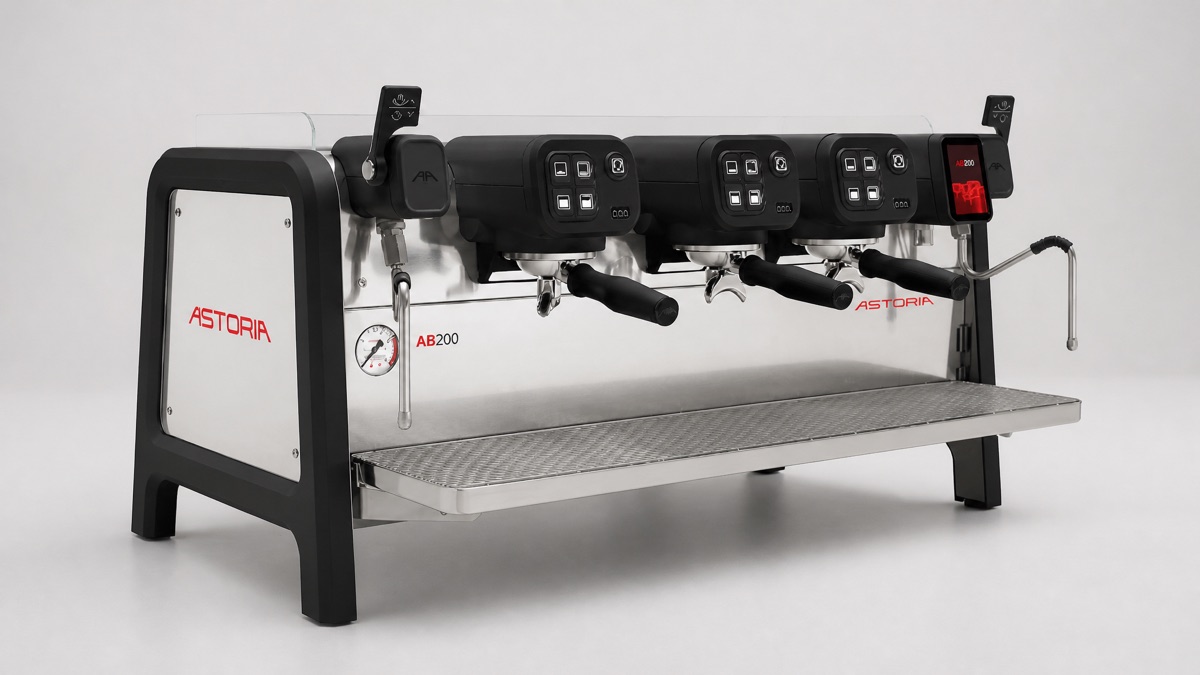
The Astoria AB200 adds a shot counter on every group, a height-adjustable drip tray and a steam lever with a Purge function. Astoria launched it at World of Coffee Copenhagen on June 27 to 29, 2024.
Designer Valerio Cometti of Studio V12 Design shaped the AB200. The goal was a compact body with stability and a clean look. The AB200 Compact is a 2-group machine with a 5 L (1.3 US gal) single boiler. It measures 24.25 x 25 x 19.5 in (615 x 633 x 490 mm) and weighs 112 lb (51 kg).
The Compact runs on 1,800 W at 110 V or 2,500 W at 208 V. A standby mode saves energy, and a USB port handles software updates.
Options include:
- Touch screen: The screen measures 3.5 inches (8.9 cm).
- Easy Clean steam wand: This wand is available as an option.
- Autosteamer wand: This wand controls milk temperature and froth level.
How Much Does an Astoria Espresso Machine Cost?
An Astoria espresso machine costs about $5,100 to $8,300 new for the AB200 and Pratic Avant ranges. The flagship Storm runs far higher.
The AB200 spans roughly $5,280 to $8,255 depending on group count. The Pratic Avant Xtra SAE 2-group sells near $5,380, and the 1-group lists at $5,124.
The multi-boiler Storm costs $13,200 to more than $19,400. Prices vary with group count and options.
The Core 600 SAE 2-group lists at $8,899 after a markdown from $10,710. That price puts the dual boiler Core 600 well above the Pratic Avant.
Astoria Price Guide:
| Model | Price |
|---|---|
| Pratic Avant Xtra SAE 1-group | $5,124 |
| Pratic Avant Xtra SAE 2-group | $5,380 |
| AB200 | $5,280-$8,255 |
| Core 600 SAE 2-group | $8,899 |
| Storm | $13,200-$19,400+ |
Quotes differ in what they include. Installation, plumbing kits, shipping and warranty change the final number, so compare quotes on the same basis.
Used machines sell for much less. A used Astoria is easy to find, though condition and parts support vary.
Is an Astoria Worth the Price?
Yes. An Astoria is worth the price for a café that needs a durable commercial machine at a mid price. A 1-group Pratic Avant at $5,124 lands near the Nuova Simonelli Appia Life 1-group range.
That price looks smaller once it is spread over the drinks a machine makes. A compact AB200 can make 100 to 180 drinks a day, so the machine cost per cup stays low.
Technicians call Astoria very reliable and not that expensive.
Used Astoria machines are widely listed, which gives owners a fallback when they upgrade.
How Many Drinks Can an Astoria Espresso Machine Make in a Day?
An Astoria espresso machine makes about 80 to 600 drinks a day depending on group count and boiler size. These figures assume an 8 to 10 hour day and skilled baristas.
The compact AB200 with a 5 L (1.3 US gal) boiler handles 100 to 180 drinks a day. It peaks at 30 to 50 drinks per hour with two baristas.
The 1-group AB200 handles 80 to 150 drinks a day. One group caps output at 25 to 40 drinks per hour.
The 2-group AB200 with a 9.5 L (2.5 US gal) boiler makes 200 to 350 drinks a day. Peak rates reach 50 to 80 drinks per hour.
Group count sets how many shots run at once. Steam capacity and boiler recovery set how fast milk drinks follow, so a milk-heavy menu hits the steam limit first.
The 3-group AB200 with a 15 L (4 US gal) boiler makes 350 to 600 drinks a day. Peak rates reach 80 to 120 drinks per hour.
AB200 Daily Output:
| Version | Drinks per Day | Peak per Hour |
|---|---|---|
| 1-group | 80-150 | 25-40 |
| Compact 2-group | 100-180 | 30-50 |
| 2-group | 200-350 | 50-80 |
| 3-group | 350-600 | 80-120 |
Which Astoria Group Size Fits a Café?
The right Astoria group size fits a café by daily volume and bar space.
Astoria machines come in three group sizes:
- 1-group: This size suits kiosks and backup duty. It has a 3.5 to 5 L (0.9 to 1.3 US gal) boiler. The Pratic Avant 1-group is 19 in (48 cm) wide, so it fits a small bar.
- 2-group: This size suits most independent cafes and is the most common configuration. It leaves room for two baristas to work side by side.
- 3-group: This size suits busy urban shops.
Menu and upkeep change real output. Milk-heavy menus slow service. Poor water or skipped cleaning cuts output by 20 to 30 percent.
What Do Owners Say About the Astoria Espresso Machine?
Astoria espresso machine owners say the machines are reliable and not that expensive. One technician with 29 years on Astoria machines calls them reliable inside and out.
Other service engineers agree that most Astoria and CMA machines are pretty reliable. Their praise centers on build quality and easy repair.
The evidence has limits. No independent lab test or long-term study of Astoria machines turned up. The case rests on the word of people who work on them.
Technicians also give a buying rule. Pick a machine the local repair company knows and keeps parts for.
Is the Astoria Plus 4 You Reliable?
No. The Astoria Plus 4 You has no independent reliability record that proves it reliable. Technician feedback on this model is the weakest in the lineup.
One service engineer names the Plus4You as the Astoria to avoid. That engineer calls the units in their shop a poor choice.
Dealers describe PID temperature control that holds brew water within 1°C (1.8°F) of the set value. That figure comes from product copy, not from a test.
The Plus 4 You uses individual brew boilers, Greenline energy saving and an auto wash cycle. New units list a 12 month parts warranty.
Does an Astoria Draw a Lot of Power?
Yes. An Astoria draws a lot of power because commercial boilers need large heating elements. The 2-group Pratic Avant Xtra pulls up to 5,350 W at 110 to 120 V.
The 1-group Pratic Avant Xtra draws up to 2,750 W. It needs a dedicated circuit sized to its amperage.
The Gloria carries a 4,500 W element, the Perla 4,000 W and the Pratic Avant 4,400 W. Larger elements shorten recovery but raise the electric load.
Heating Element Power:
- Gloria: 4,500 W
- Pratic Avant: 4,400 W
- Perla: 4,000 W
- Pratic Avant Xtra 1-group: up to 2,750 W
- AB200 Compact: 1,800 W at 110 V
The older Divina 2-group is a heavy draw. A coffee truck owner reports it needs about 15 minutes to warm up.
The AB200 Compact eases the load. It runs on 1,800 W at 110 V and has a standby mode.
How Does the Astoria Espresso Machine Compare With Rivals?
The Astoria espresso machine compares with rivals as a mid-price choice between budget machines and premium names like La Marzocco. No independent head-to-head test of Astoria against rivals was found.
Nuova Simonelli focuses on ergonomics, energy efficiency and high-volume consistency. The Appia Life 2-group lists at $7,600 to $8,300.
La Marzocco is known for dual boiler design and a high price. The Linea Classic S starts at $9,610 for the semi-automatic version.
The Rancilio Classe 5 USB 2-group lists at $9,000 to $9,500 in the US. The Faema E71E 2-group lists at $21,780.
Two-Group Price Check:
| Machine | Price |
|---|---|
| Astoria Pratic Avant Xtra SAE | $5,380 |
| Nuova Simonelli Appia Life | $7,600-$8,300 |
| Rancilio Classe 5 USB | $9,000-$9,500 |
| Faema E71E | $21,780 |
Some technicians find La Marzocco overpriced and harder to service. Others rank it first, so the choice stays a matter of taste and local support.
Astoria is the least documented of the three. A café owner choosing between the Sabrina and the Nuova Simonelli Aurelia II found little information on Astoria.
Is an Astoria Cheaper Than a Nuova Simonelli or La Marzocco?
Yes. An Astoria is cheaper than a La Marzocco, but not cheaper than a Nuova Simonelli Appia Life 1-group. It costs about half as much as a Linea Classic S.
The Astoria Pratic Avant Xtra 1-group lists at $5,124. The Nuova Simonelli Appia Life 1-group lists at $4,140 to $4,950. That makes the Astoria a little more expensive than the Appia Life.
The La Marzocco Linea Classic S starts at $9,610 in the semi-automatic version. The automatic version starts at $11,060. Both prices are well above the Astoria, which is why the Astoria costs about half as much.
Dealers set their own prices, and prices shift over time. A new owner should compare quotes that include the same install and warranty terms.
How Do You Install and Maintain an Astoria Espresso Machine?
Professionals install and maintain an Astoria espresso machine with a dedicated electrical supply and regulated water pressure. Local codes set the exact electrical and plumbing rules.
The Pratic Avant Xtra SAE carries ETL and NSF listings. These marks matter to inspectors in US cafes.
Service access is a design focus. The AB200 has side panels. The Core 600 has removable panels over key parts.
Cleaning is partly automatic. The Pratic Avant Xtra has automatic backflush. The Sabrina has an auto wash cycle. The AB200 has shot counters, which help schedule service.
Does an Astoria Need Water Filtration?
Yes. An Astoria does need commercial water filtration to protect its boiler from scale. Every dealer page for the line makes the same recommendation.
Scale hurts output. Poor water quality can cut daily drink output by 20 to 30 percent.
Filtration also protects flavor. Clean water keeps espresso taste steady across shifts.
Competition baristas follow a set water spec. World Coffee Events asks for 125 to 150 mg/L of total dissolved solids, zero chlorine and a pH of 7.0 to 8.0.
Technicians add a budget tip. Spend more than expected on the grinder and the filter or softener system.
Is the Astoria Espresso Machine Worth It?
Yes. The Astoria espresso machine is worth it for a café that wants a proven Italian commercial machine at a mid price. The case rests on spec sheets and technician opinion, not lab tests.
The strengths are clear. Volumetric dosing, raised groups and one-to-three group choices fit most cafes.
Pros:
- Volumetric dosing on every group
- Raised groups for cups up to 16 oz (473 ml)
- One-group to three-group choices
- Technician praise for reliability
- Wide used market
Cons:
- Thin independent testing
- Plus 4 You complaints
- High power demand
- Commercial use only
The weaknesses are just as clear. Independent testing is thin, the Plus 4 You draws complaints, and power demand is high.
Technician praise and a wide used market back the buy. A shop with local Astoria service gets the most from the machine.
Who Should Skip the Astoria Espresso Machine?
Home users should skip the Astoria espresso machine because every US model is a plumbed commercial unit. Prices start above $5,000 and a dedicated circuit is required.
Mobile cart owners should check power first. The Divina draws heavy power and needs about 15 minutes to warm up.
Buyers without local service should look elsewhere. Technicians advise buying a brand the nearest repair company stocks.
Plus 4 You buyers should ask for service references. Technicians flag that model as the weak point of the line.
A short checklist closes the buy. Ask for the nearest authorized technician, confirm the circuit against the model wattage, test the water, get warranty terms in writing and compare quotes on equal terms.
Odradeks Coffee House is reader-supported. If you buy through a link on this page, we may earn a small affiliate fee at no extra cost to you.